An optional hint appears beside a puzzle and the player closes it. A dashboard records the dismissal. The designer could delay the next hint, rewrite its content, or make the help control easier to recognize. Each change assumes a different reason for the same action. Before using dismissals to tune an AI helper, decide which explanation the available evidence can distinguish.
Microsoft’s HAX guideline on efficient dismissal asks designers to make unwanted AI services easy to dismiss or ignore, including mistaken activation. It supports giving the player a way out. It does not make a dismissal a reliable report of why help was unwanted or what the next hint should contain. Those questions need evidence about this player’s situation.[1]
Keep the action and its explanation separate
Imagine two visits to the same puzzle. One player understands the hint but wants another attempt without it. Another opens help expecting information about a switch and receives a clue about a door they have already passed. Both close the panel. Delaying help might suit the first player while preserving the second player’s problem. Rewriting the clue might help the second while revealing information the first wanted to discover. These are possible explanations, without an observed count for either.

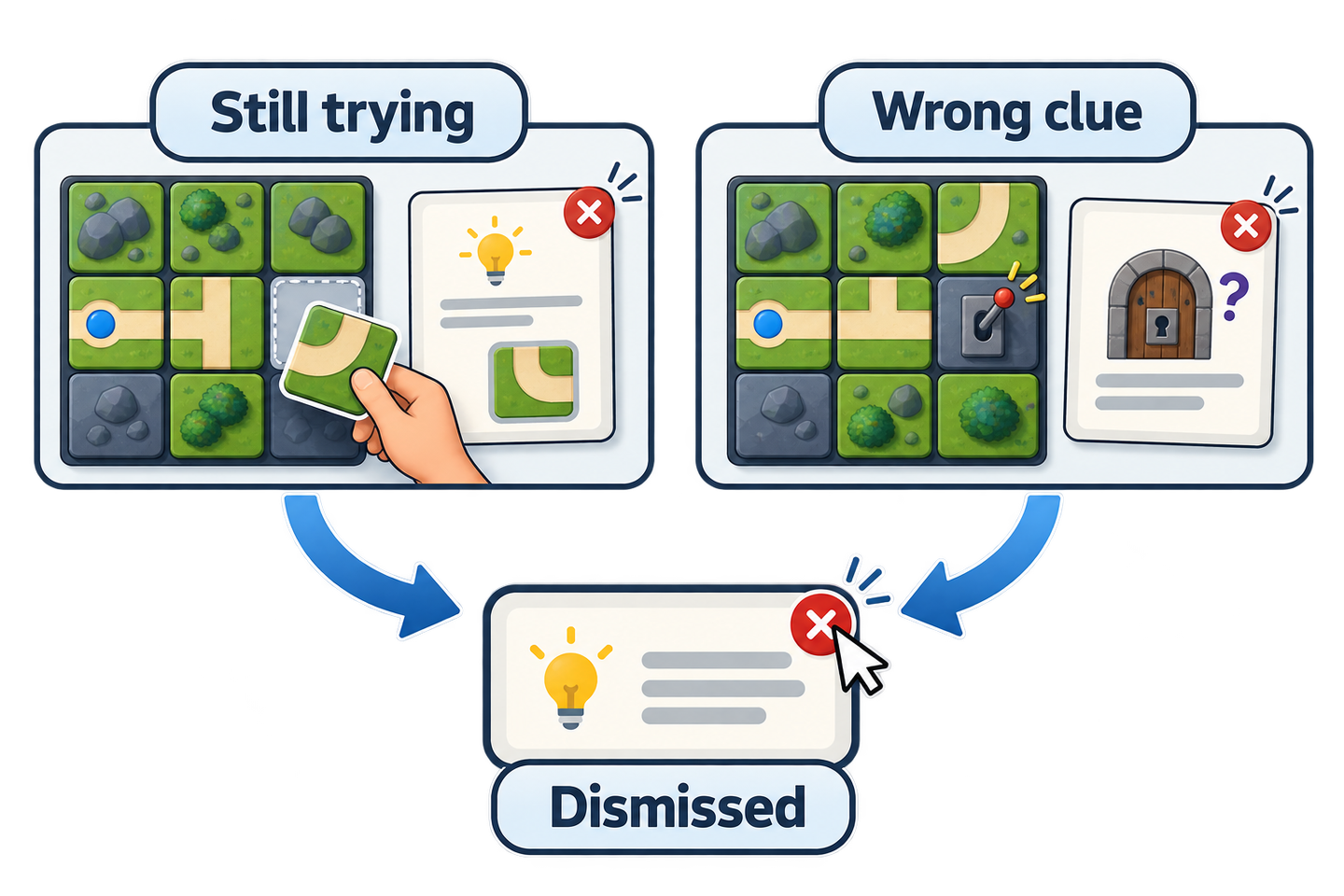
A close button can also be mistaken for a way to advance the conversation. Or the player may be clearing the screen to see the puzzle. Keep these possibilities open until the interaction is understood. In particular, a dismissal should not silently become a permanent preference that prevents later help. For this proposed helper, Not now closes the current offer, and a visible Help control lets the player request assistance later. A persistent preference belongs in an explicit setting.[1]
Steve Bromley’s study-design guide separates questions about what players do from questions about their understanding and experience. It recommends matching methods to the research objective and collecting enough context to explain an observed action. For our hint decision, that means pairing the dismissal with observation of the puzzle attempt and a question about what the player expected. A frequency alone cannot settle those explanations.[2]
Observe the choice before explaining the control
Start the proposed session with the knowledge and controls the player would normally have reached. Let the person play the section without instructing them to try or reject the hint. Note when the offer appeared, what it said, what the player was doing, and what happened after it closed. Use the team’s existing consent and data-handling process. Capture only the task context needed for the question; an unrestricted recording or full generated conversation log is not automatically necessary.
After the moment, ask what the player was trying to do and what they expected from the offer. A prompt such as “What were you hoping would happen there?” leaves more room than “Was that hint too early?” Follow their account with the relevant observed sequence. Someone may say they did not need help yet and later search for the Help control. Keep both pieces of evidence. The account can guide interpretation, while memory and the moderator’s questions can also affect it.
Choose the repair the evidence can support
For one iteration, a designer can provide a reversible dismissal and an accessible way to ask again. A researcher can focus a short session on whether players understand those controls and whether the offered information addresses their current obstacle. Defer a system that infers lasting help preferences from every close event. It would require evidence and ongoing checks that the smaller design does not yet have. The number of participants and study design should follow the decision’s stakes and the explanations being compared; no universal sample size is proposed here.
Change timing when the observed problem concerns interruption and the player can recover help later. Change content when the hint addresses the wrong obstacle. Repair the control when people misunderstand what closing does or cannot request help again. If several explanations remain plausible, keep the reversible control and collect a more focused observation before automating adaptation. Task completion, voluntary use and the player’s account can disagree; preserve that disagreement when deciding whether the helper supports the intended experience.
Sources
- HAX Guideline 8: Support efficient dismissal
article · Microsoft HAX Toolkit guideline explanation read October 24, 2026; linked product examples excluded · Source accessed:
- Designing a games user research study
article · Steve Bromley; current author-hosted book extract read October 24, 2026; precise publication date not established · Source accessed: