Imagine a small archive exploration game. Each new map should let the player enter, collect a ledger, and reach the exit. A generator assembles convincing corridors and rooms, yet one seed places the ledger behind a sealed wall. The room art looks consistent. The promised journey is impossible. Before adding more tile variations, the designer needs a way to reject that map.[1]
Maxim Gumin’s WaveFunctionCollapse README describes an algorithm that preserves local patterns from an input, or propagates allowed tile adjacencies in its simple tiled model. It also describes contradictions that can prevent a result, and examples that add constraints or navigation heuristics. Those are useful distinctions: a generator completing its local rules and a game supporting a particular journey are separate checks. This does not mean every WFC tileset produces disconnected maps. A carefully designed tileset can encode stronger properties.[1]
For this archive, start with the player’s movement rules. A route checker should treat a solid wall as blocked and a passage as usable only if the character fits. Its acceptance condition is entry to ledger to exit. For the first version, use static corridors without keys, moving platforms, combat requirements or one-way drops. A simple search over walkable cells can then answer the narrow question the design actually asks.[1]

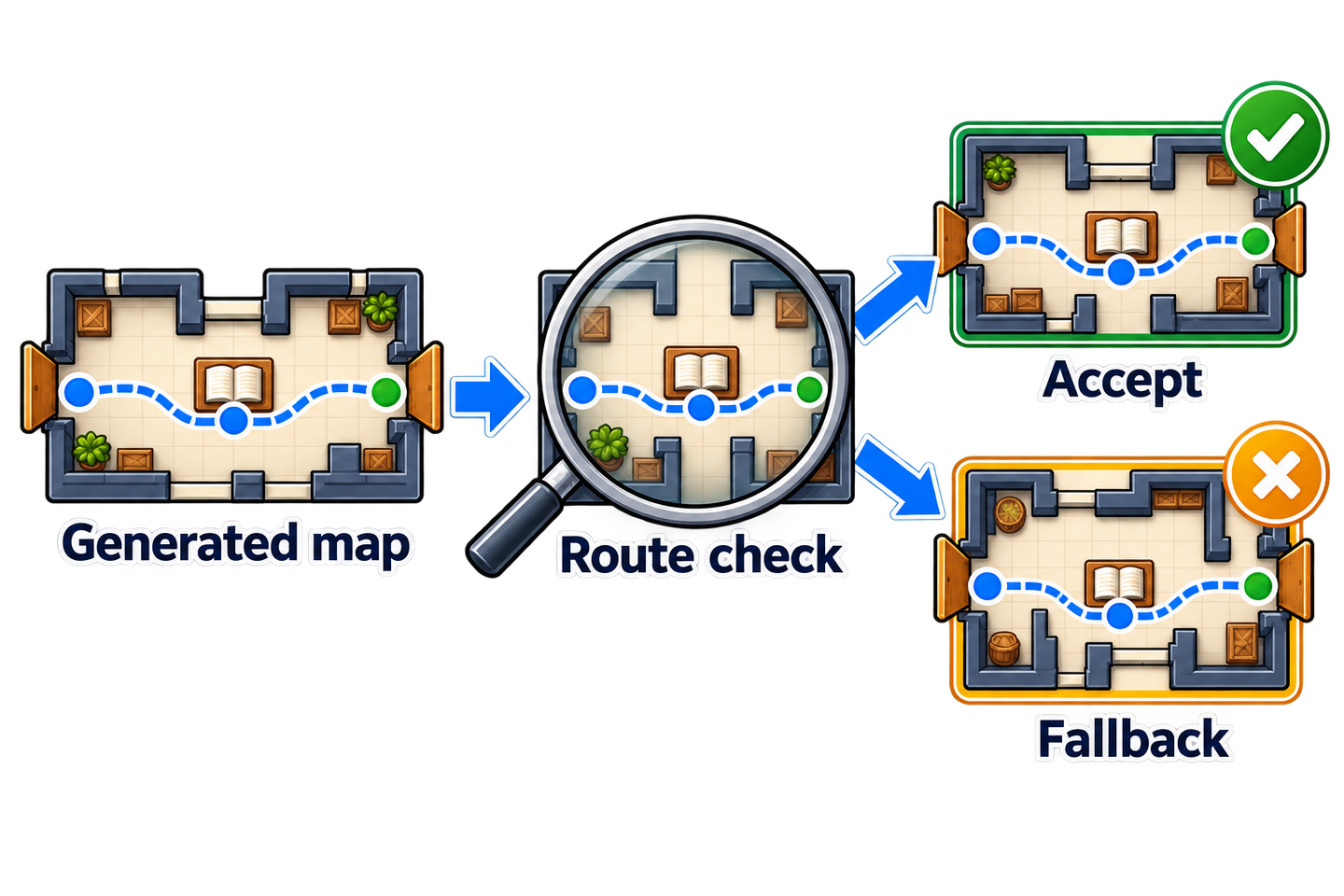
Choose what may vary
Keep the entry, ledger room and exit as authored anchors. Let the generator vary the corridors and optional rooms between them, then check the required connections before adding decoration. This gives up some freedom to place every landmark anywhere. It also gives a level designer three familiar places to inspect when a seed fails. The anchors are a proposed production choice, not a requirement of WFC.[1]
Separate a contradiction from a finished map that fails the journey. The first gives the pipeline no usable result. The second gives it a result that the game should decline. Keep the seed, generator and validator versions, tile rules, movement configuration and failed connection together so a designer can reproduce the relevant case. A single pretty screenshot cannot show how often either failure occurs, and repeated random attempts do not explain a bad rule.[1]
For the first prototype, make one generation attempt per level load. If it produces no result or the journey check fails, load an authored map that has passed the same check. The fallback must include the ledger and exit too. A blank room that merely avoids a crash does not satisfy the promised exploration. Additional retries are a later option only if measured loading time on target hardware leaves room for them; no such timing measurement was made here.[1]
Spend the first prototype on rejection
The initial implementation needs walkability data, the route check, reproducible seeds, failure records and a playable fallback. Fund those before a larger decoration library. If that work displaces the team’s only chance to test the core exploration, keep one authored map and vary its contents or appearance instead. Generation earns its place when its variation supports the activity the game needs.[1]
In a proposed engineering check, run the same validator over a recorded collection of generated maps and deliberately broken fixtures. Keep separate counts for no result, rejected result and accepted result. Inspect the rejected maps as well as the accepted ones. Then traverse accepted maps with the actual character controller: a cell graph can miss collision shapes, clearance or movement behavior that its data never represented. These checks have not been executed here.[1]
A later game with keys or consumable tools needs a richer test. Reaching a locked door is insufficient if the key sits beyond that door; the search must represent the relevant inventory and transitions. That added state raises engineering and review costs. Keep those mechanics authored until the validator can express them, rather than labeling an unchecked map solvable.[1]
Reconsider the approach if accepted maps repeatedly feel interchangeable, the fallback dominates ordinary play, or designers spend more time repairing rule interactions than making worthwhile rooms. Stronger constraints may improve the output, while a different generator or an authored route may better fit the game. Passing the route check establishes one necessary condition. It leaves pacing, discovery and the pleasure of finding the ledger for actual playtesting.[1]
Sources
- WaveFunctionCollapse README
documentation · mxgmn/WaveFunctionCollapse master README; live October 19, 2026; commit not pinned · Source accessed: