A player finds a puddle beside a broken pipe and concludes that the room flooded. If your generated mystery scores that answer, the generator needs a reason to connect those objects. Otherwise the player may make a sensible inference from a scene that your hidden answer cannot support. Start by choosing which details may count as evidence.
Michael Cook describes this problem in the 2020 preprint Generative Forensics. In Nothing Beside Remains, an abstract simulation supplies a ruined village, but the rendering adds details that the simulation does not justify. Section 5.6.2 notes that farm counts and positions need not reflect population or food stocks. Cook distinguishes the value of open interpretation from the problems this creates when a game judges the player’s understanding.[1]

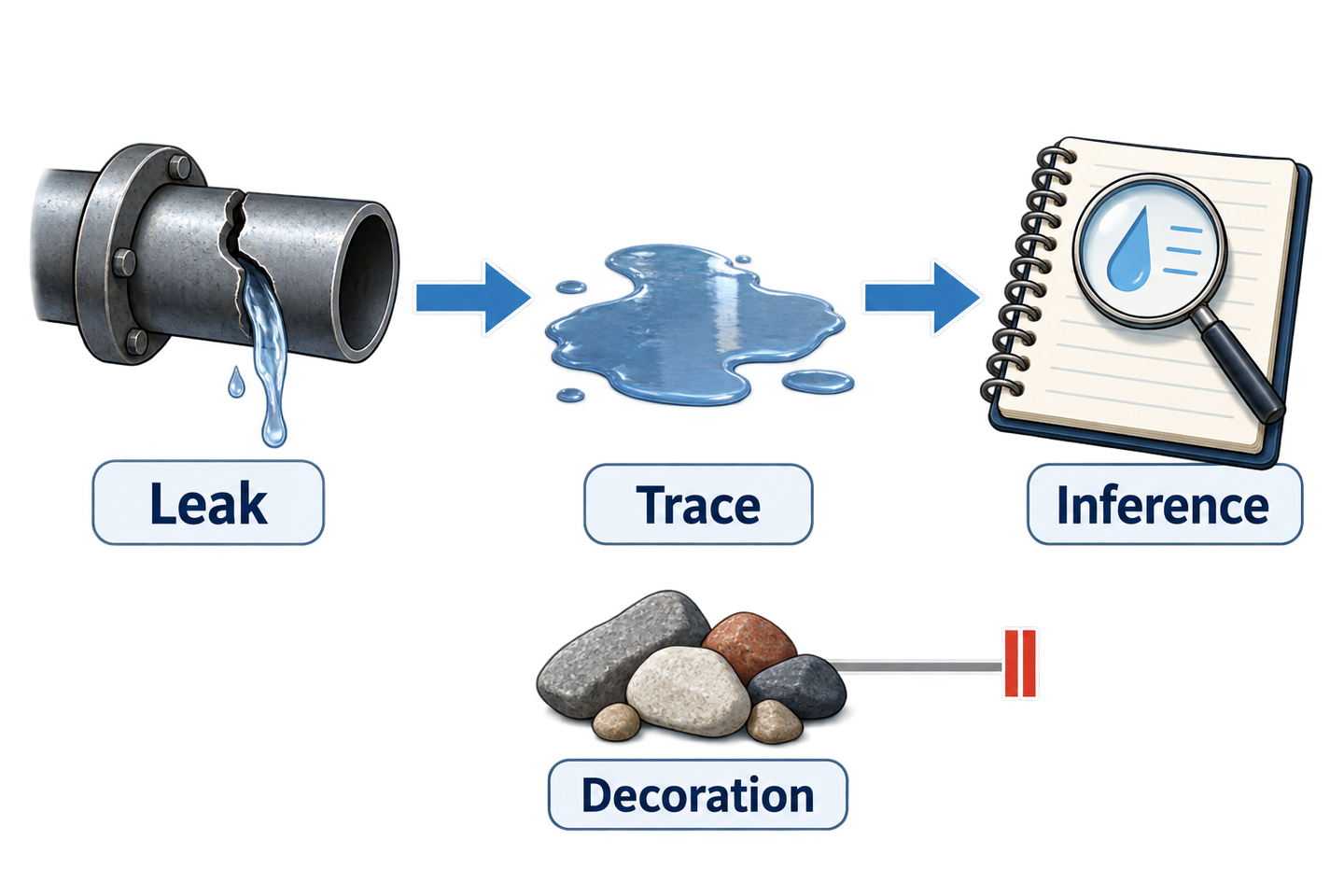
Decide what the answer promises
A scored mystery and an invitation to interpret a place ask different things of their scenery. For a scored answer, write down what the player must establish and which reachable observations can establish it. For an open exploration, a suggestive detail can invite a story without confirming one. The same puddle can serve either purpose, but the ending should honor the purpose you chose.
Cook also reports that Condition Unknown deliberately omits generation-time checks for a solvable core mystery. Section 7.0.1 treats investigations that end without answers as an intentional possibility and discusses guaranteed-solvability designs as further work. This is a design account, not evidence that unresolved mysteries improve player experience.[1]
Applying this to your game
Consider a hypothetical abandoned pump room. The generator first records whether a pipe leaked, then places the water trace that follows from that event. It also scatters stones for visual variety. Keep a private record linking the leak, the puddle and the answer rule. A stone’s position should not affect the scored cause unless the simulation gives that position a relevant cause too.
Before adding more rooms, inspect one generated room with the person implementing its rules. Hide the answer record and list the explanations the visible scene permits. Then reveal the record and check where the two disagree. This is a proposed authoring check; we have not built the room or observed players. A convincing room does not establish that every seed has a defensible answer.
Reserve a bounded iteration for one event, its visible traces, the scoring rule and a way to revisit the same seed. Give up additional decorative variants during that pass. The work depends on access to the generator’s event record and control over its rendering. If those are unavailable, use one authored room whose clues you can inspect before promising a generated scored mystery. This fallback also takes authoring and checking time; keep it within the same scope.
Try a deliberately awkward seed in which another visible cause could also explain the puddle. Inspect whether the player can reach information that distinguishes the causes. If the scene leaves both explanations reasonable, either change the evidence, accept both where appropriate, or remove that scored distinction. Adding an unambiguous clue may solve the technical problem while making the deduction too easy. Observe what someone predicts before revealing the answer, and revise the clue if it gives away the activity you wanted them to perform.
Keep the uncertainty you can support
A small player observation could change the plan. If people treat the room as a place to explore and value competing accounts, an open report may serve it better than a single correct answer. That choice gives up automatic scoring and creates different feedback work. If they expect a deduction and cannot distinguish reasonable alternatives, more decorative variety will not repair the missing evidence. Keep the previous seed and answer rule so a revision can be compared and reversed.
The useful boundary is the promise made to the player. A generator can leave some things unresolved while supporting the conclusions it rewards. Cook’s prototypes motivate this question; they do not validate the pump-room proposal, a particular checking tool, or a production budget.[1]
Sources
- Generative Forensics: Procedural Generation and Information Games
paper · arXiv:2004.01768v1 (2020-04-03) · Source accessed: