A player arranges a small room around a window, then asks the editor for alternatives. The next suggestion has a lovely alcove and moves the window behind a cupboard. Accepting it would erase the arrangement the player was exploring. The generator has offered another room, but the tool has given the player an awkward choice about keeping their own work.
For a proposed room-building toy, keep the current room visible while showing a few alternatives beside it. Browsing should leave the current version intact. A separate selection action can adopt a candidate, and Undo should restore the complete previous room. This lets a player inspect a surprising suggestion without paying for the inspection by losing their arrangement.

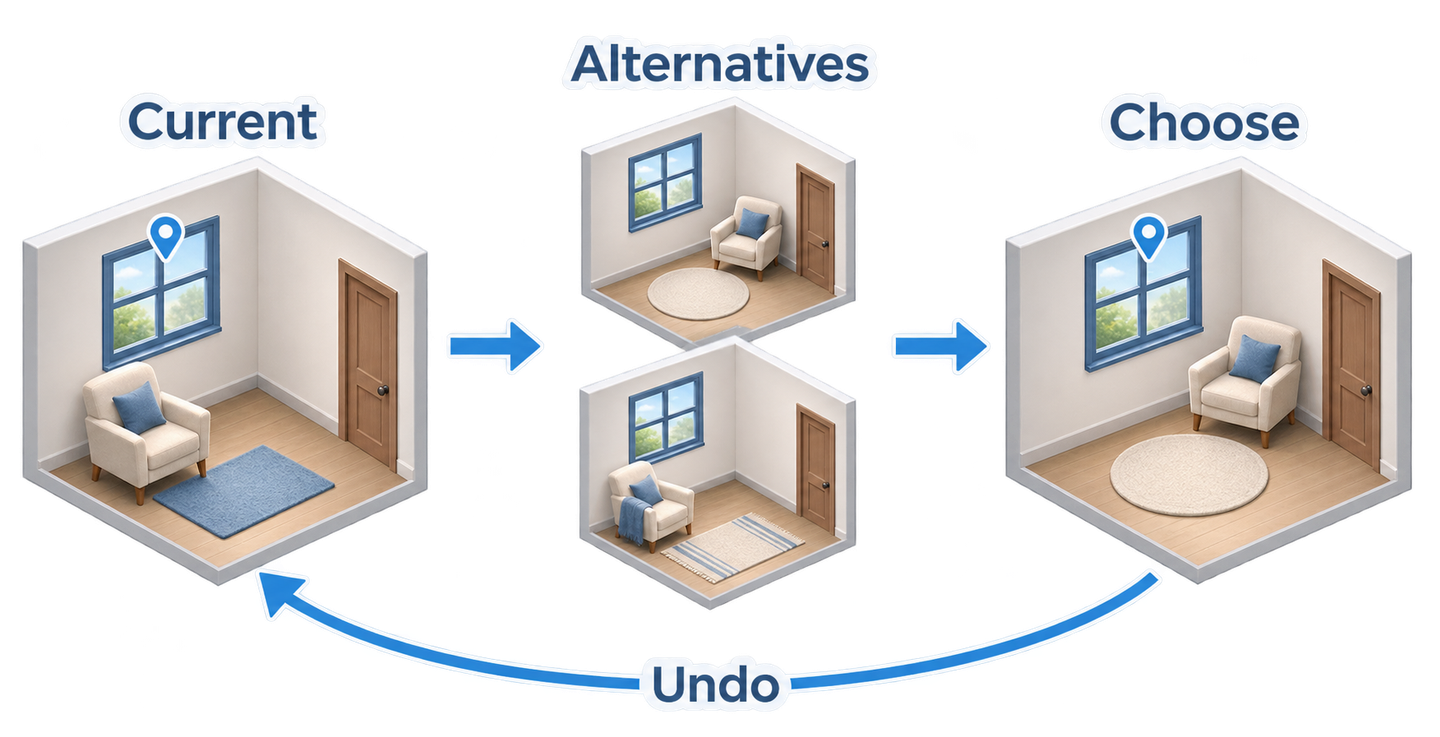
Kate Compton and Michael Mateas describe mutant shopping in Casual Creators: people explore a possibility space by selecting suggested alternatives, sometimes alongside direct editing. Their examples distinguish nearness in the underlying representation from nearness under a more abstract metric. The pattern concerns enjoyable discovery; it does not establish that a particular room editor improves creativity. Preserving a selected room is our proposed interaction rule.[1]
Applying this to your game
Start by deciding what an alternative is allowed to change. In this toy, a player can pin the window and doorway while asking for different furniture arrangements. Every displayed candidate must preserve those pinned objects and leave the doorway usable. If the generator cannot produce a candidate under those constraints, keep the room and say that no alternative was found. A decorative lock icon is misleading if generation can still move the window.
The meaning of nearby needs equal care. A tiny change in a random seed can reorganize the whole room. A useful alternative might instead keep the walking route and change the seating area. Choose the relationship the tool promises, show what changed, and keep unpinned changes visible before adoption. Players may want a larger surprise, so offer a clearly separate way to relax the pins rather than quietly ignoring them.
This costs more than displaying extra thumbnails. The team must retain the room state, generate or retrieve alternatives, check the pinned features, and restore the exact prior version on Undo. Furniture identity and attached decorations matter too. If persistence across sessions is promised, the save format must retain the same information. A smaller prototype can offer a few authored arrangements around fixed openings while giving up some generative variety.
Propose a short comparison with a version that replaces the room immediately. Ask people to explore alternatives, keep one arrangement, then return to an earlier one. Observe whether they can predict what selection will replace, recover the earlier room, and explain which features they meant to preserve. Also ask whether pinning made discovery tedious. These checks have not been run; faster selection alone would not demonstrate greater ownership or creative pleasure.
If people mostly browse whole rooms and do not value the retained arrangement, a separate pinning interface may add work without helping. Keep a simple return path and reconsider the added controls. If they repeatedly repair the same moved objects, investigate whether the offered alternatives respect the relationship they care about before increasing the number of suggestions.
Sources
- Casual Creators
paper · ICCC 2015 proceedings; selected design-pattern sections, pp4–6 · Source accessed: