A player asks a ferryman for a ticket. In the proposed encounter, a generated reply can respond to the player’s wording, but the ticket itself is an ordinary game action. During a burst of requests, generation becomes unavailable. The team has to decide what the player can still do: wait for conversation, choose a fixed response, or leave. That decision belongs in the encounter design before the service is under pressure.[1]
Alejandro Forero Cuervo’s Google SRE chapter describes cheaper, degraded responses as one way to handle overload. It also notes that severe overload can make even those responses unaffordable. The chapter warns that request counts can hide different resource costs. These engineering arguments motivate a question for a game team: which smaller interaction can the team actually support when the richer one is unavailable? They do not supply a tested game implementation.[1]
Choose what the smaller encounter preserves
For this ferry scene, preserve the ability to inspect the fare, buy one ticket, and continue across the river. Let the player close the conversation without spending anything. The smaller route can use locally stored dialogue and the existing ticket interface. It gives up replies tailored to free text. If persuasion is the scene’s central challenge, however, replacing it with a purchase button would remove the point of the encounter. In that game, a clear pause or a different authored negotiation may be the defensible choice.[1]

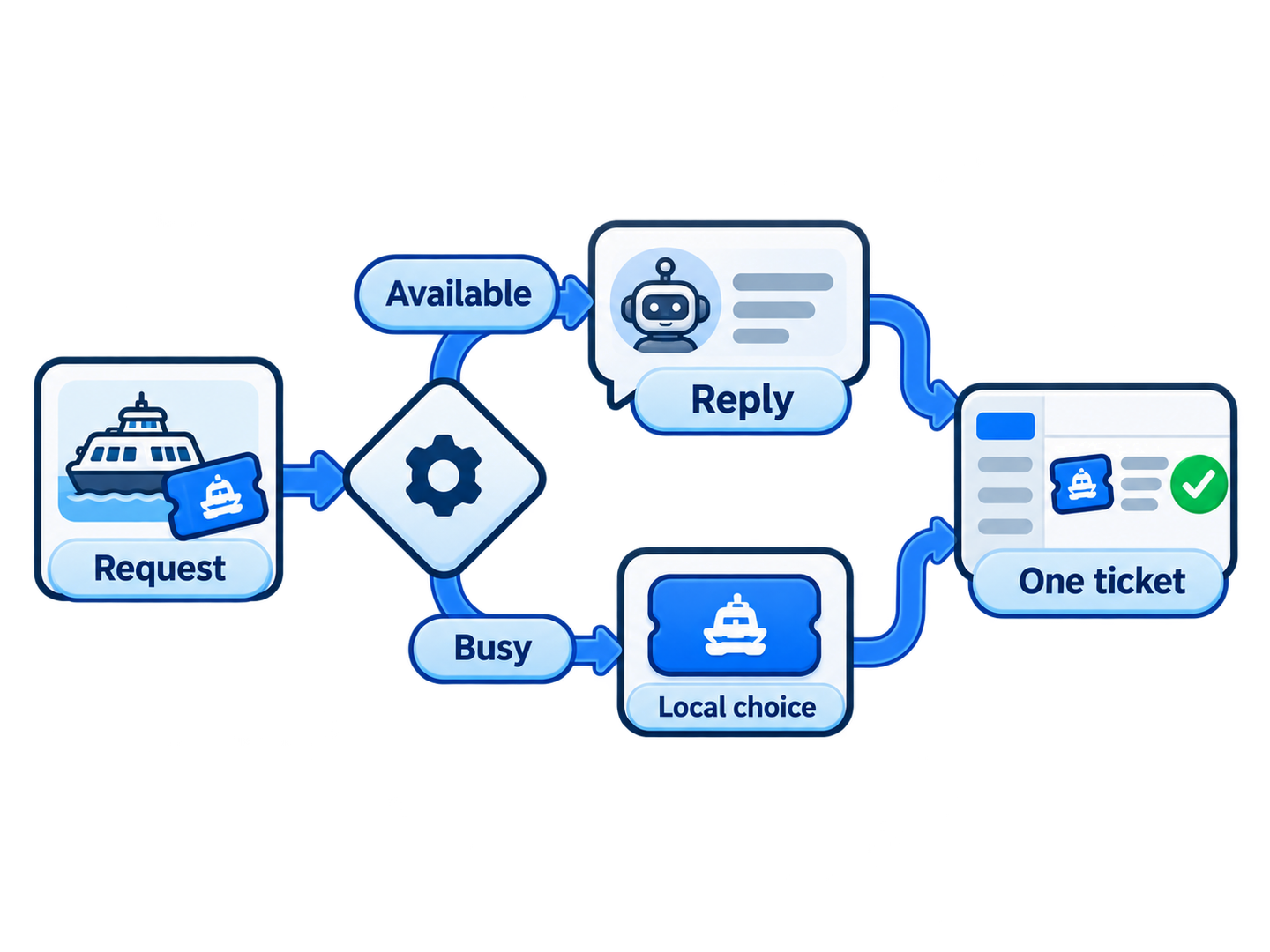
An admission gate decides whether a new request can use generation. When it cannot, the interface should offer the supported local choice and explain that conversation is temporarily limited. It should not start another generation call merely to describe the failure. Both routes must submit a ticket purchase through the same authoritative inventory and payment operation. A late generated reply may update presentation only while its conversation is still current; it must never purchase a second ticket or overwrite a choice already confirmed.[1]
This proposal assumes that the inventory and payment authority remains available when generation fails. If the client cannot reach that authority, keep the purchase unavailable or visibly pending. When an acknowledgment is lost after a possible commit, check the authoritative transaction status using the same purchase identity before allowing another attempt. Do not infer that no ticket was bought from a timeout. The local dialogue can explain the interruption, but it cannot promise an offline purchase.[1]
Pay for the fallback before expanding it
Suppose the team has one engineer-day left for this encounter. Spend it first on connecting the existing purchase action, cancel behavior, and stale-reply check. A designer must also supply the fixed wording and verify that it still makes sense when the player lacks money or already owns a ticket. Defer extra personalities and broader free-text topics. This allocation is a planning proposal; the team must estimate its own work. If the supported route cannot fit, remove generation from this encounter until the smaller route is ready.[1]
Local dialogue still needs memory, rendering, state checks, localization and maintenance. A remote fallback service adds its own dependency and can fail alongside the first one. Keep the first comparison small enough to inspect: normal generation available, admission refused, connection lost, a response arriving after cancellation, and a committed purchase whose acknowledgment is lost. Record which route ran, whether the ticket action completed once, and what resources each route consumed. A green server response alone cannot show that the player understood what happened.[1]
Applying this to your game
Pick one encounter with an existing useful action and write down what the player should retain during an outage. Rehearse the same saved state through normal and unavailable-generation routes, including insufficient funds and a previously purchased ticket. Inspect state changes and the rendered choices. Then ask someone unfamiliar with the fallback to continue the encounter and explain what they think is still possible. This is a proposed observation, with no results collected here.[1]
Keep generation if its extra flexibility earns its integration and operating cost. Revise the smaller route if people mistake its fixed choices for the full conversation, lose a necessary negotiation, or cannot continue despite correct state. If the local route consumes the same constrained resources as generation, reconsider the admission boundary. The useful promise is specific to the encounter: a ferry ticket can survive reduced conversation; another game may depend on precisely the expressive exchange this route removes.[1]
Sources
- Handling Overload
article · Google SRE online chapter 21; Alejandro Forero Cuervo, edited by Sarah Chavis; retained October 20, 2026 snapshot · Source accessed: