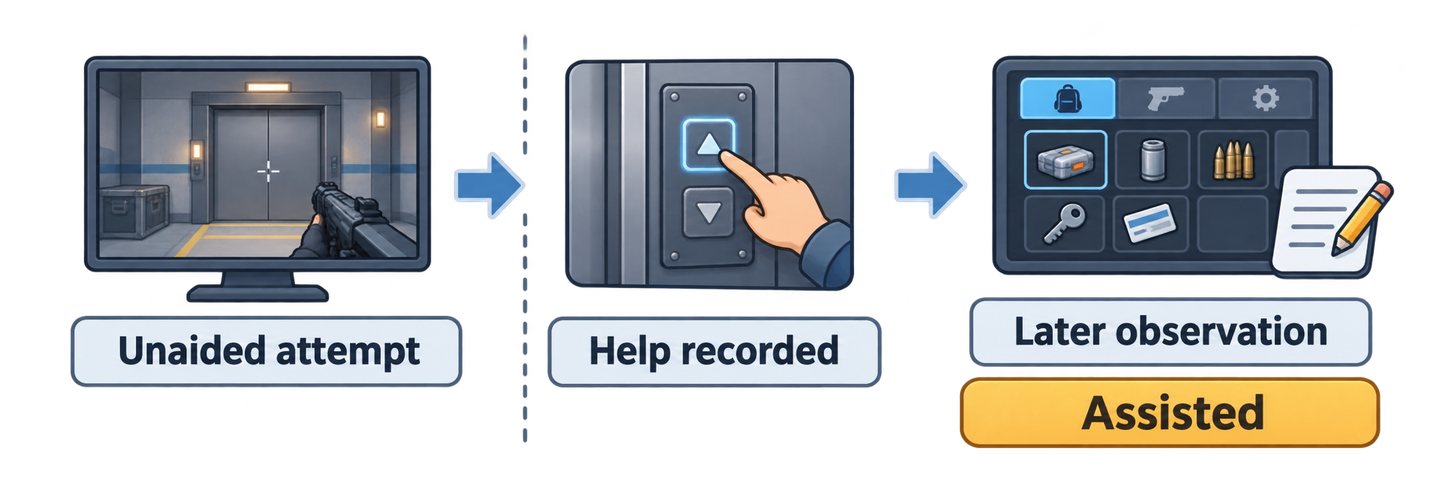
A player cannot find the lift control. The team already agrees that its label is missing and plans to fix it. The session is also meant to examine the inventory screen beyond the lift. The moderator points out the control, the player continues, and the final report says they completed the route. That sentence has lost the help that made the route possible.
Decide whether the next observation is worth an intervention, then preserve where the evidence changes. In this proposed session, the researcher records the unaided attempt up to the lift, the exact help given and the later inventory behavior. Reaching the inventory can reveal another problem. It cannot establish that the player would have reached it alone, and the help may affect how they interpret what comes next.

Steve Bromley’s moderation guidance generally advises against helping stuck players. It describes exceptions for unfinished parts of a game and for problems the team already understands and agrees need fixing, so researchers can investigate further issues. He also warns that moderator questions can reveal information. This is practitioner guidance on conducting sessions, not an experiment showing that help leaves every later observation unaffected.[1]
Before using the exception, make the reason concrete. Is the lift genuinely unfinished, or has the team agreed on an observed issue? What later decision requires seeing the inventory today? A designer being impatient with one participant does not answer either question. If the purpose is to learn whether players can discover the lift, giving the answer ends that unaided observation rather than completing it.
Write a short intervention note at the moment of help: what the player had tried, what the moderator said or did, and which later observation the team now wants. Keep the spoken help exact when possible. A report can then say that the inventory was observed after the moderator identified the lift control. The proposed note is a reporting practice for this example, not a template validated by the source.
Keep the help narrow enough for the remaining question. Pointing to the lift control may also teach a visual convention used throughout the game. A later inventory button with the same outline is no longer encountered under the original information conditions. Record that possible carryover instead of assuming that moving to another screen resets the participant’s knowledge. If that convention is what the inventory study needs to examine, recruit an unassisted session or change today’s question.
This choice spends researcher time. Waiting indefinitely at a confirmed blocker can prevent the team from seeing anything later, while helping too early can hide a problem that deserved observation. For a small formative study, agree on the known issue and intervention wording before later sessions. Preserve the first unassisted observation and report the assisted sessions separately. Counts of completed routes must retain that distinction; a shared total can conceal it.
After the lift is repaired, observe the relevant route with participants who have not already been taught its answer. A successful assisted session is useful preparation for that check, not its result. If later evidence shows that the original issue was misunderstood, reopen the diagnosis. If the inventory behaves differently after help, narrow the earlier claim. These are proposed follow-up checks; no playtest was conducted for this article.
Sources
- Expert playtest moderation – ask unbiased questions
article · Authored article last updated March16 2022, body read November12 2026 · Source accessed: