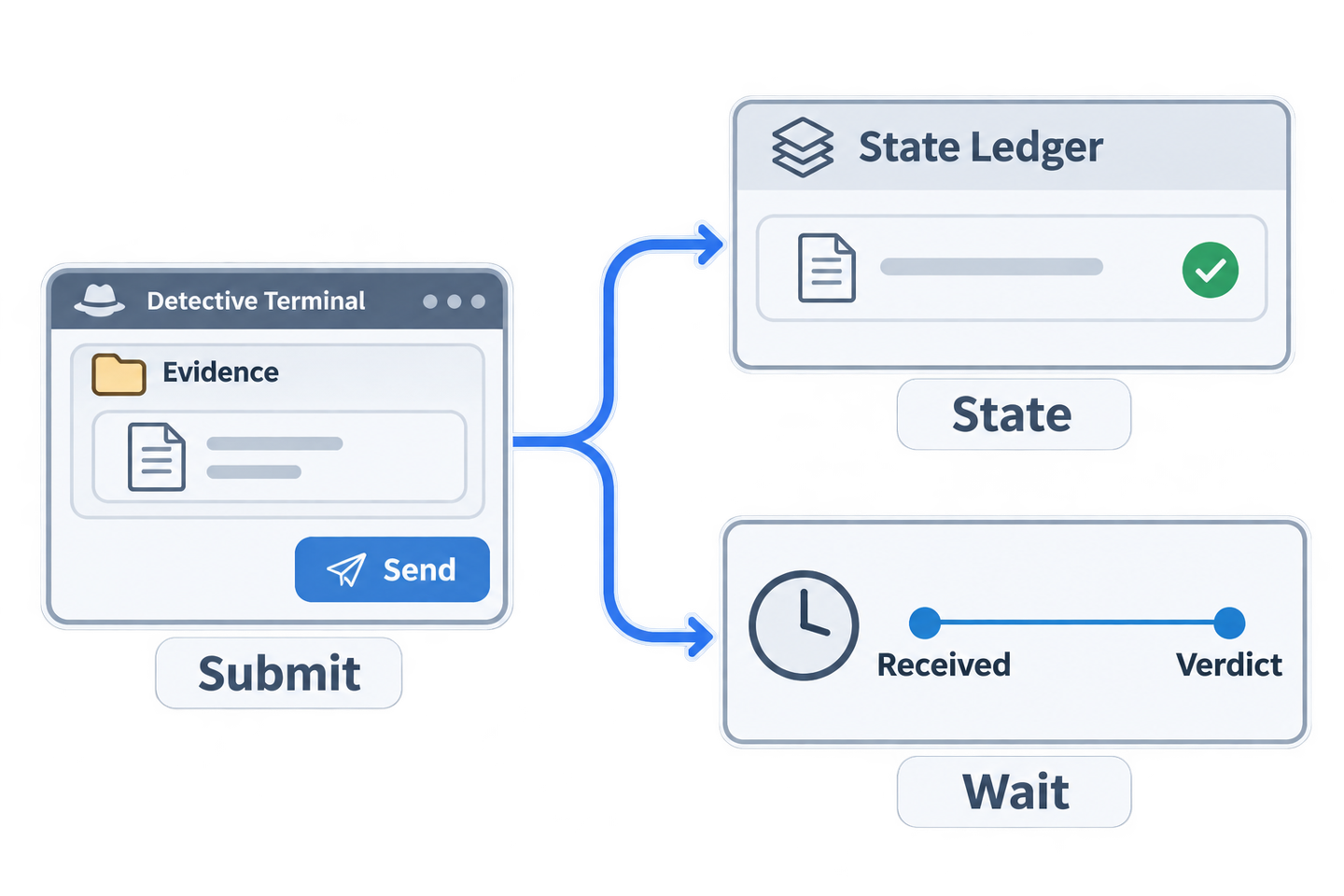
A player submits evidence at a detective-game terminal. The service eventually returns the correct verdict, records the evidence once, and leaves the case in a valid state. During a busy session, the terminal sits silent long enough that the player submits again or walks away. Passing the state checks has left a different release question unanswered: can someone use the interaction under the workload the team expects?
Keep the correctness checks and add an explicit response-time question. For this proposed terminal, record elapsed time from submission to visible acknowledgement and separately to the final verdict. Those moments mean different things to the player. An acknowledgement can confirm that the request was received while the verdict is still being evaluated. It must not imply that a result has already been committed.

Marc Brooker’s Formal Methods Only Solve Half My Problems argues that safety and liveness checks leave other distributed-system design questions open, including latency, cost and overload. He discusses modelling, prototypes and simulation, along with the effort and assumptions they require. His argument supports separating the questions; it supplies no acceptable waiting time for this game.[1]
Use the workload the interaction will face
For a small prototype, compare one terminal with the expected busy scene on the actual target service and client hardware. Keep the build, configuration, request mix and cache conditions in the record. Include the size of submitted evidence and concurrent work, because counting requests can conceal different amounts of processing. Start with a small, explicitly stated workload; do not call it production capacity.
Record individual timings and failed or unfinished attempts as well as a summary. An average can hide a few very long waits. A timeout is not a completed response at the timeout value: retain that the outcome remained unknown at the observation boundary. Inspect acknowledgement and verdict separately, and trace whether a slow acknowledgement comes from the client, network or service before choosing a remedy.
Correctness still needs its own failure cases. A lost response after commitment must reconcile the original submission rather than invite an unchecked duplicate. Waiting indicators should allow the player to leave the screen without silently canceling or repeating a committed action. Those behaviors need implementation and state checks; a quicker animation or a smaller average cannot establish them.
The team pays for instrumentation, a controlled workload and someone to interpret the results. Begin with the existing terminal path and a small reproducible harness before building a detailed simulator. If the first comparison identifies a slow dependency, measure that boundary under the same conditions. A larger model is useful only when its assumptions can change an affordable design decision. Keep unmeasured service costs and limits unresolved.
Then propose a player observation around the waits actually encountered: can people tell whether the evidence was received, what they can do while it is pending, and how to find its eventual verdict? No game, service benchmark or player study was run for this article. If timings fit the team’s chosen target but players still think submission failed, revise the acknowledgement and recovery interaction. If the service cannot support the scene, reduce the live work or use an authored case that the team can validate.
Sources
- Formal Methods Only Solve Half My Problems
article · Author post dated 2022-06-02, original submission and Later commentary · Source accessed: