Suppose a village guard watched you return a stolen key. When you come back, he asks you to find it again. Before adding the whole conversation history to his next prompt, inspect the record of the return, the memories selected for this reply, and the quest state. This is a hypothetical debugging example.
In Generative Agents, Park and colleagues store experiences in a memory stream and select records using recency, importance and relevance (§4.1). The selected memories, rather than every stored event, enter the prompt. Reflections are stored alongside observations (§4.2).[1]
The authors describe an agent that recalled a planned conversation at a party while remaining unsure whether the party existed: retrieval had supplied an incomplete fragment (§6.5.2). They also report unsupported embellishments. A stored record alone did not ensure an accurate answer.[1]

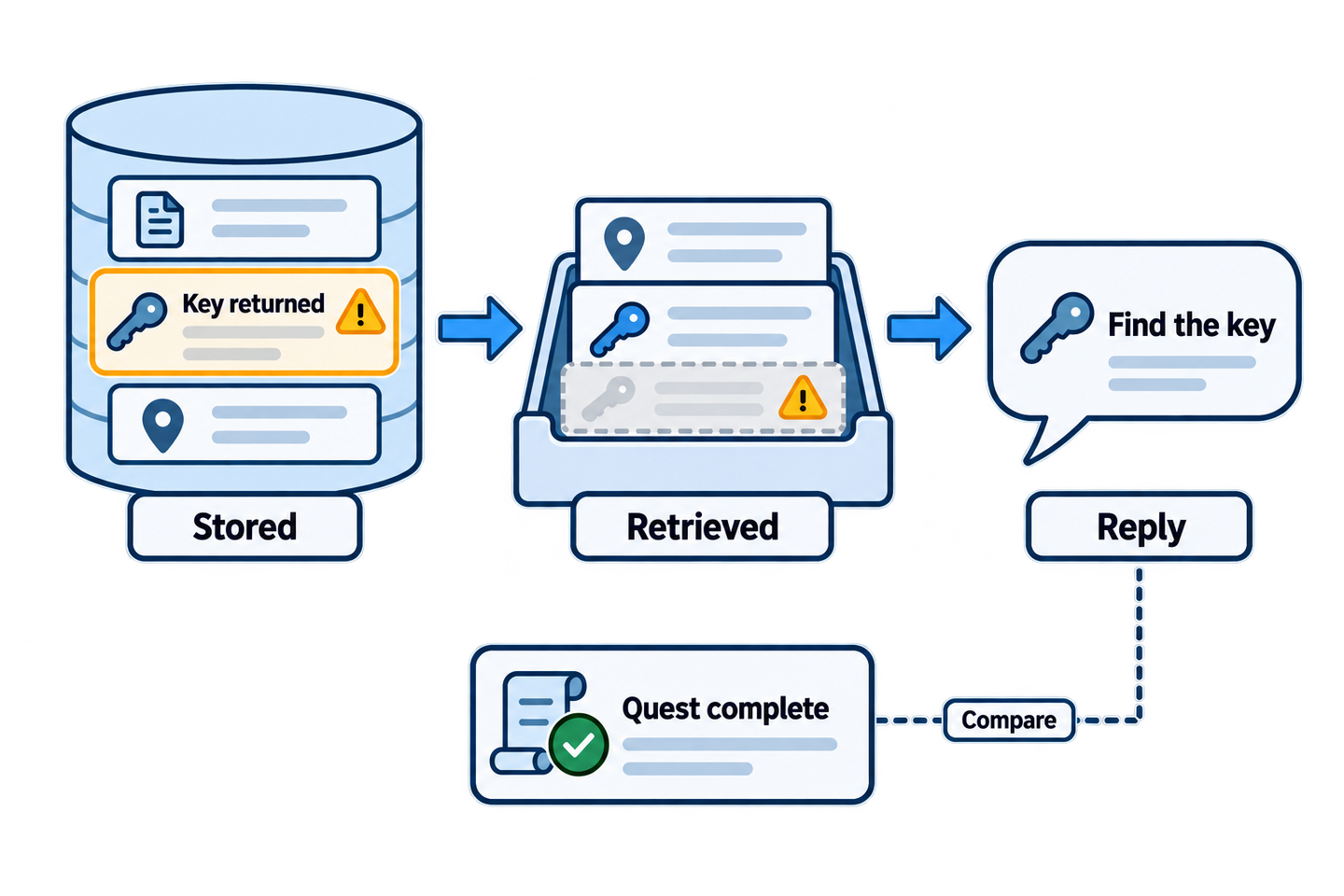
Follow the missing fact
For the guard example, keep one trace with the player’s question, the relevant event record, the retrieved records, the assembled prompt and the reply. If the return event was never recorded, changing retrieval cannot recover that missing input. If it was stored but omitted from the prompt, inspect selection. If the prompt included it and the reply contradicted it, investigate how the answer was generated.
Keep the quest’s authoritative state beside that trace. “The guard remembers the key” and “the quest is complete” are separate checks in this proposed design. Decide which component may mark the quest complete and whether dialogue is allowed to change it. Otherwise a convincing reply can hide a disagreement between conversation and progression.
Try a small comparison
A proposed test is to ask about the same completed event immediately, after unrelated conversation, and after a later event changes its status. Keep the intended answer and the selected memories for each case. Try an explicit event name as well as a natural reference such as “what i brought back.” These cases help locate failures; they are not a validated test suite.
Applying this to your game
For a team preparing a quest demo, start with the existing completed-event record and one saved reply trace. Keep the event identifier, retrieval query, selected records and assembled prompt together so a programmer can reproduce the disagreement. This narrow check gives up broad conversational coverage initially. It avoids committing the team to a larger memory store before anyone knows which step lost the fact.
The game programmer owns the event record and quest-state check; whoever maintains dialogue supplies the retrieval and prompt trace. Those tasks need an available logging path and time to replay the same question. Do not add a new retrieval index, a model migration and a dialogue rewrite together. After the first trace identifies the failing boundary, spend the remaining debugging session on that boundary and keep the previous dialogue path available for the demo.
If the returned-key record is missing, repair event capture first. If the record is present but selection omits it, compare a focused event lookup with the existing retrieval for this one quest. If the correct record already reaches the prompt, stop blaming retrieval and examine the reply instruction or the authored response. A direct state-based acknowledgment is a possible fallback for this completed-event exchange. Use it only if the dialogue maintainer can author it and route it from authoritative quest state, and the programmer can check that route and its state safety within the remaining debugging session. It sacrifices free-form replies here. If that work cannot be paid for or checked in time, defer this generated exchange rather than shipping a known-wrong response.
Keep that fallback only if it addresses the intended player concern. A technically accurate acknowledgment may still feel repetitive or miss what the player meant. A player account showing that problem would justify revisiting the exchange itself, while trace evidence that the model answers correctly would weaken the case for more retrieval machinery. These are proposed decision gates, not observations already collected.
Sources
- Generative Agents: Interactive Simulacra of Human Behavior
paper · arXiv:2304.03442v2 (2023-08-06) · Source accessed: