A recording can show a character jumping without telling a model which button caused the jump. Genie asks whether that missing action vocabulary can be learned from the changes between video frames. For designers experimenting with generated environments, the interesting promise is a control that keeps a recognizable meaning when the starting scene changes.

Learning a small vocabulary
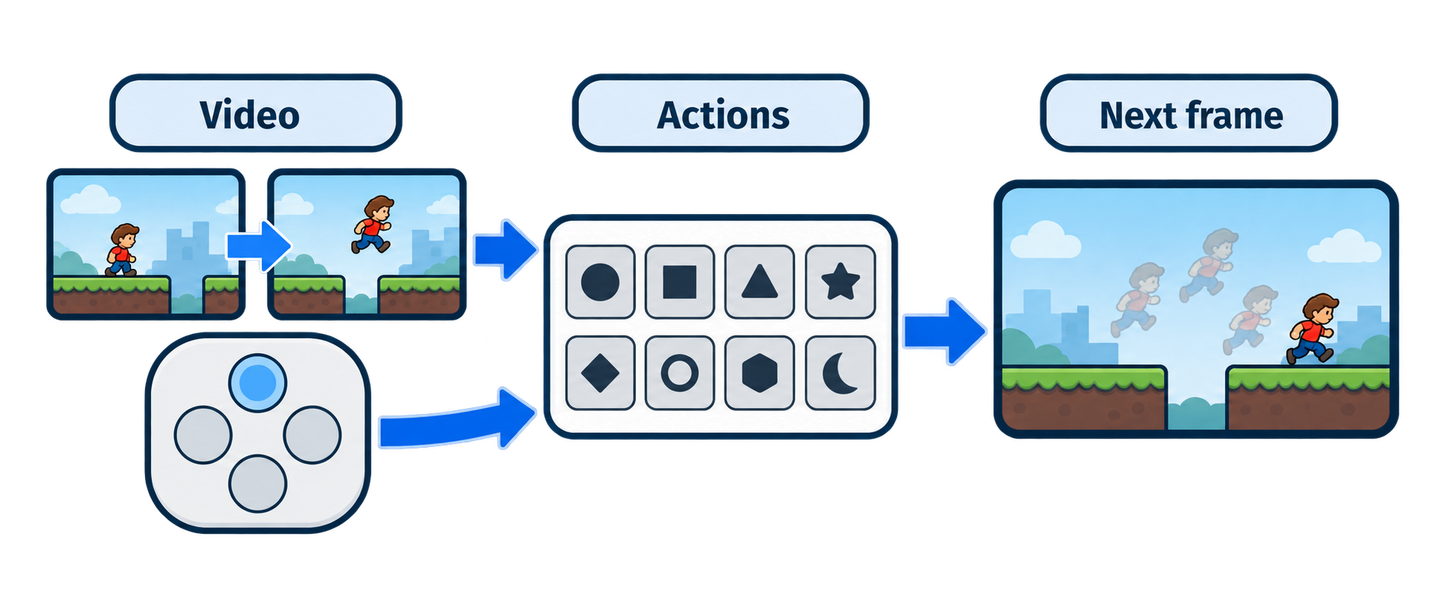
Genie's latent action model learns from unlabeled videos. During training, it sees previous frames and the next frame, then compresses the transition into one of a small set of discrete codes. A decoder uses the past frames and that code to reconstruct the next frame. Limiting the codebook encourages the action representation to capture useful changes rather than encode an unrestricted description of the image. The authors use eight codes in their experiments.[1]
At interaction time, a person selects a code instead of providing the future frame. A separate dynamics model predicts the next image from the preceding images and the chosen action. The training decoder is not the playable environment's controller; most of the latent action model is discarded for inference, while the learned codebook supplies the actions.[1]
These codes do not arrive with familiar button names. The authors describe learning their effects as similar to learning a new controller, and report consistent action meanings across different inputs. That is the capability to inspect: does a control produce a recognizable kind of change across scenes, even when each generated image looks different?[1]
An action's effect is only part of a game
The paper evaluates visual fidelity separately from controllability. Its controllability measure compares generations conditioned on inferred actions with generations using random actions. This tests whether the action input changes the generated trajectory in a way that tracks the source video. It does not directly measure whether a player understands the controls or whether every important game rule survives a long session.[1]
A model can make movement visible while leaving questions about collisions, progress and revisiting an earlier place unresolved. In its limitations, the paper reports generation at approximately one frame per second and memory extending only sixteen frames into the past. That memory length is not a maximum session duration; it limits which earlier events the model can directly use. Those limits change the sort of prototype a team can reasonably build from this early system.[1]
Applying this to your game
Genie v1 does not release trained checkpoints or its training dataset. The following proposal requires an accessible prototype with suitable action controls; reproducing the paper would require separate implementation, data and training resources. Recorded demonstrations can help formulate questions, but they cannot substitute for executing that comparison.[1]
If you have such a prototype and are exploring a visual toy, give each experimental control several starting scenes and record what changes when you repeat it. Compare the control's effects before assigning a label such as “jump.” A label promises a relationship that players can learn; it should follow the observed action vocabulary rather than force an attractive clip into familiar mechanics. This is a proposed evaluation for your prototype.
Then choose one consequence your toy must retain, such as landing on a platform. Inspect the full attempt from input to landing, and repeat it from different plausible positions. Keep a separate record of visual coherence and the consequence's consistency. An appealing trajectory can help creative exploration even if the interaction cannot support a precision challenge, but those are different intended uses.
This first comparison gives up breadth of scenes to inspect a few controls carefully. It also needs someone to review failed trajectories, not only select successful clips. If controls vary too much to name, consider presenting the prototype as exploratory manipulation or using an authored controller. If players can learn useful effects despite some ambiguity, you may not need to explain every internal code. We have not run Genie or collected player evidence; the research identifies a way to learn actions, while the prototype must establish which promises those actions can keep.
Sources
- Genie: Generative Interactive Environments
paper · 2402.15391v1 (2024-02-23; arxiv_v1_submission_date) · Source accessed: