Sending a key press is a small engineering fact. Knowing that the character opened a cabinet is a larger one. A game agent that confuses the two can continue with a perfectly reasonable plan for a situation that never happened. Cradle's original Red Dead Redemption II case study makes that gap unusually concrete.

Follow the command back to the screen
The framework acts through keyboard and mouse operations and observes screen images. It turns low-level input calls into code skills, selects skills for a task and executes them. Its reflection module then examines key screenshots, the previous planning context and the task to judge the preceding action. Those judgments feed task selection and another action plan.[1]
In one reported case, the agent selects a knife when the task requires a gun. The game continues to display the weapon-selection instruction. Reflection recognizes that the intended action has not succeeded, and a later attempt selects the gun. The informative part is the return to an observable requirement, rather than the existence of another reasoning step by itself.[1]
The same silence can have different causes
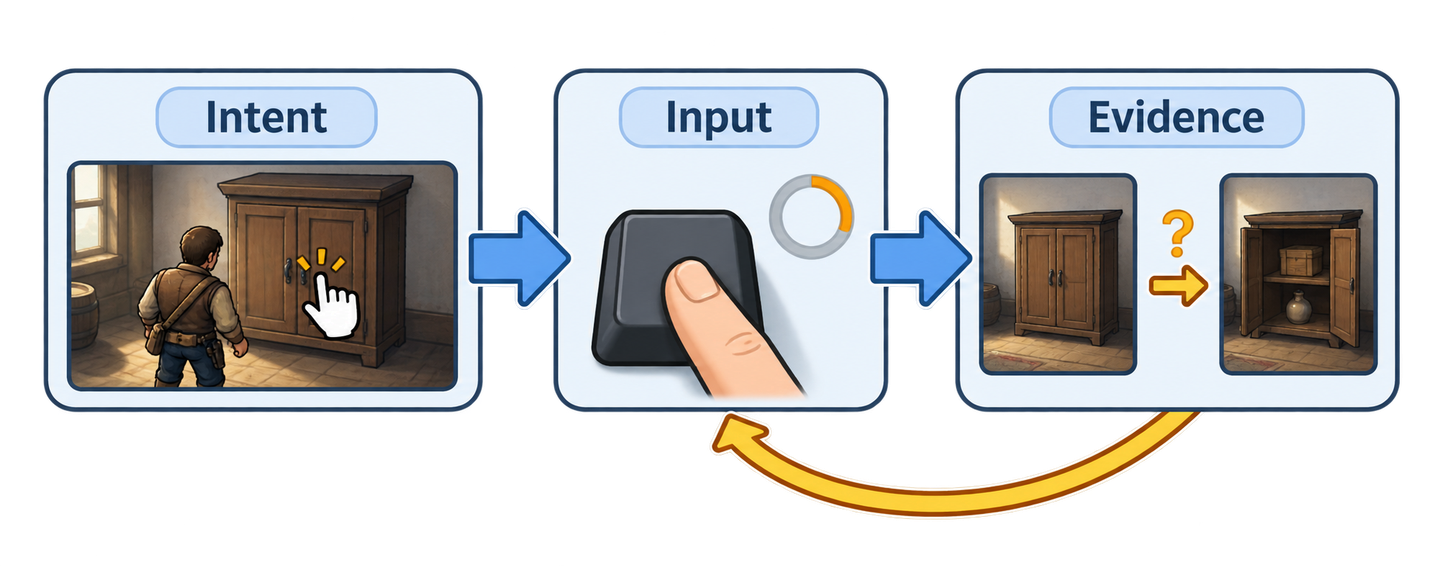
The paper describes an interaction that requires holding a key long enough to open a cabinet. A short press produces no effect. That absence can resemble choosing the wrong action or acting from the wrong position. Other cases involve an object being out of reach, an outcome hidden from view, or an animation interrupting a multistep action.[1]
A stored input routine can also change meaning with context. In the authors' horse example, the same key participates in hitching and dismounting. Reusing the routine without observing the current context can therefore cause a different action. A skill's name does not settle which game behavior its inputs will trigger.[1]
These are reported problems in a preliminary screenshot-and-input agent for RDR2. They do not demonstrate general reliable control across games. This article uses the March 2024 first version, whose case-study scope should remain attached to any conclusion drawn from it.
Applying this to your game
If you are building an external playtest agent, trace one interaction from intention through input to visible result. Keep the screenshot before the action, the input duration and location, the screen after it and the agent's success judgment. Inspect those records together when an action stalls. This proposed record lets a tester distinguish a failed command from a mistaken interpretation before rewriting the plan.
Prepare cases where the same input has two contextual meanings, and where an animation delays the expected response. State what observable evidence would justify continuing, retrying or abandoning the task. If the screen cannot resolve that distinction, record uncertainty; repeated reasoning over the same incomplete observation does not supply a missing fact.
An internal test harness may expose authoritative state if you control the game. Keep that state separate from what the agent can see, then use it to inspect false success judgments. This gives up the source framework's purely screen-based interface for a more informative engineering test. The choice is appropriate when diagnosing your own system matters more than demonstrating general computer control.
Start with that one interaction and its recovery path before adding more skills. Reviewing traces and maintaining timing rules will take effort even if the planner is capable. If visible evidence remains too ambiguous, an authored test or an internal hook may serve the testing goal better. If the agent handles meaningful variations that those smaller approaches miss, expand its scope while retaining the observable checks. We have not executed Cradle or the proposed harness; the paper's failures identify what the harness should make inspectable.
Sources
- Towards General Computer Control: A Multimodal Agent for Red Dead Redemption II as a Case Study
paper · 2403.03186v1 (2024-03-05; arxiv_v1_submission_date) · Source accessed: