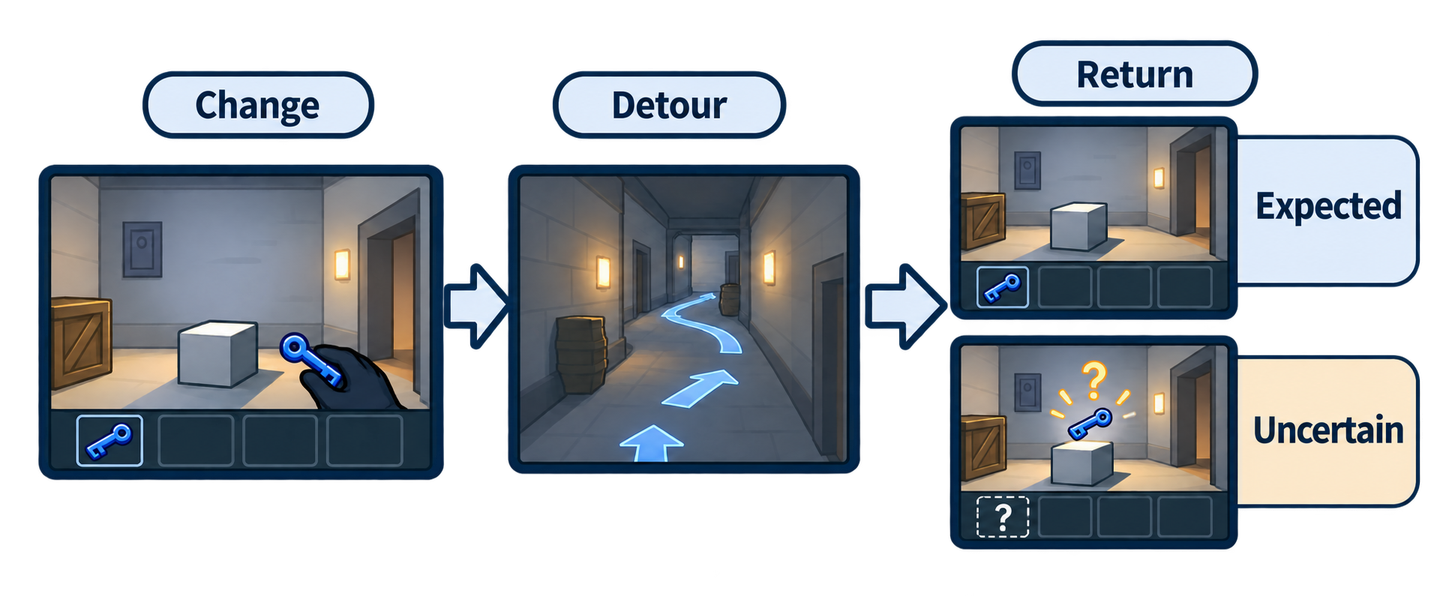
A room can look right when you first enter it and change when you return. For a generated game, that discrepancy can affect more than scenery: an earlier pickup, opened passage or resource change may no longer be reflected. GameNGen offers a concrete way to inspect the difference between plausible frames and a simulation that retains the consequences of play.

Generate from the previous interaction
The authors train a diffusion model to predict DOOM frames conditioned on earlier frames and actions. They first collect training trajectories with a reinforcement-learning agent. The generative model then learns from that recorded interaction, and at runtime generates new frames as actions arrive. This is a learned simulation of a particular game's observations, not an implementation of arbitrary game rules.[1]
Training on real recorded frames and later conditioning on generated frames creates a mismatch. Errors in one generated frame can become inputs to the next prediction. The paper addresses this by adding noise to context during training, helping the model handle imperfect prior frames during autoregressive generation. The mechanism is meant to reduce accumulating divergence; it does not create an authoritative symbolic record of every event.[1]
The authors evaluate simulation quality using image measures, trajectories and human judgments of short clips. Such evidence can demonstrate convincing output within those conditions while leaving longer interactions and particular game-state promises unresolved. A participant having difficulty distinguishing a short generated clip from a real one is not a test of every rule over a complete play session.[1]
A short context changes the promise
The discussion identifies limited memory from the short context and behavior the model does not perfectly simulate. A consequence that leaves no relevant information in the context can be difficult to preserve when it becomes important again. That makes revisiting and delayed consequences useful inspection cases for an interactive prototype.[1]
This question differs from asking whether an input changes the image. An action can influence the next frame and still fail to establish a durable state change. For a visual experiment, that limitation may be tolerable. A game that asks players to plan around retained resources needs a different promise.
Applying this to your game
Choose one consequence that should survive leaving and returning to a location. Record the input sequence and what the player should reasonably find on return. Compare a short local action with the same action followed by a detour, keeping the intended consequence explicit. This is a proposed inspection, not a GameNGen result reported for your scene.
Keep visual coherence, action response and state continuity in separate notes. A convincing clip should not hide a missing consequence, and a continuity defect should not erase the value of a visual toy whose purpose is exploration. The team needs to decide which of those activities it is building before treating a demonstration as an engine replacement.
An authored state record can supply the retained consequence in a hybrid prototype, if the generator can actually use that record. Integrating and checking that connection is additional work, not a free benefit of the image model. It gives up unrestricted generation where the rule demands a specific result. A conventional engine with generated assets may be the smaller option when many consequences must remain exact.
Begin with one return path and its failed cases rather than collecting more attractive scenes. If the visual system already supports the intended exploration without durable commitments, leave some ambiguity available. If a missed commitment changes the player's plan, fund a state mechanism or narrow the promise. We have not run GameNGen or these comparisons; the research motivates the inspection, while the intended play determines what the simulation must retain.
Sources
- Diffusion Models Are Real-Time Game Engines
paper · 2408.14837v1 (2024-08-27; arxiv_v1_submission_date) · Source accessed: