A cooperative agent can finish many tasks with one partner and offer little useful help to another. A single success score may hide whether it understood the partner's goal, handled a constraint or simply did the work itself. CHAIC makes those distinctions part of an embodied benchmark, providing a useful question for teams evaluating game companions: which contribution should count as help?

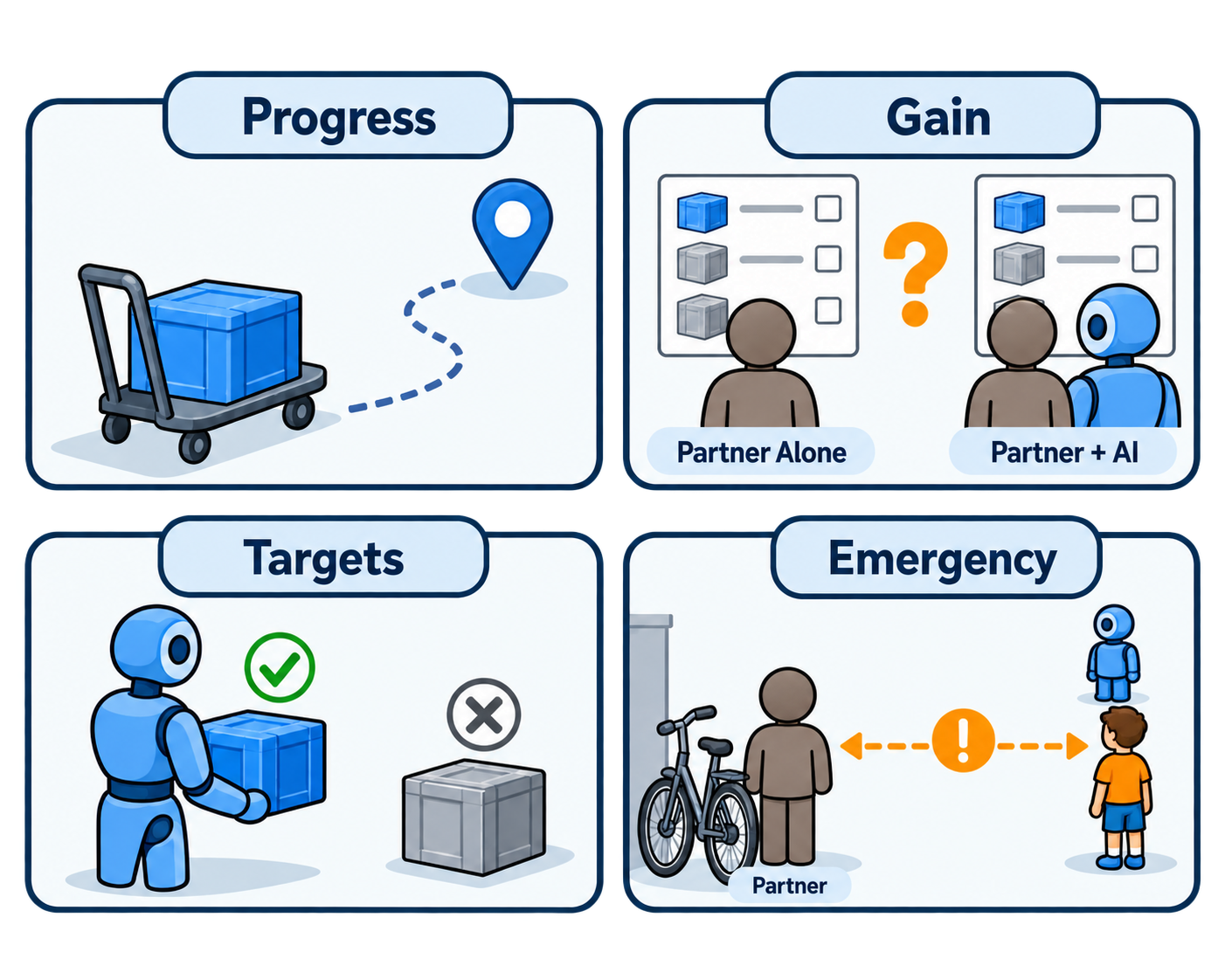
Keep several outcomes visible
CHAIC places helper agents alongside simulated partners with different physical constraints in long-horizon embodied tasks. Its settings include indoor and outdoor scenes and emergency events. These are modeled agents and tasks; the benchmark is not a study with disabled game players.[1]
The evaluation separates transport rate, efficiency improvement, goal-inference accuracy and emergency handling. Transport rate is the proportion of target objects transported. Efficiency improvement uses the change in transport rate with a helper, normalized by the larger of team or unaided transport rate; it is not a direct time-saving measure. Goal-inference accuracy is the proportion of the helper's transported objects that were targets, a behavioral proxy for identifying the partner's goal. The shopping task's emergency rate measures frames in which a child agent is away from the constrained partner. These measures expose different contributions and failures rather than directly reading a partner's intentions.[1]
The paper evaluates planning- and learning-based baselines across constrained settings. The value for a game researcher is the explicit separation of outcomes. A helper can infer a goal incorrectly while still moving objects, or improve a completion score while missing an emergency. Those cases call for different changes.[1]
A contribution can have competing explanations
Suppose a companion retrieves an object the player was moving toward. The retrieval may remove an unwanted obstacle, interrupt an intended action or happen to advance the objective while misunderstanding the plan. A task-progress measure alone cannot distinguish those interpretations.
For a game, participation may also matter independently of completion. The companion might need to preserve the player's opportunity to decide, not merely minimize time. That extends beyond what a simulated constraint benchmark can establish and needs evidence from the intended interaction and audience.
Applying this to your game
Choose one cooperative task and specify what useful help means in that setting. Compare the same opportunity with no companion and with a bounded helper. Record completion, the action the helper selected, the goal it appeared to infer and any recovery the player needed. This is a proposed evaluation structure inspired by the benchmark, not a measured game intervention.
Include a case where the player's route is constrained and another where the player deliberately chooses a different approach. A helper should not treat every deviation from its plan as a limitation to fix. Observe whether the partner can decline or correct assistance and whether the game respects that response. Ask what the participant wanted to do alongside what the system completed.
Start with this small task before building a broad automatic model of needs. Authoring and testing correction paths will take work even if the helper raises completion. An explicit request or a fixed offer may be easier to interpret than inferred intervention; that alternative gives up some automatic responsiveness while retaining the player's control over help.
If the helper improves progress but repeatedly takes away valued actions, narrow its role. If participants knowingly prefer delegated work and can revise that choice, preserving every manual step may be unnecessary. Keep both observations visible. We have not run CHAIC or evaluated players; its separate metrics help formulate a more precise study, while claims about inclusion or accessibility require evidence from the people and setting concerned.
Sources
- Constrained Human-AI Cooperation: An Inclusive Embodied Social Intelligence Challenge
paper · 2411.01796v1 (2024-11-04; arxiv_v1_submission_date) · Source accessed: