A model trained on one game's videos may learn both its appearance and its movement. If changing the scene also changes what an input does, the designer loses a useful control while gaining visual variety. GameFactory investigates whether those two kinds of learning can be separated so that action control transfers beyond the training game's style.

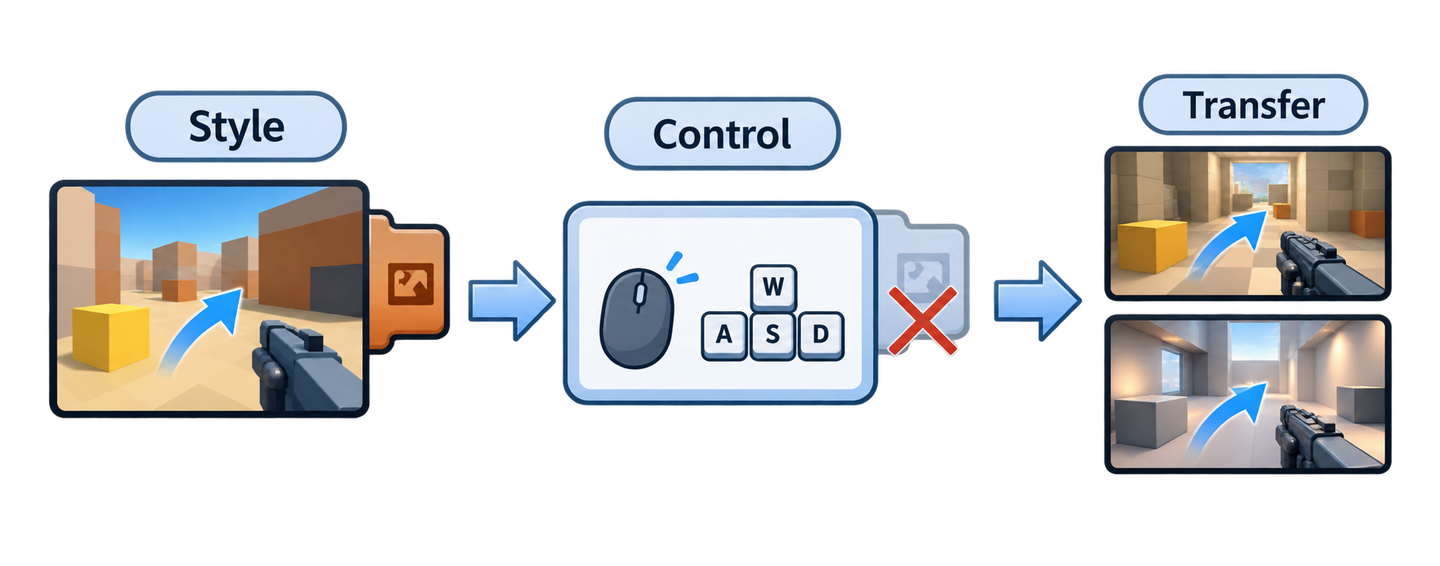
Train the two jobs separately
The framework begins with a pretrained video diffusion model. It first adapts the model to game videos using LoRA, a parameter-efficient adaptation layer, while preserving most original parameters. In a second phase it freezes the pretrained model and the style-adaptation weights and trains the action-control component using game videos and action signals.[1]
At inference, the authors remove the game-style LoRA weights while retaining the action-control component. The intended division is that style fitting during training lets the later component focus on actions, while removing that style adaptation permits generation in broader scenes. The paper evaluates action-controlled video generation using a first-person Minecraft dataset and open-domain examples.[1]
This is a contribution about controllable game video and scene generalization. It does not supply a complete game with authored objectives, dependable interactions and every required state transition. A control that visibly transfers to another scene still needs an interpretation and consequences that the intended play can support.
Which control promise should survive a style change?
Suppose your prototype lets a visitor move toward an object in a generated scene. Decide what must remain recognizable across appearances: camera movement, approach direction or reaching a meaningful interaction. Those promises require different observations. Similar-looking motion is not enough if the player expects the object to become usable at the end.
Visual variety can be valuable in its own right. A creative exploration tool may tolerate effects that a precision challenge cannot. Earning an action label therefore depends on the activity you are asking the visitor to attempt, rather than requiring every generated scene to behave like the training game.
Applying this to your game
With an accessible action-controlled prototype, select a few controls and compare them in familiar and unfamiliar scenes. Keep the input sequence and intended effect explicit, then inspect failures as well as attractive generations. Record style differences separately from changes in action meaning. This is a proposed comparison, not execution of GameFactory or proof of transfer to your game.
Choose one downstream interaction to inspect after movement. If it needs exact state, determine whether the generator can use an authored record and pay for that integration and its checks. A conventional controller over varied generated assets is a smaller alternative when dependable actions matter more than fully generated trajectories.
This first comparison postpones scene breadth to establish which effects remain useful. It still needs model access, inference resources and someone to interpret awkward outputs; the paper's architecture does not make those costs disappear. If useful control survives visually different scenes, expand that range. If the effect changes too much for the visitor's intended action, narrow the control or keep the authored route. We have not run the model or tested visitors; the separated training phases motivate the comparison, while the activity defines the promise to preserve.
Sources
- GameFactory: Creating New Games with Generative Interactive Videos
paper · 2501.08325v1 (2025-01-14; arxiv_v1_submission_date) · Source accessed: