A generated scene can look plausible while responding poorly to a player's input. If turning the camera or moving forward no longer has a dependable meaning, faster frames will not restore that interaction. MineWorld evaluates action following alongside visual quality and decoding speed, giving developers separate questions to ask about an interactive world model.

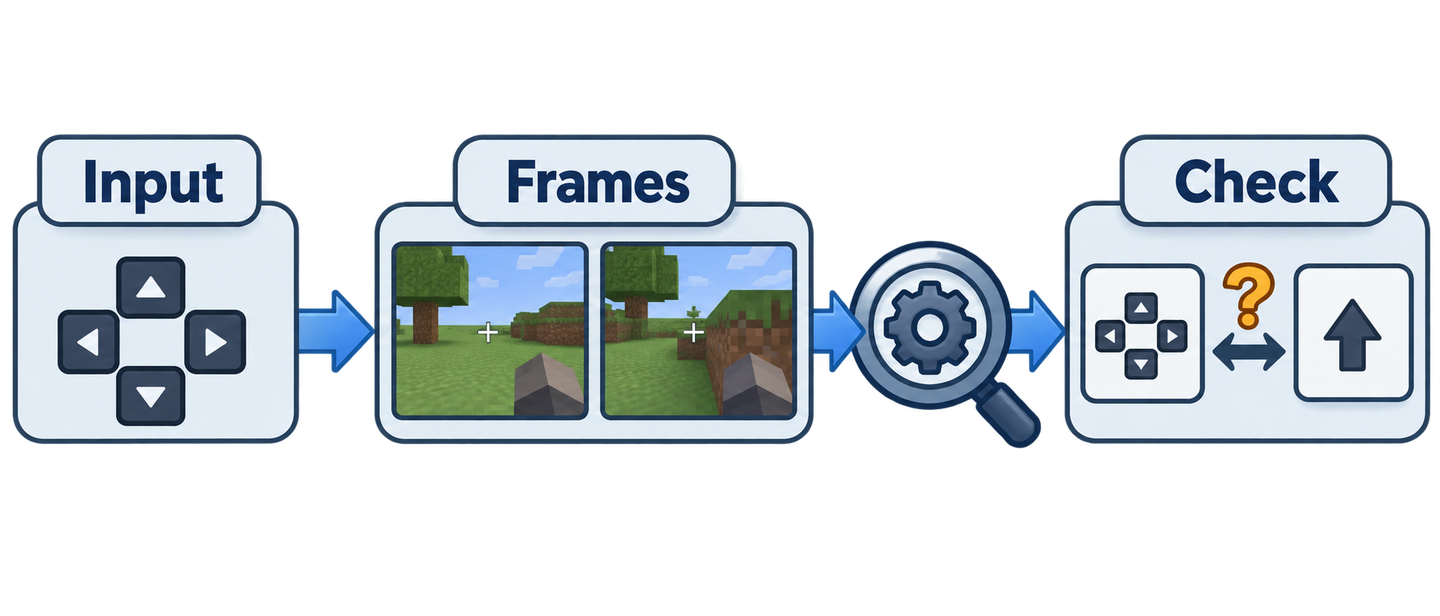
What the action score actually measures
MineWorld trains an autoregressive model on interleaved Minecraft state and action tokens. Separate tokenizers represent the observations and controls. The model predicts subsequent tokens from that sequence; it does not inherit a conventional engine's explicit simulation rules simply because its output resembles the game.[1]
For controllability evaluation, the authors use an inverse dynamics model to predict actions from consecutive generated states, then compare those predictions with the actions provided to the generator. They report classification measures for discrete actions and a separate error measure for discretized camera angles. Macro averaging helps reduce the influence of imbalanced action categories.[1]
This measures recoverable action alignment through an evaluator. It does not check every game consequence. A recognizable movement can coexist with an incorrect inventory, lost object or inaccessible continuation. Visual similarity measures answer another question, while the inverse model's own errors remain part of the action assessment.
Faster decoding still has conditions
The paper compares ordinary autoregressive decoding with parallel decoding, including variants with and without fine-tuning for the parallel attention mask. Its reported speed, action and image results belong to those model configurations. They are not a latency promise for a different device or game.[1]
The stated limits matter to an interaction design: training uses Minecraft at a fixed downsampled resolution, and the context window contains a bounded sequence of state-action pairs. The authors do not guarantee consistency beyond that window. A short agreeable response cannot settle what happens after a long detour.[1]
Applying this to your game
Choose one supported control and one consequence the player needs it to preserve. With an accessible model or comparable prototype, compare the issued input, visible motion and resulting game state. Include a stationary action and a direction change so that an evaluator cannot succeed by assuming movement continues. This is a proposed inspection, not our reproduction of MineWorld.
Record frame rate and response delay separately from action errors, with the actual configuration and workload. If the model can produce a recognizable turn but cannot preserve the next usable object, keep that distinction in the result. An authored controller with generated visual assets is a practical alternative when stable control is the central promise.
This first comparison gives up a broad visual benchmark to inspect one playable continuation. Integration, failure traces and a supported recovery path still take work. Keep the existing route available if generation cannot honor its consequence within the available response time. If a bounded generated interaction does honor it and offers useful variation, expand that interaction before adding more controls. We have not executed the source model or measured its runtime.
Sources
- MineWorld: a Real-Time and Open-Source Interactive World Model on Minecraft
paper · 2504.08388v1 (2025-04-11; arxiv_v1_submission_date) · Source accessed: