A leaderboard can help compare agents without telling a designer what those agents will do for players. The meaning of a rank depends on the games, opponents and rating procedure behind it. TextArena makes those ingredients visible through competitive text environments and an evolving online evaluation system.

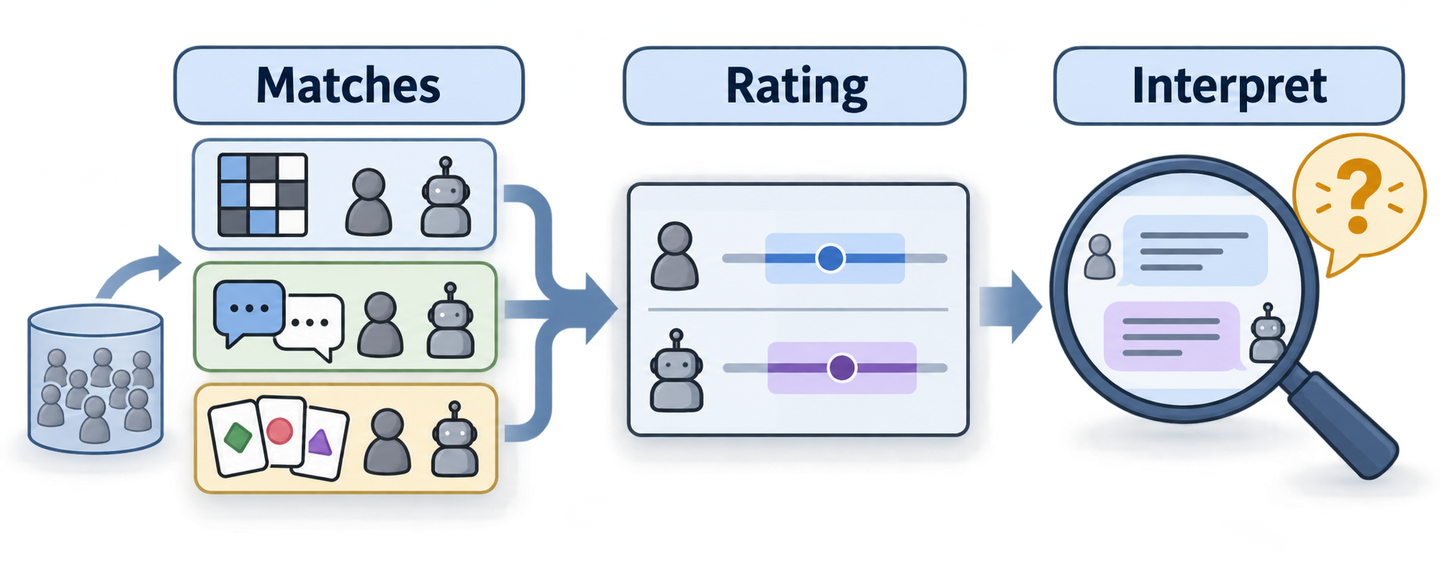
A rating describes a comparison
TextArena updates TrueSkill ratings after matches. The rating system represents an estimated ability and uncertainty, rather than treating every recorded win as a settled ordering. New results can change the estimate as the opponent population and available matches change.[1]
The framework supports model-versus-model and model-versus-human play. Human players are pooled into a single collective entry called Humanity. That entry provides an aggregate comparison; it does not describe a typical person, establish population representativeness or retain the differences among individual participants.[1]
An agent's success in one game may require handling legal moves, following a negotiation convention or exploiting an opponent's predictable choices. A combined rank can conceal which of those tasks contributed to the result. Before using it to select an in-game feature, identify the specific behavior the feature needs.
Skill tags need interpretation
TextArena assigns environments soft-skill tags and associated weights, then computes a skill score from a weighted average of relevant environment ratings. This is a useful grouping mechanism. It does not independently validate a psychological trait simply because the group has a familiar skill name.[1]
For example, a negotiation category could combine games with different information, incentives and conversational constraints. Winning under those rules does not establish that a character explains a misunderstanding well or keeps a collaboration enjoyable. Those are possible product questions with their own observations.
Applying this to your game
Start with one job for an agent: perhaps responding to an offer while preserving the partner's opportunity to make a counteroffer. Choose benchmark environments whose rules expose part of that job. Record the tested model version, game mix, opponents, match count and rating uncertainty when available. Missing uncertainty should remain an information gap, not become a confident ordering.
Then inspect a few consequential exchanges in a working prototype or accessible trace. Distinguish invalid actions, strategically weak choices and exchanges that remove the partner's intended participation. These diagnoses imply different work; a higher aggregate rank does not select the repair.
This first pass postpones a large competitive tournament. An authored response policy or smaller model is worth comparing when it can support the same interaction. Reading transcripts and resolving disputed outcomes also cost time, so choose cases that can change a specific implementation decision rather than collecting another general score.
If the benchmark favorite fails the intended exchange while a simpler policy preserves it, revise the selection. If the stronger agent handles relevant alternatives the smaller policy cannot, extend the comparison to those alternatives. We have not run TextArena or recruited players. Its leaderboard is useful evidence about a defined competitive protocol, and that protocol remains part of every conclusion drawn from it.
Sources
- TextArena
paper · 2504.11442v1 (2025-04-15; arxiv_v1_submission_date) · Source accessed: