A simulated player can produce a useful criticism without having experienced the game as a person would. Free Lunch for User Experience studies this possibility in early NPC prototyping. Its comparison gives teams a reason to inspect synthetic feedback, while keeping the people and procedures behind judgments of usefulness visible.

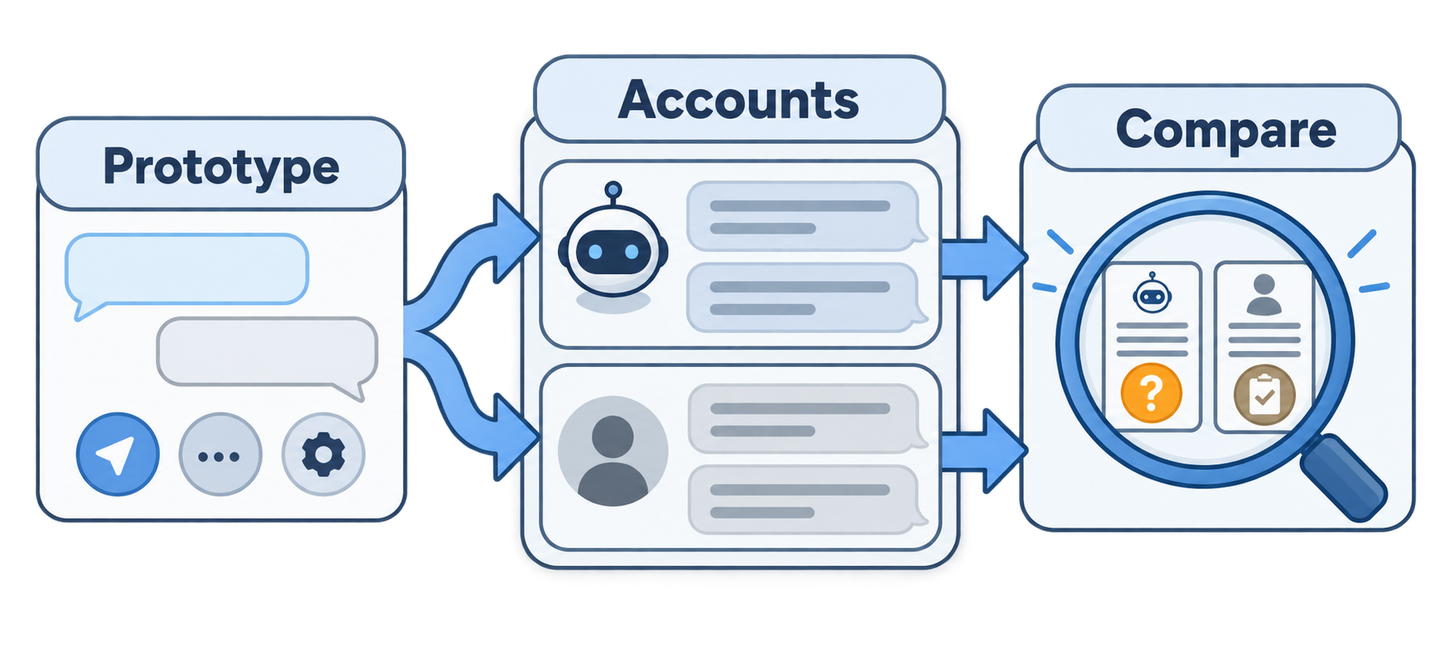
The simulation has its own interaction conditions
Agentic H-CI constructs language-model player agents with profiles and structured research protocols. The source explicitly describes its anthropomorphic research language as an approximation: programmed surveys and interviews are not identical to the human processes they resemble.[1]
The prototype centers on text-based NPC interaction and a virtual action list. Human participants use a web interface; agents receive context, rules and instructions through prompts. The prototype does not implement the full visual effects or underlying mechanics of the source games it references. Feedback from this setting cannot establish how someone navigates or feels inside a complete game.[1]
The researchers compare local participants, crowdsourced players, profiled agents and a generic language-model user. Three game developers judge study efficiency, behavior and insight fidelity, and helpfulness. Local participants receive the highest fidelity and insight-quality assessments, while agentic players offer a favorable time and cost tradeoff within this early prototype comparison. Exposure differs: simulated participants interact with all eight NPCs, while humans choose one because of time constraints. That difference belongs in the interpretation of breadth and efficiency.[1]
Use a criticism as a question
Suppose a simulated player says an NPC's offer is confusing. That can prompt a useful inspection of the offer's wording and available next action. It does not establish that real players encountered confusion, or identify its cause. The simulation may reflect a prompt convention, an omitted interface detail or a design problem a person would also notice.
An expert's helpfulness rating answers whether the output can inform work under the evaluation conditions. It does not convert that output into an independent participant account. Retain disagreements with human observations rather than treating a coherent synthetic explanation as confirmation.
Applying this to your game
Choose one exchange and one decision synthetic feedback could affect. If you have model access, generate a bounded set of critiques with the exact prototype context recorded. Compare them with an authored review checklist or existing human feedback where available. Label every account by its origin.
Follow a proposed criticism into a reversible edit, such as clarifying what accepting an offer commits. Inspect whether the interface actually supports the action described in the critique. This is a proposed workflow, not our replication of Agentic H-CI or evidence that people prefer the edited scene.
This first pass postpones a large profile library. Preparing context, sorting redundant claims and investigating plausible errors still take time; those costs should count alongside model calls. A colleague's review may identify the same issue more directly. Preserve the human validation needed for consequential claims about access, comfort or enjoyment.
If synthetic comments merely repeat the supplied description, reduce the simulation or use the checklist. If they expose a consequential inconsistency missed in the smaller review, inspect that case and revise the prototype. We have not recruited participants or run the source framework. Its contribution is a bounded comparison of research aids, with fidelity and practical usefulness remaining separate from inexpensive output.
Sources
- Free Lunch for User Experience: Crowdsourcing Agents for Scalable User Studies
paper · 2505.22981v1 (2025-05-29; arxiv_v1_submission_date) · Source accessed: