A test agent can recommend a sensible move and still fail to issue it on the current board. Towards LLM-Based Automatic Playtest follows screenshots into a structured board, model-selected swaps and executable device inputs. That chain helps developers locate failures before crediting an agent with exploring the game.

Preserve the board through each translation
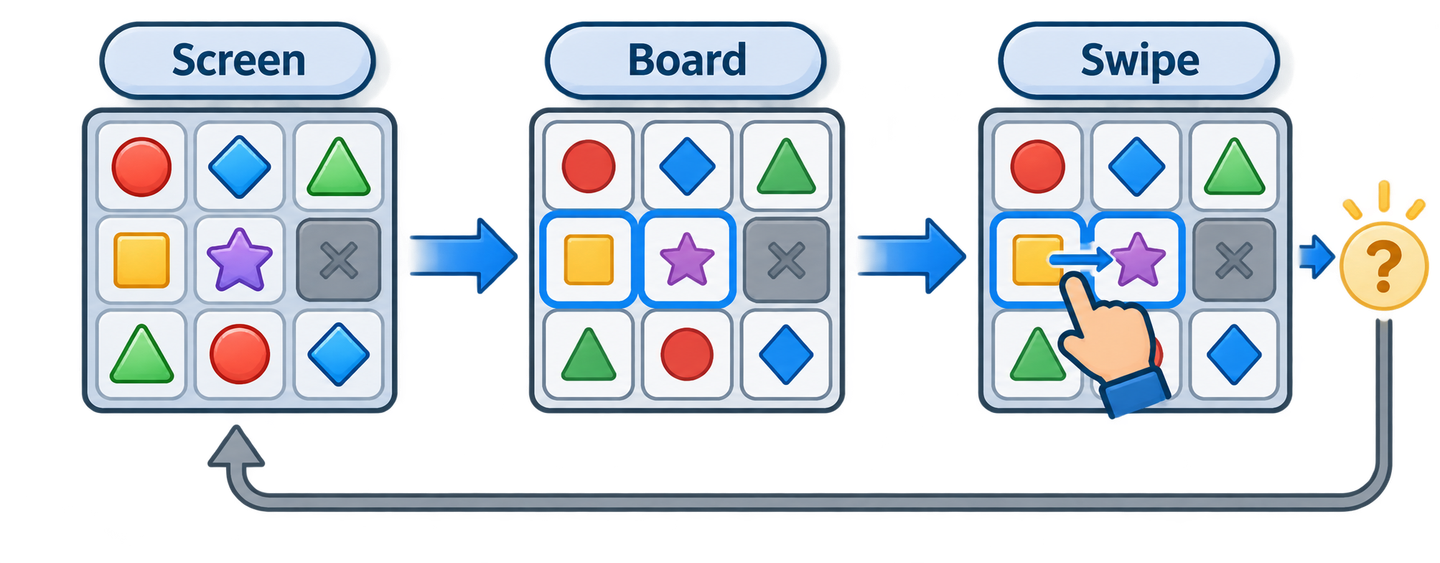
The LAP method captures Android screenshots and uses OpenCV to recognize specified candy icons and their coordinates. It converts the board into a matrix with numerical representations for candy types, including special and blocked cells. Swapping adjacent candies becomes an exchange between matrix positions.[1]
Prompts supply game context, objectives, rules and example strategies. The model's proposed coordinates are then translated into screen coordinates and ADB swipe commands. A structured representation makes the proposed move inspectable, but every translation can introduce an error.[1]
A stale screenshot, an unrecognized icon or an incorrect coordinate map can cause the game to receive a different move from the one the model reasoned about. Retrying the same recommendation may repeat that failure while producing an increasingly confident explanation.
Reaching a level is part of coverage
The paper evaluates LAP on a particular match-3 game using line coverage, game score, level progress and crash triggering. It reports improved exploration against its tested baselines and crashes during the experiment. Those observations concern the tested application and configurations.[1]
Score and level progress help indicate whether a tool reaches additional scenarios. They cannot show that every rule interaction or defect was exercised. Likewise, a crash count does not identify distinct root causes without further diagnosis. Coverage needs the code version and workload that produced it.
Applying this to your game
Start with a small set of boards containing ordinary pieces, a special piece and a blocked cell. If device control and instrumentation are available, compare the screenshot, extracted matrix, suggested legal swap and observed result. Keep those records together so a failed action can be assigned to recognition, choice, translation or execution.
Reject an invalid or stale move before it changes the game, then recover through a fresh observation or an authored legal move. This is a proposed integration boundary; we have not run LAP or reproduced the reported crashes. A deterministic solver or scripted board test is a useful alternative when the legal cases are small and known.
This first comparison postpones unattended testing of many levels. Maintaining icon recognition, coordinates, legal-action checks and crash reproduction takes work that also could fund regression cases. Measure useful coverage and recovery on the actual tested build rather than counting fluent move suggestions.
If scripted tests already exercise the consequential states, keep them. If the model-guided route reaches relevant cases those scripts miss and the input chain remains dependable, expand that route while preserving reproducible failures. The result worth keeping is an action and its observed consequence, including the evidence needed to replay a defect.
Sources
- Towards LLM-Based Automatic Playtest
paper · 2507.09490v1 (2025-07-13; arxiv_v1_submission_date) · Source accessed: