A designer might ask for a long route and a particular enemy distribution in the same level. Satisfying one property while silently dropping the other makes the request difficult to use. Multi-Objective Instruction-Aware Representation Learning studies how an instructed procedural generator can represent several defined objectives together.

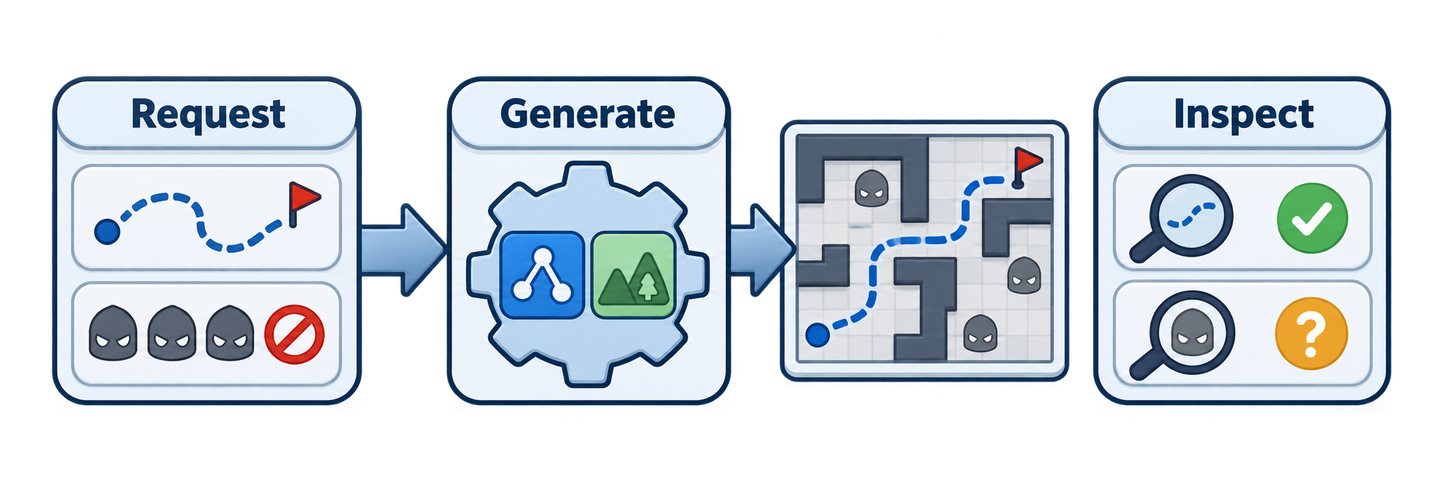
Keep the objectives distinguishable
MIPCGRL embeds a natural-language instruction and refines it into task-specific representations. A multi-label classifier estimates which predefined tasks are active, while a multi-head regression component predicts task fitness. The representation then conditions reinforcement-learning level generation.[1]
The study's tasks concern a bounded 2D level setting: region count, maximum path length, wall count, bat count and bat distribution. These defined objectives have evaluation functions. The architecture does not establish unrestricted understanding of every possible request about atmosphere, difficulty or narrative meaning.[1]
Its experiments compare single and combined objectives against instructed and scalar-conditioned baselines. Reported gains vary by task combination, and the ablations examine the contributions of classification and regression. A favorable average cannot tell a designer which constraint a particular output missed.[1]
A constraint still needs a design purpose
Consider an illustrative request for a longer route with fewer encounters. Path length and enemy count can be measured, but the resulting walk could still be tedious or confusing. The numerical properties specify part of the output; the intended pacing remains a design question.
When constraints conflict, a useful tool should make the tradeoff inspectable. A generator that optimizes a combined reward can favor one property enough to conceal failure on another. Preserve the requested components and their separate checks instead of letting the overall score become the only explanation.
Applying this to your game
Choose two properties your level representation can actually measure. Generate or construct examples for each request alone and for their combination. If an implementation is accessible, inspect each component's satisfaction and the playable consequence. Otherwise, a small authored set or parameterized generator can establish the same comparison without pretending to reproduce MIPCGRL.
Include an awkward combination and a revised request. Check whether the result changes the intended property while retaining the other one. If a property cannot be represented by the existing evaluation function, leave it as a design judgment requiring inspection rather than assigning it an invented numerical target.
This first pass postpones an open-ended instruction interface. Task definitions, training, evaluation functions and reviewing failed combinations all cost work. Simple sliders may communicate the supported range more directly; natural language earns its place when composing the defined properties makes the designer's work easier without hiding the range.
If the tool keeps returning technically valid but unrewarding routes, revise the objective or retain authored examples. If composition supports useful variations the smaller generator cannot express, expand those combinations. We have not trained the model or evaluated its levels with players. The paper helps keep several requested properties visible through generation, while the designer still determines why those properties matter in play.
Sources
- Multi-Objective Instruction-Aware Representation Learning in Procedural Content Generation RL
paper · 2508.09193v1 (2025-08-08; arxiv_v1_submission_date) · Source accessed: