A cooperation study can change when the same partner is introduced with a different identity label. AI's assigned gender affects human-AI cooperation examines this issue through an online Prisoner's Dilemma. Its controlled labels give game researchers a reason to record what participants are told before interpreting their choices as a response to agent behavior.

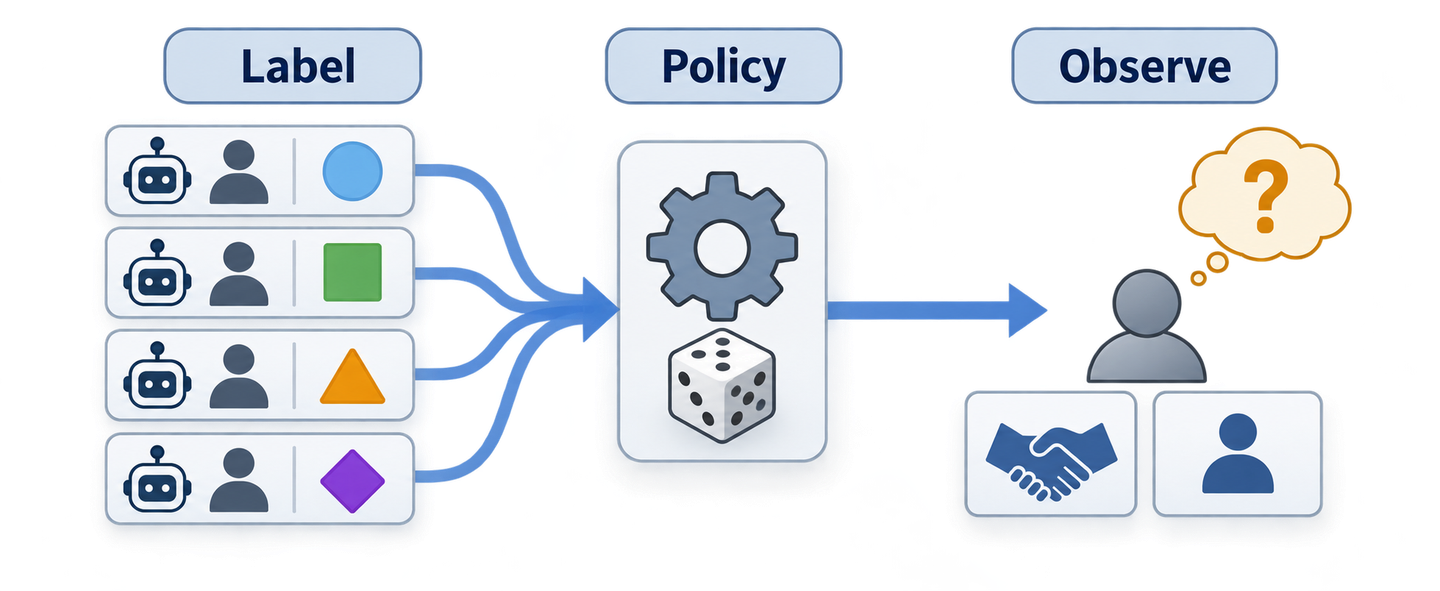
The label is part of the condition
The study assigns partners human or AI labels together with gender labels: male, female, non-binary/fluid or no gender identification. Participants choose whether to cooperate and predict the partner's choice. The partner's decision is sampled uniformly rather than generated by a differently capable agent in each label condition.[1]
This design isolates the participant's response to the presented conditions from differences in partner performance. The paper reports label-related patterns in cooperation and expectations within its sample and payoff rules. It does not establish that a gender label reliably predicts cooperation for every audience or culture.[1]
The assigned labels describe what participants see. They do not identify a machine's actual gender, demonstrate a natural personality or explain the individual motive behind every decision. The researchers use choices together with predicted partner behavior to interpret cooperation and defection; those operational distinctions belong to this experiment.[1]
A presentation change can become a hidden comparison
In a game prototype, a name, portrait or voice may alter expectations before a character acts. If one agent version also receives a different presentation, a preference for that version could reflect the introduction, the behavior or both.
That does not make presentation irrelevant. It means the team must decide whether it wants to study the whole character as presented or isolate one behavioral change. The question determines which parts should remain constant and which should vary deliberately.
Applying this to your game
Record the information participants receive about a partner, alongside its supported actions and actual behavior. For a narrow behavior comparison, keep relevant presentation conditions constant where feasible. For a presentation question, vary the intended label while maintaining the behavioral policy, and retain expectations as evidence distinct from action outcomes.
A small authored policy can make that separation easier than a freely improvising agent. This is a proposed study design, not an experiment we have conducted. Do not use the paper's labels as a recipe for making players more trusting or as a stereotype to assign to a character.
This first pass postpones a large character-condition matrix. Preparing comparable materials, checking what participants understood and analyzing differing expectations take work. A direct prototype revision can be appropriate while its causal explanation remains open; it should not be reported as an isolated label effect.
If people understood a label differently from the intended condition, revise the materials or the interpretation. If a controlled comparison reveals a relevant presentation effect, keep its population and setting attached to the finding. We have not recruited participants or run the source game. The practical lesson is to include a character's introduction in the evidence about how people respond to it.
Sources
- AI's assigned gender affects human-AI cooperation
paper · 2412.05214v1 (2024-12-06; arxiv_v1_submission_date) · Source accessed: