An update to one tool can affect a sequence of actions beyond that tool's immediate use. Replaying every old test is costly, but testing only the named change can miss dependent consequences. Knowledge Graph-enhanced Large Language Model for Incremental Game PlayTesting uses structured game relationships to focus a bounded testing route after an update.

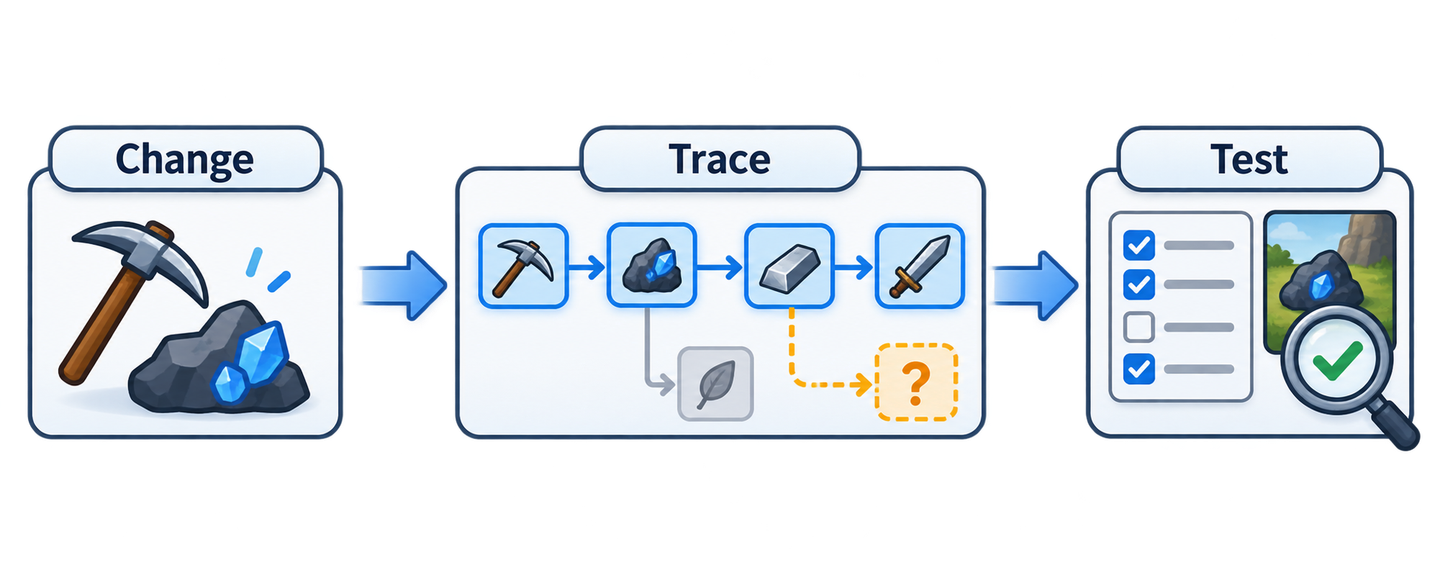
Trace a change through dependencies
KLPEG extracts changed elements, relations or actions from update logs and synchronizes a knowledge graph. Bounded multi-hop traversal identifies potentially affected content, which is matched to tasks and used to generate test objectives and action sequences.[1]
The paper's illustrative mining change connects a new tool capability to ore, ingots and crafted equipment. The useful relation is that testing the first action alone may not exercise the later dependent task. Graph-guided test selection makes that reasoning inspectable.[1]
The evaluation uses Overcooked and Minecraft settings with simulated updates and injected bugs. Its coverage and detection results belong to those environments, changes and comparisons. They do not establish complete regression coverage for a live service or identify every dependency a different game's update might affect.[1]
Missing knowledge creates a testing boundary
The source explicitly notes that missing mechanisms, such as hidden task branches, can make impact analysis incomplete. A focused route can accurately follow the graph while overlooking a relationship that was never entered.[1]
For a developer, a useful report should therefore preserve both the tested path and the knowledge that selected it. A claim that an update is safe needs the relevant gameplay obligations, not only evidence that the generated sequence finished.
Applying this to your game
Choose one small change and write its direct dependency path from input to committed consequence. Compare an authored regression case with a graph-guided proposal if a working implementation is accessible. Keep the update, graph revision, selected task, issued actions and observed state changes together. This is a proposed comparison, not a KLPEG reproduction.
Include a known dependency omitted from a deliberately limited graph. Check whether the resulting report exposes its coverage boundary or silently declares the update clear. Keep a deterministic baseline for the critical consequence so a generation failure does not remove the only supported check.
This first pass postpones a comprehensive game knowledge graph. Extracting relationships, correcting missing edges and maintaining test execution compete with adding more test objectives. A small explicit dependency table may be sufficient when the affected mechanics are few and known.
If the graph adds no useful path beyond the authored case, keep the case. If it reveals a consequential indirect relation and the test can reliably exercise it, extend that specific dependency coverage. We have not executed KLPEG or reproduced its timing and detection results. Its mechanism helps explain why a test was selected, while the completeness of that explanation remains a separate responsibility.
Sources
- Knowledge Graph-enhanced Large Language Model for Incremental Game PlayTesting
paper · 2511.02534v1 (2025-11-04; arxiv_v1_submission_date) · Source accessed: