A station generator places a locked checkpoint before it knows where the side corridors will end. Later it puts the access card beyond that checkpoint. Each room can look plausible while the proposed infiltration has already become impossible. Moving the card into the entrance fixes that particular failure, but it also removes the detour the designer wanted the player to consider.
For this proposed station, finish the corridor layout before assigning its security. Then inspect the available branches and place a reachable card on a detour. That ordering gives the placement rule information it lacked while rooms were still being added. It does not guarantee an interesting infiltration.

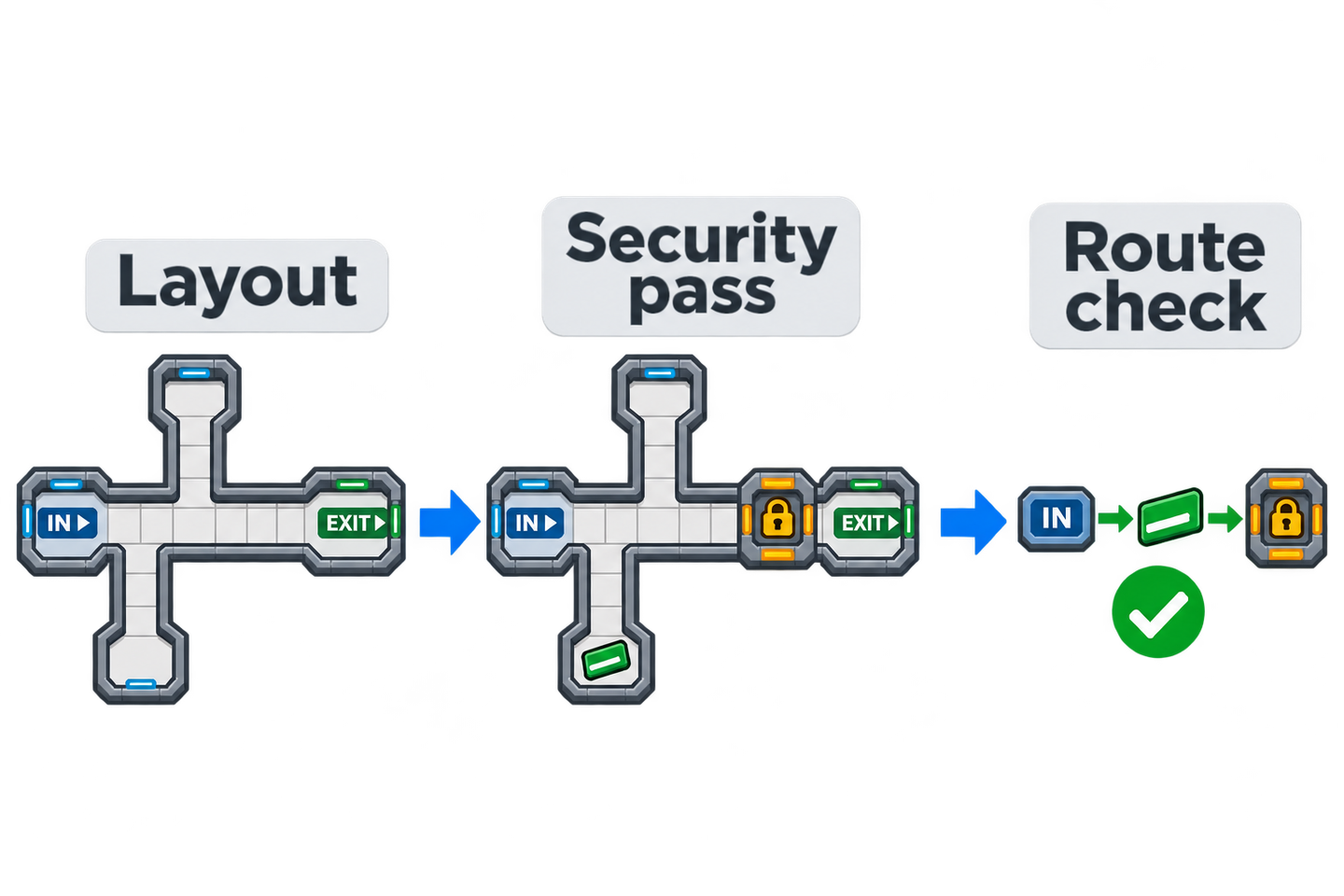
In his 2015 development post, Tom Francis describes separating security placement from ship geometry in Heat Signature. The layout process could establish a long route before adding branches, which made simultaneous key placement awkward. His later pass uses dead ends and recorded predecessor sectors to assign reusable security-level cards and doors. The account reports a working development algorithm and leaves hazards and functional ship modules for subsequent checks.[1]
Our station has a simpler design promise: before the checkpoint, offer two reachable detours, either of which contains the required reusable card. One is exposed to a patrol; the other takes longer. These are invented design conditions, not descriptions of Francis’s shipped game. If the layout contains only one suitable branch, the security pass should return that specific shortfall rather than invent a second option by putting a card behind its own lock.
Build the first placement pass around an inspectable route record. For each candidate card location, ask whether the entrance can reach it while the target checkpoint remains closed. Include the other doors and starting inventory in that check. A room being on the entrance side in a drawing is insufficient if another locked passage blocks it. Consumable keys or changing door states would require a different state model.
Keep the placement result and its reason with the seed. A designer needs to see which branches were available, which were excluded, and which security rule chose the final pair. This adds a placement pass, a route check and a small debugging view. The team must also author the patrol and longer-route consequences that make the alternatives distinct. A cheaper prototype can use one fixed layout with two authored detours while giving up layout variation.
Before decorating more generated stations, propose checks for no eligible dead end, one eligible branch, two branches, and a door whose key is behind another lock. Save the failed seeds. Confirm that the system rejects the unsupported two-detour promise and that the authored fallback preserves the entrance and objective. These checks have not been executed here.
After a local route check passes, observe whether a player notices the alternatives and can explain why they chose one. If both detours feel interchangeable, changing the key algorithm may buy little. Rework the patrol, time cost or information available before the fork. A security pass can make a route possible; the encounter still has to give the player a reason to choose it.
Sources
- Generating Locks And Keys In Heat Signature’s Ships
article · Historical developer post, 2015-11-28; authored body read 2026-11-09 · Source accessed: