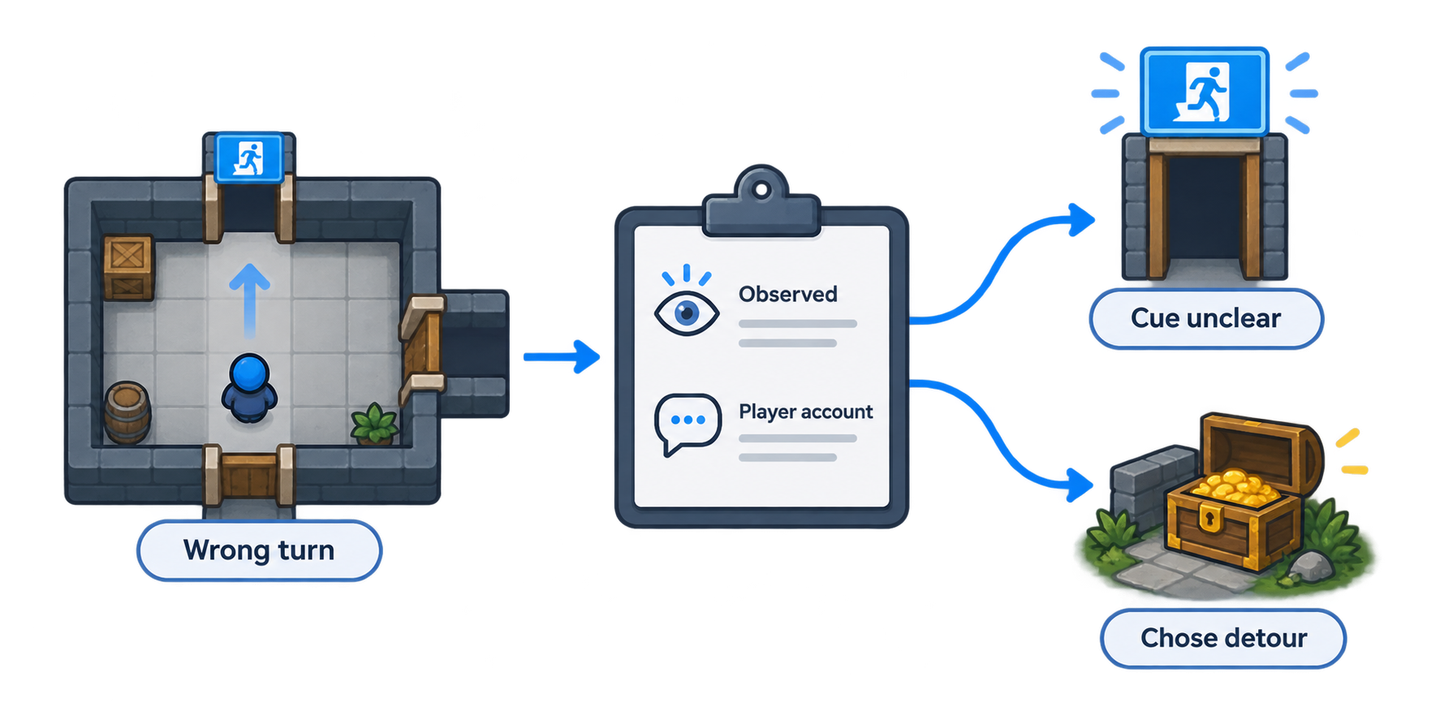
A player walks past the exit and enters a side room. Before making the exit brighter, decide what you need to know. They may not have noticed it. They may have seen it without understanding where it leads. They may understand it perfectly and want to search the side room first. Those explanations suggest different work.
Steve Bromley’s study-design guide connects research objectives with tasks, methods and planned records. Its navigation example distinguishes missing the route, misunderstanding it and deliberately going elsewhere. The guide also warns that task wording can reveal information the game has not communicated. It recommends understanding the designer’s intended experience before judging an observed result. This is practitioner guidance for planning research, not a controlled comparison of navigation fixes.[1]

Name the decision before the session
Consider a hypothetical exploration game whose next build must either clarify the exit cue or keep it as it is. The intended experience allows optional searching, but players should be able to identify the main route when they want to leave. Write that distinction into the study plan. Time spent away from the exit cannot by itself tell you whether the cue supports that intention.
Begin at a point that gives the player the knowledge they would ordinarily have. Record any substituted briefing or missing earlier section. If you teach the exit symbol during setup, you have changed what this session can reveal about discovering that symbol. If earlier teaching is assumed but absent, a failure may concern the session setup. Keep those conditions beside the observation.
Applying this to your game
Use a broad invitation to play the section, then observe the exit encounter without naming the correct doorway. Record where the player looked or moved, what they tried, what happened next and any help the moderator supplied. A route trace can locate the moment for discussion; it cannot establish what the player noticed or intended.
At an appropriate pause, ask what the player was trying to do and what they expected the available routes to lead to. Keep their account beside the observed actions. Asking too early can interrupt exploration or draw attention to the exit, so record the timing of the question and treat later behavior as potentially influenced. A retrospective account can also be incomplete. Neither record alone guarantees the explanation.
Before recruiting, agree who can make the cue change and reserve time to inspect the relevant moments with that person. For this bounded pass, postpone a broad balance survey and focus on the navigation decision. Prepare consent and data handling through the team’s existing research process. If the available build cannot present the intended route, repair or document that limitation before interpreting the session as evidence about the cue.
Let the explanation change the work
If the observed moment and the player’s account suggest a missed cue, a reversible visibility change becomes a candidate for another check. If the player identifies the exit and explains a deliberate search, brighter signage may leave the relevant behavior unchanged. The team might instead inspect whether optional searching fits its intended pace. Preserve disagreement between the account and the action; do not force every wrong turn into one diagnosis.
Try the smallest supported change while keeping the previous cue available. A later comparison should retain the task and starting conditions while documenting what changed. Repeated exposure teaches the route, so improvement by someone who already played the room cannot establish that new players will discover it. A small observation can motivate a local repair without supplying a population-wide rate or proving its causal effect.
This example remains a proposed study, with no recruited players, measured outcomes or tested cue. Its immediate deliverable is a decision the team can revisit, the observations that might change it and time reserved to act. If the deadline leaves no room for a new study, state the uncertainty and choose a reversible change rather than presenting a guess as a finding.
Sources
- Designing a games user research study
article · Steve Bromley; author-site book extract; updated January 1, 2021; live October 16, 2026 · Source accessed: