Several players reach a station where a remote service generates a side mission. The service has been failing, so the game offers an existing authored mission instead. When a recovery interval ends, every station asks the service to try again. An outage can become another burst of requests before anyone knows whether generation is working.
Martin Fowler’s circuit-breaker explanation separates normal calls, an open state that refuses them, and a half-open state that allows a trial after an interval. A successful trial can reset the breaker; failure restarts the wait. He also stresses that callers need a response to refusal. His Ruby example explains the pattern, rather than supplying the concurrency and game-state handling this station needs.[1]
Give the trial one owner
For the proposed station service, put recovery admission at the boundary shared by callers of the failing dependency. While that boundary is open, new encounters use their supported authored route. After the chosen interval, allow a small, explicit number of trials. Other callers continue along the supported route instead of joining an unbounded recovery queue.
An engineer must make trial admission safe when requests arrive together. A separate breaker in every station or process can still let many trials through to the same service. Identify which component owns the shared allowance and what happens when that component restarts. If the service already provides a suitable recovery gate, inspect and reuse it before adding another.

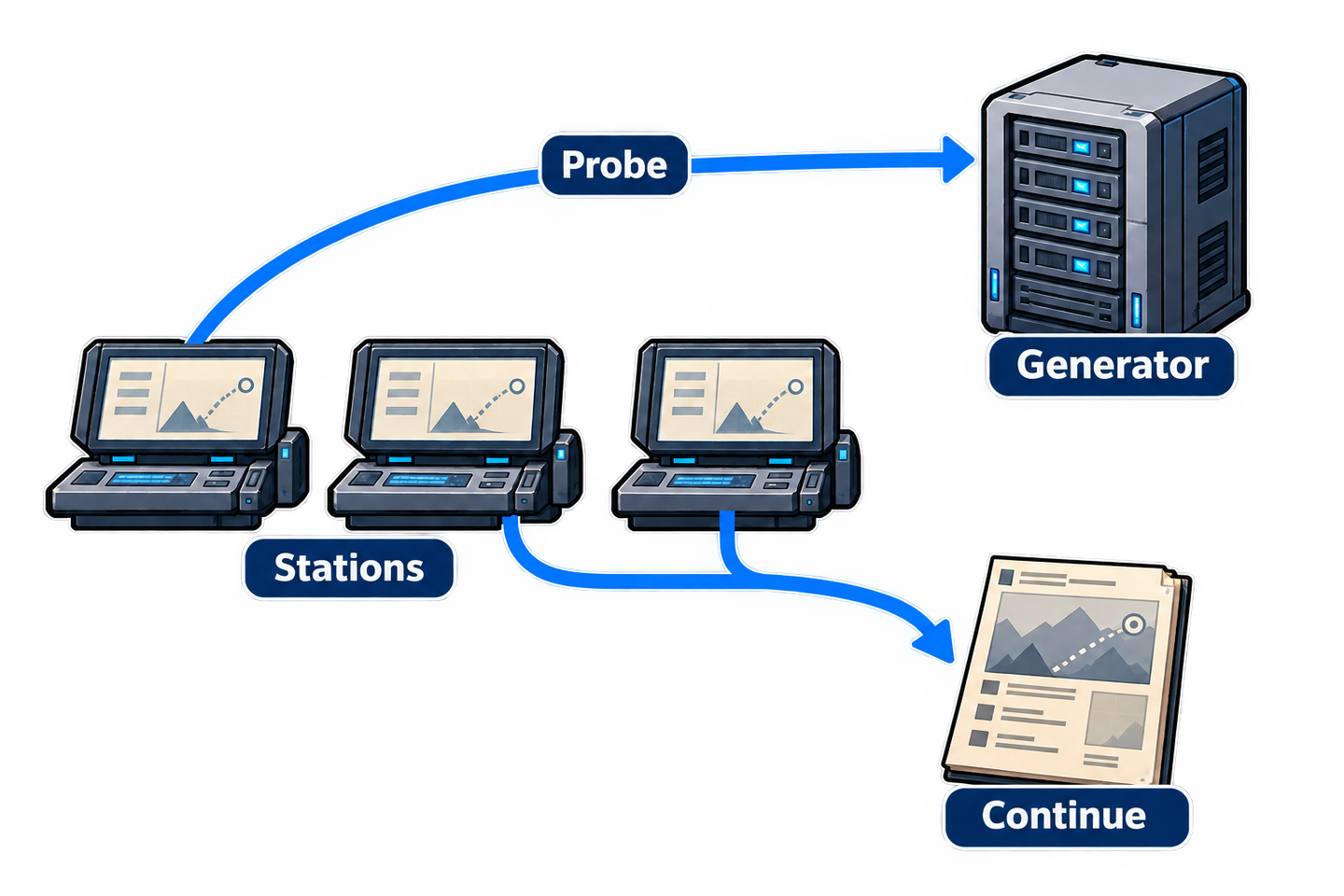
Choose the interval and trial allowance from the actual dependency and workload. This article supplies no suitable threshold. Keep the scope narrow enough that one failing mission generator does not disable unrelated services. Decide which failures count toward the breaker: an invalid player input should follow normal validation, while a dependency timeout may justify containment.
Applying this to your game
Use one existing station and a controlled test service. Propose a sequence that fails ordinary requests, refuses new generation, and then makes several callers eligible for recovery together. Inspect how many calls actually reach the service, what the other callers can do, and whether a failed trial returns to refusal. Repeat around a restart. These are proposed checks, with no service or game executed here.
A transport success is only part of recovery. Check that the returned mission meets the current game contract before offering it: its references exist, its requirements match the current state, and it has an ending the game can support. Keep the player’s selected authored mission if the trial finishes after they have committed to it. A recovery probe must not replace an accepted mission or award another reward.
Fund this as one boundary, its shared admission check and the authored continuation already used during the outage. Defer wider automatic recovery until that path works. The continuation needs content and maintenance, and shared coordination adds its own failure modes. If the team cannot support those costs, a deliberate operator-controlled reopening can be a smaller first release.
Change the proposal if the service already limits recovery traffic, if a shared gate becomes less reliable than the dependency, or if the authored mission removes the reason players came to the station. Observe separately whether players understand the available choice. Keep a way to return the boundary to refusal while preserving accepted missions; passing a trial establishes a bounded recovery observation, not lasting service health.
Sources
- Circuit Breaker
article · First-party engineering article, 2014-03-06; live text accessed 2026-11-01 · Source accessed: