Your player offers a rare key to finish a quest. The server accepts it, but the confirmation never reaches the game. A retry button can help only if the next request can recover that same action. Treating the timeout as proof of failure risks consuming another item or applying a reward twice.
In his AWS account of timeouts and retries, Marc Brooker explains that a missing response does not establish that a remote operation had no effects. He recommends making operations safe to repeat when repeated effects would be harmful. He also describes how retries can add load during failures, and why waiting between attempts does not remove the need to limit them. These are service-engineering lessons, not evidence from a quest system.[1]

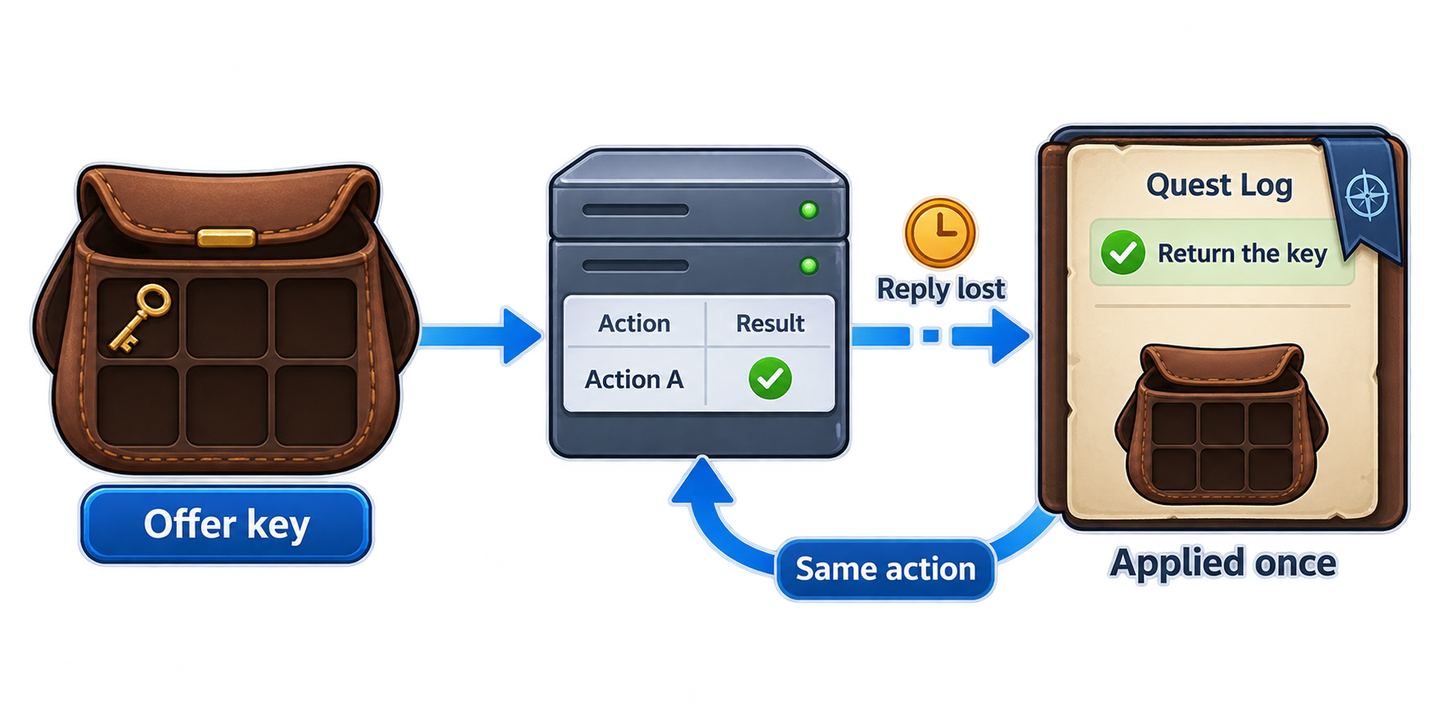
Give the action a recoverable identity
For a proposed quest implementation, create an action identity before the first submission. Retain it while the outcome is unresolved. The authoritative service should associate that identity with the player, the offered item, the quest transition and the resulting response. Reusing the identity with different inputs must fail rather than silently attaching a different action to the old result.
The difficult work sits at the commit boundary. The item change, quest change and recorded outcome need a consistent way to survive interruption. A check for an existing identity followed by an unrelated write leaves a race between simultaneous requests. Ask the engineer who owns persistence how that boundary is enforced before putting automatic retries in front of it. A label saying pending cannot supply the missing storage guarantee.
Applying this to your game
Start with one quest action in an existing test environment. Propose a controlled case where the service commits the action and its reply is withheld. Reconnect with the same identity and inspect the authoritative inventory, quest state and recorded result. Then try two simultaneous copies and a copy with a changed item. These checks are a proposal; no game or service was executed for this article.
Keep a visible unresolved state while checking. Avoid telling the player that the offering failed until the service can establish that result. A manual refresh can be a valid first release if it reads the authoritative outcome without starting a second offering. If the service cannot resolve an uncertain commit, preserve the identity and route the case to a supported recovery procedure; repeated blind submission is not recovery.
Reserve the next integration pass for this one mutation, its stored outcome, interruption checks and the interface that explains uncertainty. Give up automatic retries for other quest actions during that pass. Persistence changes require migration and retention decisions: an identity forgotten too soon can make an old request look new. The team must choose the supported reconnect window and reject or reconcile older unresolved requests deliberately.
Only after the mutation is safe to repeat should the client add bounded retry timing. Keep one component responsible for retries, fit its attempt limit inside the interaction budget, and stop when the result becomes uncertain beyond the supported recovery path. Choose timing from measurements of the actual dependency; Brooker’s service examples do not provide suitable latency values for your game.[1]
Keep the smaller route playable
This plan changes if an existing engine service already supplies the required identity and commit contract. Reuse and verify that behavior instead of adding a second ledger. It also changes if persistence work cannot fit before release: keep the existing supported quest route and defer the new remote offering. Disabling a button after a click can reduce accidental input, but it cannot settle what happened during a disconnect.
A successful recovery check establishes a bounded state transition. Observe separately whether players understand the delay and trust the recovered result. Keep the previous client path and a deployment plan compatible with outstanding actions so reverting the interface does not abandon an offering already committed. The useful promise is a recoverable player action, with a continuation the team can actually support.
Sources
- Timeouts, retries, and backoff with jitter
article · Marc Brooker; AWS Builder Center; published and modified December 5, 2019; live October 16, 2026 · Source accessed: