A generated cave gives a player two tempting routes around a visible treasure. The designer saves that seed, adjusts the generator, and searches for another cave with the same appeal. That can be a useful way to explore a design. It leaves another question unanswered: what happens when a player presses New Game and receives a result the designer never selected?
Michael Cook’s tutorial distinguishes what a content format can represent from what a particular generator can produce. Its platformer examples also compare broader output ranges with more controlled ones. A generator can include an interesting level among its possible outputs while making such a result unlikely. The tutorial motivates looking beyond a showcase; it does not validate the comparison proposed below.[1]
Keep the ordinary draws
For a proposed cave prototype, write down the experience you want before changing a parameter. Perhaps the player should see a reachable reward and choose between a short exposed route and a longer sheltered one. Record those separately. A connected cave may offer no meaningful route choice, and two drawn paths may feel identical once played.
Collect a comparison batch without discarding results that look dull. Retain each seed, generator version, configuration and output, including errors. Use the same selection procedure for the original and changed configurations, and decide the batch size before inspecting the results. A small batch can expose a failure worth investigating; it cannot establish a reliable rare-failure rate.

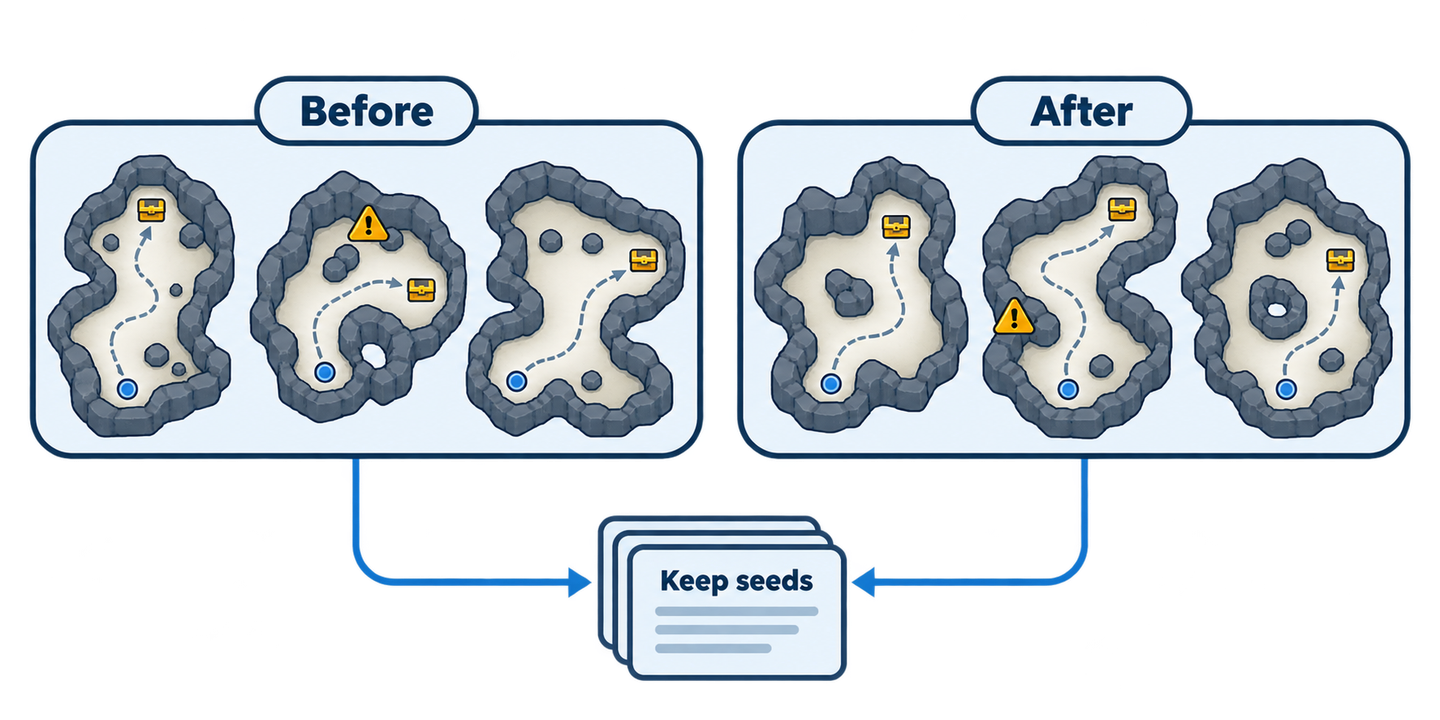
If the generator supports reproducible seeds, paired seeds can help trace what a parameter changed. They do not guarantee equivalent challenges when the algorithm consumes randomness differently. Keep a separately chosen, unfiltered sample for judging routine output. If results change with runtime state, save that state or narrow the reproducibility claim.
Applying this to your game
Have the level designer mark whether each cave presents the intended route tradeoff, and have the developer check the movement constraints the current character actually uses. Keep a cave that fails either check in the record. Then inspect a few examples in play: a visible detour may be mechanically valid yet too obscure for a player to recognize. Neither a path checker nor a screenshot can settle that question alone.
Reserve the next tuning pass for this comparison and one change that addresses a recurring failure. Defer more decorative variants until the team knows what the change costs. Record generation time, rejected attempts and manual repair effort if those affect delivery. Filtering can remove a bad layout while increasing the time or work required to supply the next one. No measurements were collected for this article.
Keep exceptional seeds as examples of what to preserve, alongside the ordinary batch. A designer may deliberately choose a small authored set for release, in which case the relevant work becomes curating and testing that set. If players receive unrestricted new draws, selected examples cannot describe the whole experience.
Reconsider the change if it makes routine caves less usable, or if the new variety gives players choices they value enough to justify extra testing. Keep the old configuration and retained seeds so the team can compare the decision again. The next observation should answer a concrete question about play, such as whether the two routes lead to different plans, before the team expands the generator further.
Sources
- Tutorial: Generative & Possibility Space
article · First-party tutorial, posted 2019-01-31; live text accessed 2026-11-01 · Source accessed: