A player confirms a purchase at a station. At the same moment, nearby terminals request fresh generated descriptions. Both paths need a shared backend. If the optional descriptions occupy its available work slots, the confirmation can sit behind text the player never asked to wait for. An authored description on screen does little to repair a purchase whose outcome is still unknown.
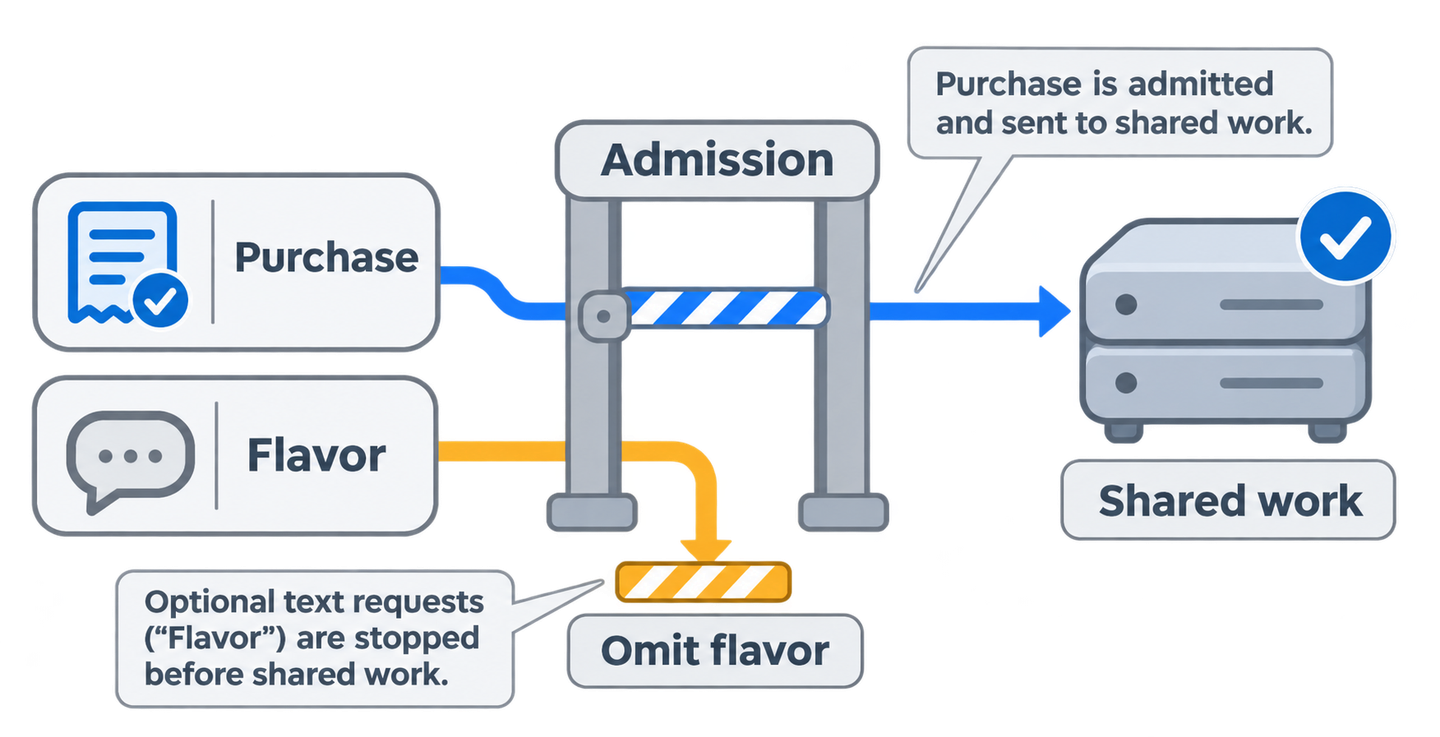
Decide which action the game has promised to finish before adding another retry. In this proposed station, purchase confirmation has priority and generated flavor may be omitted. The purchase needs its own transaction and reconciliation behavior. Assigning priority cannot prove that a charge happened once or make a lost response safe to repeat.

The Google SRE chapter Handling Overload describes carrying request criticality through dependent calls and rejecting lower-criticality traffic earlier under load. It treats criticality separately from latency requirements: optional work may still need a quick response. The chapter also warns that retries at several layers can multiply traffic. These practices concern service resource protection; they do not establish which interaction a game should value.[1]
For the station, attach a small, trusted class to each server-side request: committed purchase or optional description. Keep that class when the request reaches shared work. If an intermediary labels every downstream call urgent, it defeats the distinction. Do not let clients choose unrestricted priority, and do not assume a third-party provider honors a label that only exists in your own request format.
Start with admission to the shared work the team controls. Under a measured capacity limit, stop admitting optional generation before it consumes resources reserved for confirmations. If the dependency cannot isolate the work, avoid sending the optional request there during pressure. Use the existing authored description immediately. Dropped flavor should not build an unbounded queue that floods the backend when capacity returns.
The cost is more than an enum. Someone must trace the labels across calls, choose an admission policy, record rejected work and verify that the required path keeps capacity. Priority alone can starve optional work indefinitely or fail when required traffic itself exceeds capacity. A smaller release can disable live flavor altogether and keep authored text until the team can support the shared path.
Use a controlled service to propose a burst of optional description requests while confirming one purchase. Inspect which calls reached the shared dependency, how long confirmation waited, and what the player saw. Then test overload in required traffic itself, missing labels, a timeout after commitment, and capacity recovery. The timeout case must reconcile the original purchase before offering another attempt. No service or game tests were run for this article.
If confirmation still slows because both paths contend elsewhere, trace that resource before adding finer priority levels. If flavor is central to what players came to do, reconsider calling it optional and budget a supported version of it. The engineering classification should follow the game’s promise and actual resource observations, rather than quietly deciding that promise for the design team.
Sources
- Handling Overload
documentation · Google SRE book chapter by Alejandro Forero Cuervo; scoped prose read 2026-11-09 · Source accessed: