Google DeepMind’s August 2025 Genie 3 announcement reports navigation at 24 frames per second and 720p. It describes consistency over minutes, while also noting limited directly available actions and interaction duration. Its text-driven world events can alter the environment, but those changes are not necessarily actions the agent itself performs.[1]
For a designer, that leaves a practical question: can a player carry out the action that makes the proposed game work? Frame rate describes one part of the experience. It does not, on its own, answer whether a particular command is available or whether its consequence will persist. This is an interpretation of the announcement, not a measured result.

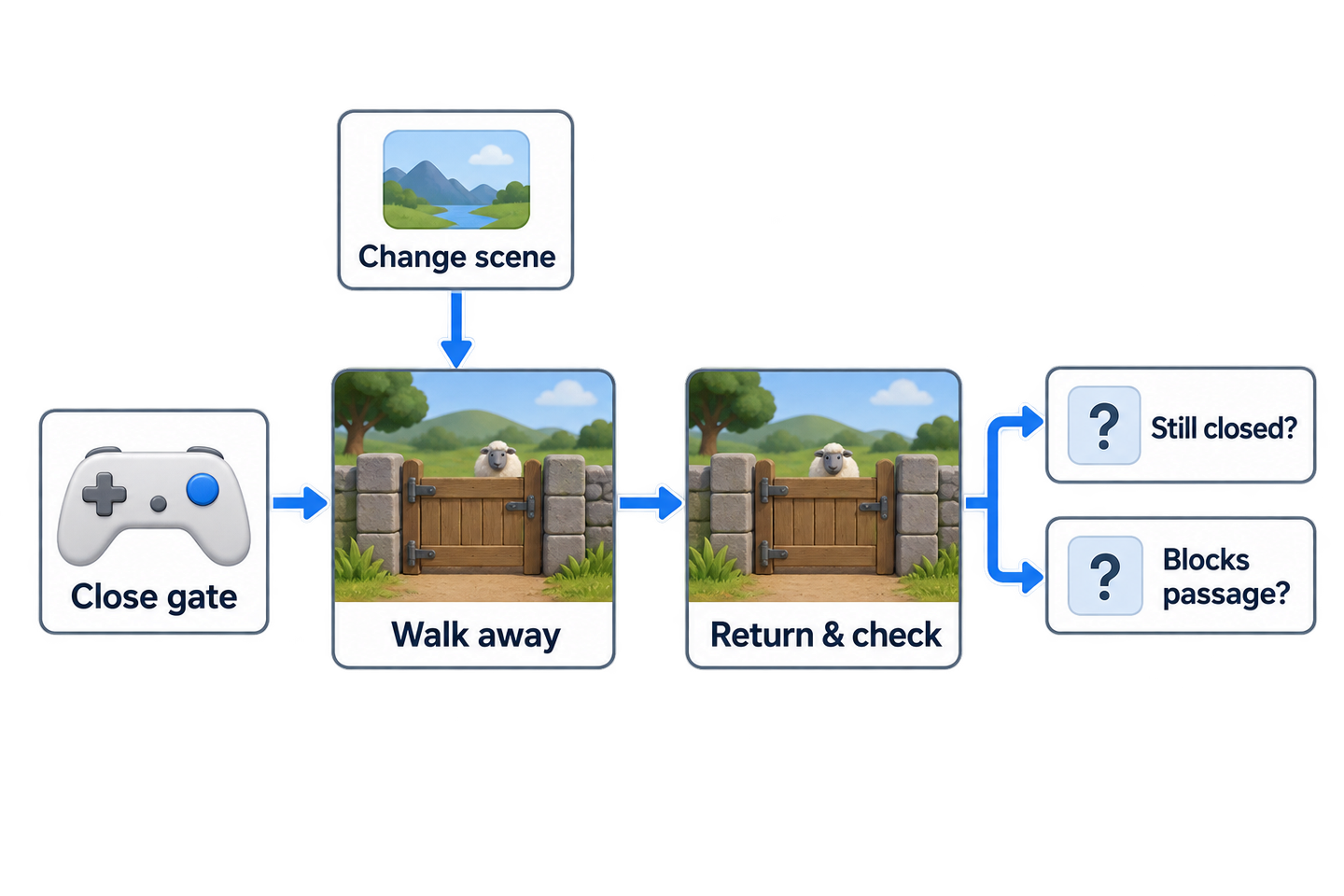
Name the action before judging the scene
Imagine a prototype in which the player must close a gate to keep an animal inside. This is a hypothetical example, not a Genie 3 demonstration. Write down how the player selects the gate, issues the command and recognizes success. Then distinguish a direct player command from a text prompt that simply changes the scene to show a closed gate.
Next, specify what should remain true. After closing the gate, the player walks away and returns. The test should inspect the gate and the animal’s ability to cross it. A similar-looking image is only one observation; the intended rule is that a closed gate prevents passage. Record that rule before judging the result.
DeepMind’s announcement also lists multi-agent interaction and legible text among its limitations. Treat those as boundaries of this dated source. The page does not supply an independent test of the gate scenario or establish current product performance.[1]
Ask for the missing measurement
For a prototype review, request the actual input sequence, the time between an input and its visible response, the duration of the session and the point where the intended rule stops holding. Keep frame rate separate from response delay. Repeat the same small task before expanding to an open-ended tour, and save failures alongside successful runs. These are proposed observations, not results from tests conducted here.
Applying this to your game
For a generated-world prototype, begin with one interaction the player should be able to choose and explain. The gate is one possible task. Before spending time on a broader world, the designer specifies its command and intended consequence, and the developer checks whether the available interface exposes that command. If the player can only navigate while an external text instruction changes the gate, describe that as a different interaction and reconsider whether it serves the game.
A team with limited evaluation time can reserve its first session for the same short input sequence and a return visit, rather than generating several attractive locations. This gives up visual breadth and cannot establish general reliability. Keep the input log and the failed sequence together; without them, a later successful scene cannot explain why the earlier attempt broke. The work depends on legitimate access to the actual prototype and a way to record inputs. The dated announcement does not establish those resources for a reader today.
Change the recommendation when the task exposes a different boundary. If the direct command is unavailable, narrow the prototype to an experience the interface can actually support. An authored gate interaction is an alternative only when the team already has that environment and a developer can integrate and check the switch within the remaining prototype time. Keep its previous working route recoverable. Otherwise, defer the gate claim; do not assume that building a second environment is a free fallback. If it is available but passage stops obeying the intended rule after returning, give up a larger generated area until the team can investigate that persistence failure. If the rule holds but the interaction is uninteresting, further technical checks alone do not justify expanding it; the next work is a changed player decision or a small play observation.
Sources
- Genie 3: A new frontier for world models
article · Official announcement dated 2025-08-05; page accessed 2026-10-11 · Source accessed: