The captain asks whether the player will join a risky rescue. Two responses appear, and a countdown begins. Before the player finishes reading, the scene continues as though they refused. The story needs an answer under pressure, but the interface has converted an unfinished decision into a particular statement.
Emily Short’s comparison of narrative input methods treats pressure separately from expressiveness and ambiguity. A timed menu can make inaction a choice, while real-time conversation can add pressure to input whose interpretation is already uncertain. Her essay offers a way to describe those combinations; it does not show that a countdown improves a conversation.[1]
For this proposed rescue scene, decide what the captain can reasonably take silence to mean. The player may be hesitating, declining to answer, or still reading. Those are different accounts of the moment. If the scene needs an explicit refusal, give the player a refusal option. If it needs the captain to act without an answer, write that response and preserve the distinction in the following scene.

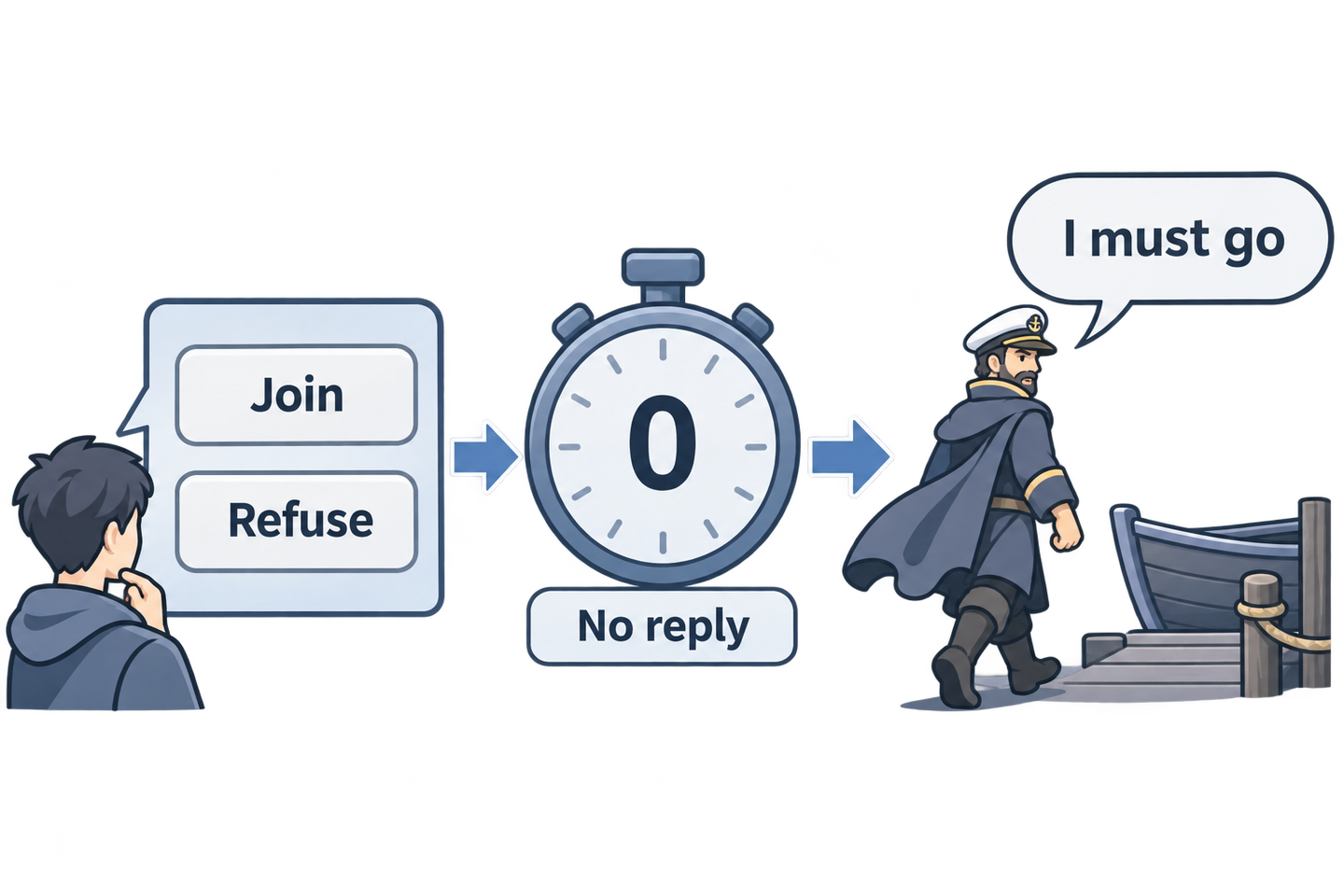
Write the timeout as an authored response
One small version can keep a timed decision while making the default visible: say that the captain will leave without an answer when time runs out. The two offered lines can still express different commitments. At expiry, the captain acknowledges the missing answer and departs; the game records no reply rather than an explicit refusal.
That does not promise that silence has no consequences. The captain may feel abandoned, and the rescue may proceed without the player. The distinction is between what the player said and how the captain interprets what happened. Later dialogue should not quote an explicit refusal the player never chose. A character can be mistaken or unfair, but the scene needs to support that reading rather than accidentally rewrite the input.
Separate the social deadline from reading the options
Start with one exchange, one timeout response and one later acknowledgment. Check when the clock begins, whether previously revealed text remains available and what a pause does. Provide an untimed or extended-time route where the game’s intended experience and access needs allow it. Pausing should have a defined effect on the deadline; a hidden pause rule makes the pressure harder to interpret.
These choices cost writing, state tracking and regression checks across the timeout and each explicit line. The smaller alternative is an untimed menu, which preserves the reply options while giving up the urgency of answering before the captain leaves. If the team cannot afford to carry silence consistently into the next scene, that may be a better first release.
A countdown can still be appropriate when hesitation itself is the intended social action. Keep it when players recognize that convention and value the resulting discomfort. The proposal here concerns a scene that needs the player to understand what they are committing to; it does not require every narrative to make every action unambiguous.
Ask what players thought silence communicated
Before explaining the rule in a planned playtest, ask what players expected to happen if they made no selection. After the scene, ask what they think the protagonist communicated and what the captain inferred. Observe whether they had finished reading before expiry. A player choosing silence on purpose and a player who never reached the last option need different follow-up.
If players understand the default but dislike being rushed, changing the label will not address their objection. If they want the tension yet believe the game invented a refusal, revise the timeout response or later reference. Keep the earlier version for comparison and avoid treating a few accounts as a population estimate. No conversation prototype or player session has been run for this example.
Sources
- Not All Choice Interfaces Are Alike
article · First-party essay2016-05-25; authored body read2026-11-07 · Source accessed: