A player misses a jump three times, then retries immediately. An adaptive system could widen the timing window. It could also interrupt someone who is deliberately practicing the original jump. The failure count alone cannot tell the designer which experience that player wants. The consequential decision is whether the game may change the challenge on that evidence.[1]
Microsoft’s HAX Toolkit separates two useful responsibilities. Guideline 17 recommends controls over what an AI system monitors and how it behaves. Guideline 9 recommends making incorrect output easy to edit or recover from. Applied to this game, those principles suggest deciding the scope of a preference and the recovery path before acting on a predicted preference. The toolkit does not establish that a particular difficulty adjustment improves a platform game.[1][2]
Give the observation a narrow job
For a first prototype, let repeated misses make assistance available at the checkpoint. Keep the original jump available and avoid a prompt after every attempt. The offer should state the consequence in ordinary terms: widen the timing window for this section, or keep the current challenge. A player can then choose the change the system would otherwise guess. A missed jump can justify offering an option without becoming permission to apply it.[1]
Here, timing means input grace: the short interval after leaving a ledge during which the game still accepts a jump press. Wider timing lengthens that interval without changing the platforms, jump speed or gap. It does not move the checkpoint, remove a hazard or alter enemy behavior. Restore at the checkpoint removes the section override and reapplies the global assistance preference, or the original default when no global preference exists. The figure shows the case where that inherited setting uses the original interval. Any affected score or achievement rule needs to be disclosed before confirmation.[1]

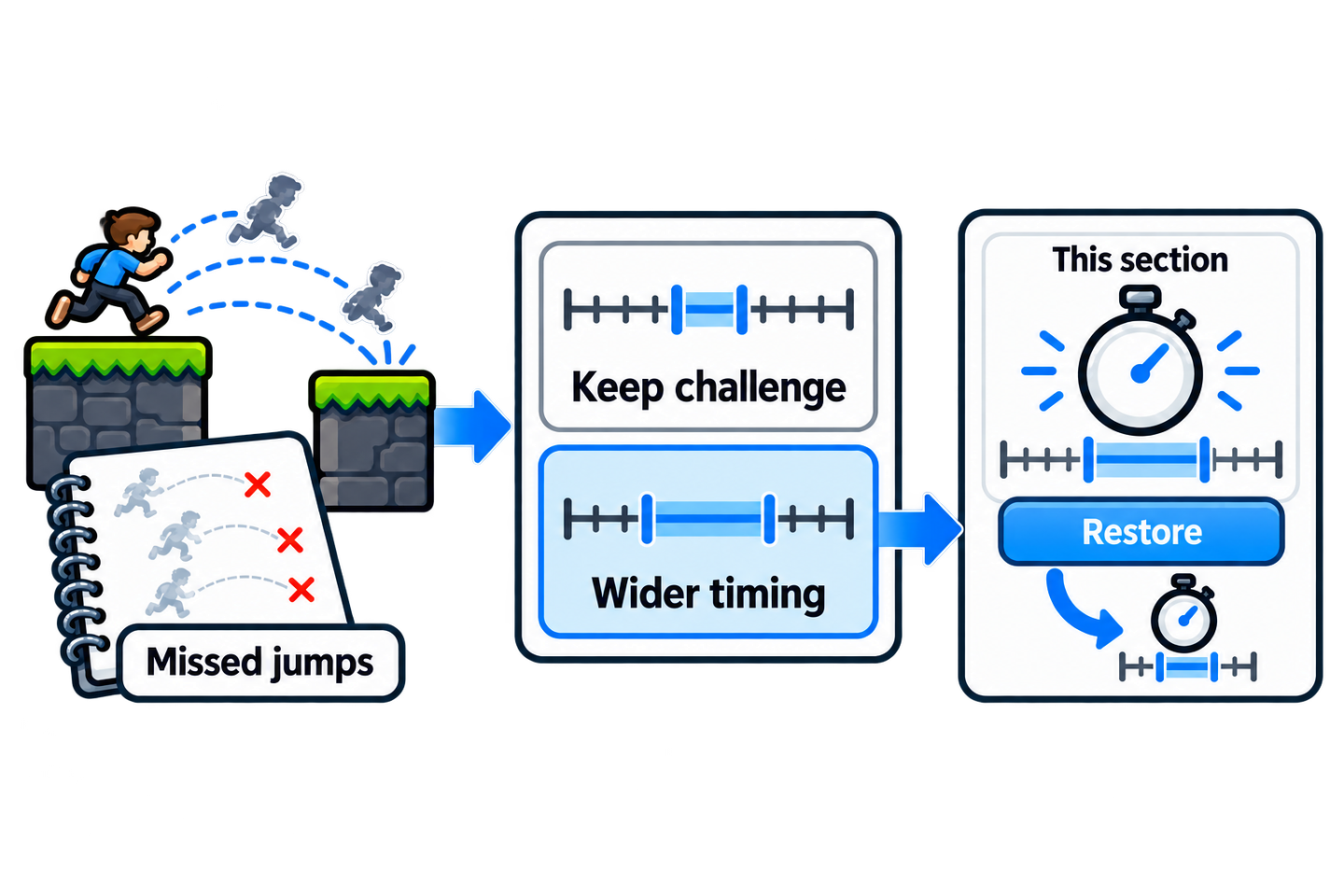
Record the chosen setting separately from the failure count. A request for wider timing in this section does not establish a lasting preference for easier games. A project that offers a global assistance preference should give it a separate, understandable control and define how that preference combines with a temporary section setting. These are different scopes; the section offer is not a substitute for global controls. In this design, the temporary override takes priority within its named section, survives a reload there, and expires when the player leaves that section. Restore removes the override immediately; the global preference or original default then applies. A save must identify the section along with its override.[1]
Silence needs a defined consequence too. In this prototype, ignoring the offer preserves the current setting and does not trigger a stronger offer during the same checkpoint visit. That policy may miss people who want help but overlook the control. A stable assistance entry in the pause menu gives them another route without treating continued retries as an inferred refusal or request.[1]
Compare the control with a simpler game
A fixed, discoverable assistance menu is a serious alternative. If players find it and understand the timing change, the prototype may not need failure-triggered offers or a predictive model. The scoped offer earns its extra logic only if it solves a demonstrated discovery problem without disrupting practice. This comparison can be made before collecting a long-lived behavioral profile.[1]
The cost includes more than a button: the team must implement a timing parameter, clear explanation, checkpoint restoration, score handling, menu access and tests for saving and reloading the chosen scope. If the team cannot support that recovery path, keep a fixed setting rather than silently applying a change that survives beyond its stated section. Use only the observations required for the offer; this design needs no personality label or account-wide inference.[1]
In a later study, ask participants to attempt a section with a chosen practice goal, observe how they encounter assistance, and check what they believe will change before they confirm it. Include people who want to keep practicing and people who want help. Compare interruptions, understanding and successful restoration alongside completion. Faster completion cannot by itself show that the game respected the intended challenge. This is a proposed evaluation, not a reported result.[1]
An explicit choice can also fail. Players may misunderstand the timing window or find even one offer distracting. Those observations would favor clearer wording, quieter access or the fixed menu. Conversely, evidence that a brief automatic adjustment serves an agreed practice mode could justify testing that narrower automation. Keep the authority tied to the stated mode and its consequences; three missed jumps do not supply a general account of the person playing.[1]
Sources
- HAX Guideline 17: Provide global controls
documentation · Microsoft HAX Toolkit; live October 19, 2026 · Source accessed:
- HAX Guideline 9: Support efficient correction
documentation · Microsoft HAX Toolkit; live October 19, 2026 · Source accessed: