A player asks a companion to forget a rumor about a stolen letter. The game removes the rumor from the companion’s memory list. On the next visit, the companion still distrusts the player because an earlier summary says they hide important things. In this hypothetical scene, the original record has disappeared while a conclusion drawn from it continues to shape the relationship.
Before offering that interaction, define what forgetting promises. Removing a line from the journal, excluding a record from future replies and undoing a relationship judgment are different changes. A game can support any of them, but its dialogue should make the chosen consequence understandable.
In Generative Agents, Park and colleagues describe reflections as generated interpretations stored alongside observations. A reflection records pointers to the memories cited as its evidence, and later reflections can draw on earlier reflections (§4.2). This creates a chain from an observed event to increasingly abstract interpretations. The paper describes that architecture; it does not establish the memory-retirement procedure proposed here.[1]
Follow the conclusion that still acts
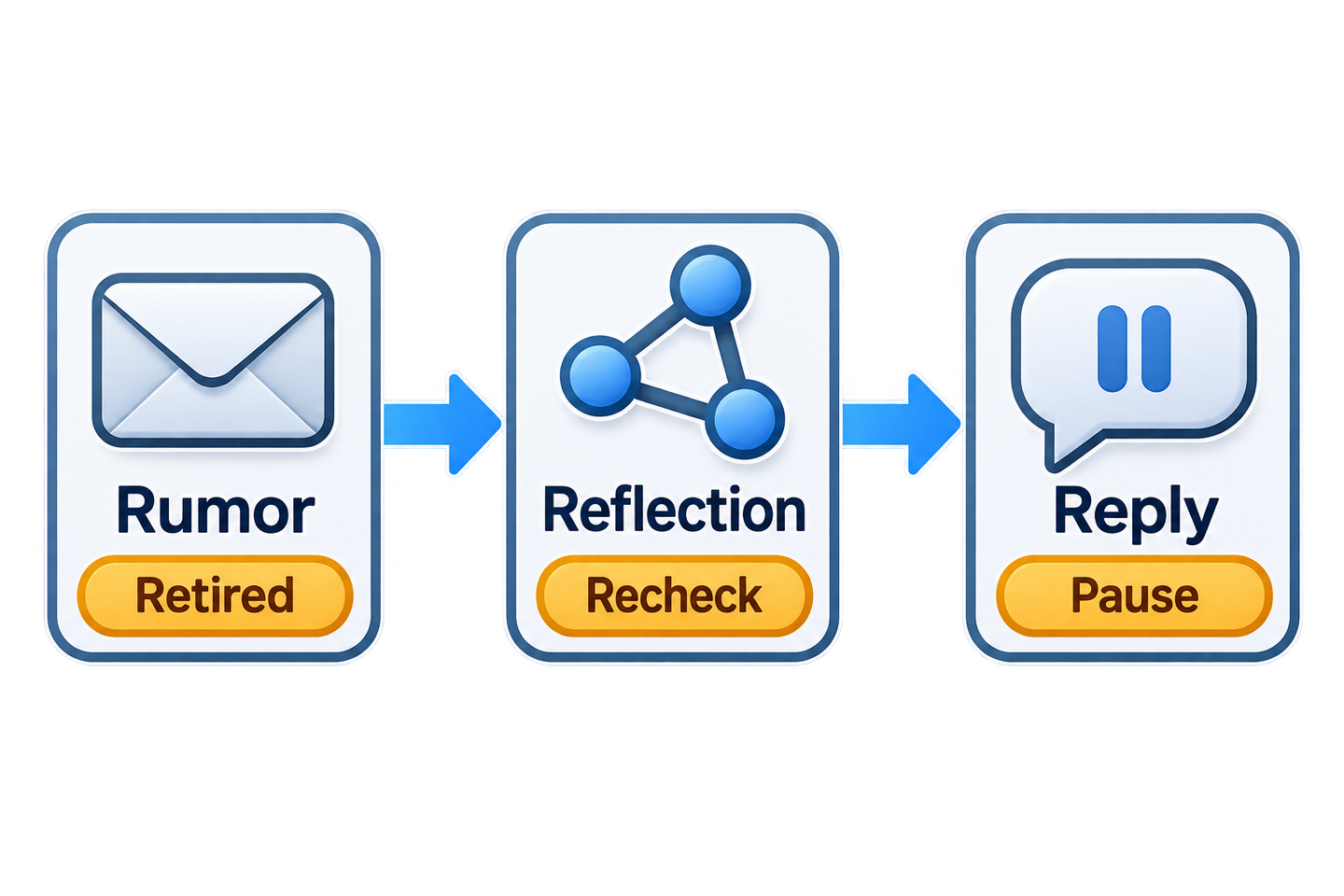
For the letter scene, give the rumor and the distrust conclusion separate identities. Record which evidence the conclusion cites and which later reply reads it. When the game retires the rumor, inspect that conclusion and anything derived from it. If no valid support remains, stop using it to choose the companion’s response. If other evidence also supports it, reconsider the conclusion from that remaining evidence rather than erasing every consequence indiscriminately.
A cited link gives the developer a place to start. It cannot establish that the generated interpretation is justified or that every dependency was recorded. The writer still needs to inspect whether “hides important things” follows from the remaining events. A system with missing links needs a narrower forgetting promise until the team can trace the affected path.

Applying this to your game
Choose one optional rumor and one later companion response. Have the programmer keep the source identifier with the derived judgment, and have the writer name the acknowledgment that is safe when the judgment has no remaining support. Defer a general forgetting interface and a world-wide relationship rewrite. If the team cannot follow even this small chain, retain authored relationship state and omit the promise to forget generated interpretations.
During retirement, keep the affected judgment out of new replies while its support is checked. Decide what happens to a reply already being prepared from the old record. For this prototype, the safer choice may be to discard that reply and use the authored acknowledgment. A delayed generated answer costs responsiveness; using a stale answer would undermine the promise the player just accepted.
Propose checks before and after a save reload. After reload, the retired rumor and any descendant still awaiting review should remain unavailable to new replies. A judgment with independent support can return only after reconsideration. Retire the rumor, ask about the letter in different words and inspect the records actually supplied to the reply. Add a case where a second independent event still supports distrust, and one where a queued reply was prepared before retirement. Inspect later summaries too. These are proposed local checks, not tests already run or proof that the model cannot repeat the rumor from another input.
Keep the history the fiction still needs
Forgetting a rumor need not undo the event the rumor concerned. If the player actually delivered the letter, the quest can remain complete. If the companion already acted on the rumor, that past action may remain part of the story. Decide which belief changes now and which events already happened, then let the response express that distinction.
Observe whether players understand what the companion agreed to stop carrying forward. If they expect the relationship to reset and the game only hides a note, change the wording or fund the larger consequence. If the correction machinery interrupts a short conversation that has no meaningful later callback, remove the extra memory promise. This proposal concerns fictional continuity in a game; deleting real player data requires a separate account of every place that data persists.
Sources
- Generative Agents: Interactive Simulacra of Human Behavior
paper · arXiv:2304.03442v2, 2023-08-06 · Source accessed: