Before writing a hint, name the move you want it to make possible. In a proposed observatory puzzle, a mission note names the gold-star group as the target, and the player must match that group on a star chart to the markings on a dial. A cue can point out the matching symbols while leaving the dial position for the player to choose. A stronger hint can reveal the position. Either can be useful, depending on whether the player wants to make the comparison or simply continue.
Lisa Spira’s account of escape-room hinting puts clear, timely and relevant assistance ahead of an elaborate delivery device. She describes hints that become burdensome because they are hard to understand, inconveniently located, unrelated to current progress or delivered just as a team is about to solve the puzzle. This is a practitioner account of room design. It supports inspecting how help reaches people; it does not establish that a particular cue teaches a skill.[1]

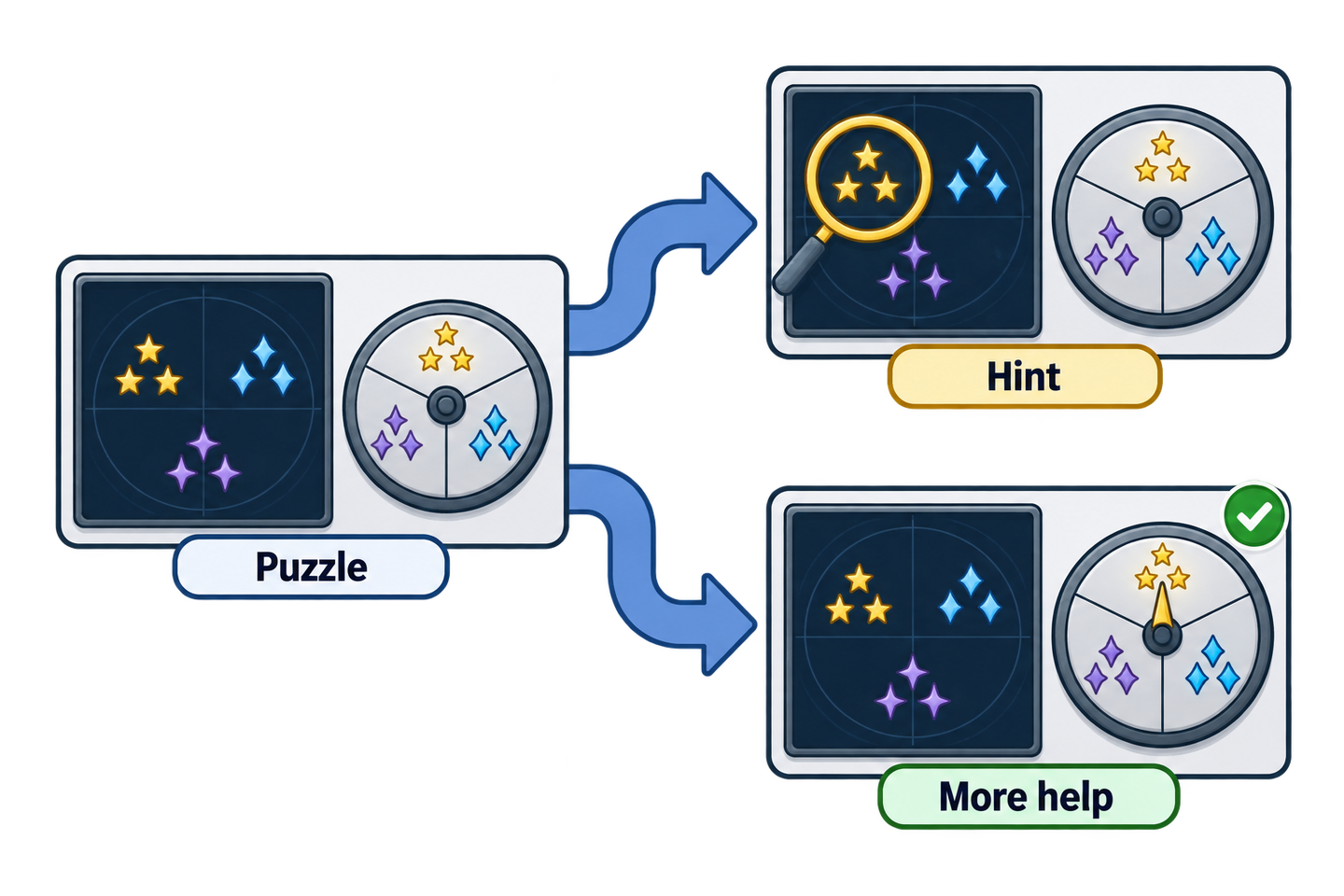
For the observatory, make the optional first cue name the comparison: compare the gold-star group named in your mission note with the dial markings. Keep both objects available while the player reads it. Do not wrap that instruction in a second riddle or make the player walk away to recover it. The cue supplies a relevant relation, but the player still has to identify the matching marks and choose the setting.
Make stronger help a real choice
Offer a clearly named route to more help from the same place. It can show the target setting directly, with a brief explanation of the match. Do not require the player to perform confusion, wait through a hidden timer or fail repeatedly to unlock that answer. If the purpose of the scene is atmosphere or story progress, direct help may fit better than preserving a comparison the player no longer enjoys.
A useful question for the designer is what the cue leaves unresolved. A vague instruction to look carefully can leave every difficulty in place. A displayed final setting can remove the whole deduction. Between them, an explicit relation gives the player something they can act on. This proposed distinction helps choose assistance; it is not a measured ranking of hint types or a requirement that every game use a ladder.
Applying this to your game
Take one existing puzzle and write down the intended player action before changing its hints. Check that the relevant evidence is actually reachable and readable. If the chart omits the mark needed to choose a setting, repair the clue or accept an unresolved outcome. A hint cannot make an unsupported deduction fair merely by telling the player which answer the author wanted.
During a future observation, record what the player tried before help, which cue they requested and what they did next. Ask whether the assistance helped them continue and whether they wanted the stronger answer sooner. Inspect actions alongside explanations, so a player who demonstrates a comparison without verbalizing it is not treated as unable to reason. A quick successful turn after a revealed answer establishes assisted progress, not independent understanding.
If the project specifically promises learning, check the same comparison later without its cue before claiming independent performance. A different puzzle or a later return would answer further questions about transfer or retention. Those observations require their own content and recruitment effort. None was run for this article, and a help-click count cannot supply them.
Spend on the cue before the classifier
Use the next assistance pass to write the two help options, keep them readable beside the puzzle and check their delivery in the current interface. Set aside automatic ability classification for that pass. The writer needs to identify what each option reveals; the developer needs to preserve the puzzle state and access to stronger help; the researcher needs to distinguish progress from learning only where that distinction serves the game’s goal.
Keep the old hint available while trying the revised version. If players already understand the comparison but cannot read the symbols, improve access instead of adding explanations. If they want the answer immediately, simplify the route to it. If they understand the cue yet still cannot find a supported setting, inspect the puzzle’s evidence. Each observation points to a different change, and none justifies a permanent label about the player’s ability.
Sources
- Hints and Hinting Systems [Room Design]
article · Lisa Spira, October 2, 2016; substantive article read live October 18, 2026 · Source accessed: