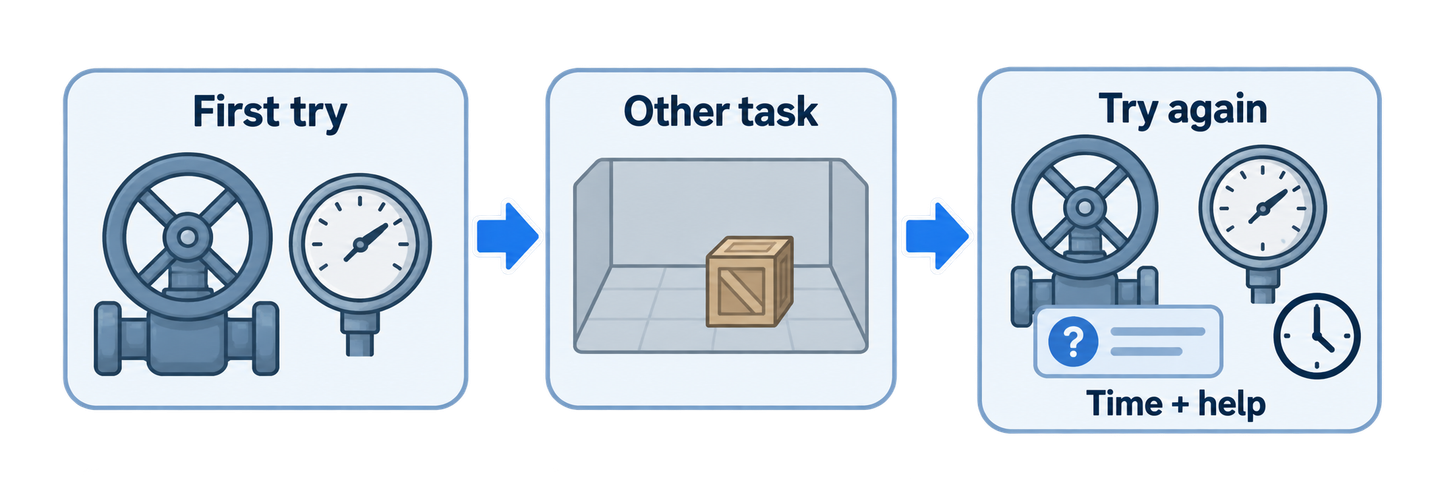
A player learns to read a pressure gauge, then encounters the same kind of valve after another room. The designer can bring that second attempt closer, leave a longer gap, or remove it to keep the opening moving. The gap spends part of the player’s session. Its value depends on what the player should remember, when that knowledge will be needed and what happens if they cannot retrieve it.
Koedinger, Pavlik, McLaren and Aleven’s 2008 discussion of the assistance dilemma treats practice spacing as a choice with time costs. Their account of a model for learning simple fact pairs considers successful recall, failure and subsequent review against instructional time. It offers a reason to examine the cost of a practice schedule, rather than treating a wider gap as automatically preferable.[1]
Name the later use before scheduling the return
For the proposed valve game, define the intended skill as reading the gauge to choose a safe release action. Decide whether it matters later in this short session or when a player returns another day. Those goals need different observations. Clearing the second room during one sitting cannot establish that a player will remember the rule on a later visit.
The paper’s discussion also shows why a single spacing prescription is insufficient: changing assumptions about failure costs or forgetting can change the model’s preferred schedule. That is a conditional modeling argument about its tasks. It supplies no validated number of rooms, seconds or days for a game’s pressure-gauge mechanic.[1]
A longer route between valves can include worthwhile play, but it can also add navigation, another rule to learn or an interruption. Those changes make a useful production comparison harder to interpret as an effect of spacing alone. Write down what fills the gap. If the team needs a causal claim about the interval, the study must address these other changes; an ordinary playtest can first reveal whether the proposed route and assistance are usable.

Applying this to your game
Build the comparison around one existing skill and two placements the team can afford to revise. One placement repeats the valve soon; the other returns to it after an existing activity. Keep the gauge rule, ordinary controls and available help consistent where possible. Use fresh surface details so an attempt requires reading the gauge, while checking that the new details do not introduce another rule. This is a proposed comparison, not evidence that either arrangement teaches better.
Have the designer inspect the intervening activity and the intended later use. Have the researcher record the actual interval, attempts reached, time spent responding and time spent recovering after difficulty. Note how much of the session the player completes, whether the help is usable and whether the activity remains enjoyable. A player who stops before the return is part of the schedule’s observed coverage, not a missing score to discard.
Choose the comparison’s resource constraint in advance. With a fixed number of attempts, one arrangement may take longer. With a fixed play window, players may reach different numbers of attempts. Preserve both the opportunity count and elapsed time, and describe which constraint answered the design question. A later assessment should fit the intended return window; if that observation cannot be funded, retain the uncertainty about delayed retention.
Spend the next iteration on moving this existing encounter, checking its help and observing the resulting route. Defer an adaptive scheduler that estimates an individual memory state. It would add model fitting and validation without first resolving whether the game’s current practice opportunity is understandable or worth its time.
Change the schedule when the costs change
If the later encounter repeatedly requires teaching the gauge from the beginning, consider a shorter gap, a clearer explanation or a less demanding return. If the repeated valve adds little challenge and consumes the best part of the opening, reduce repetition or move the skill into a meaningful later decision. Those are different repairs; observed errors alone do not choose among them.
The recommendation changes if the game’s goal is immediate access or relief rather than durable learning. Offer the help that serves that goal and assess its experience directly. When later independent use is a real promise, reserve evidence for that later use, along with the time and correction work needed to make practice possible.
Sources
- Is it Better to Give than to Receive? The Assistance Dilemma as a Fundamental Unsolved Problem in the Cognitive Science of Learning and Instruction
paper · Koedinger, Pavlik, McLaren and Aleven; CogSci2008, pp.2155–2160; author-hosted published PDF · Source accessed: