A ferryman tells the player the bridge is closed. The player repairs it, crosses, then returns to find the ferryman still warning travelers away. That exchange could express a character who has not heard the news. It could also be a stale condition accidentally controlling dialogue. Before adding more remembered conversations, decide which of those situations the game means to create.
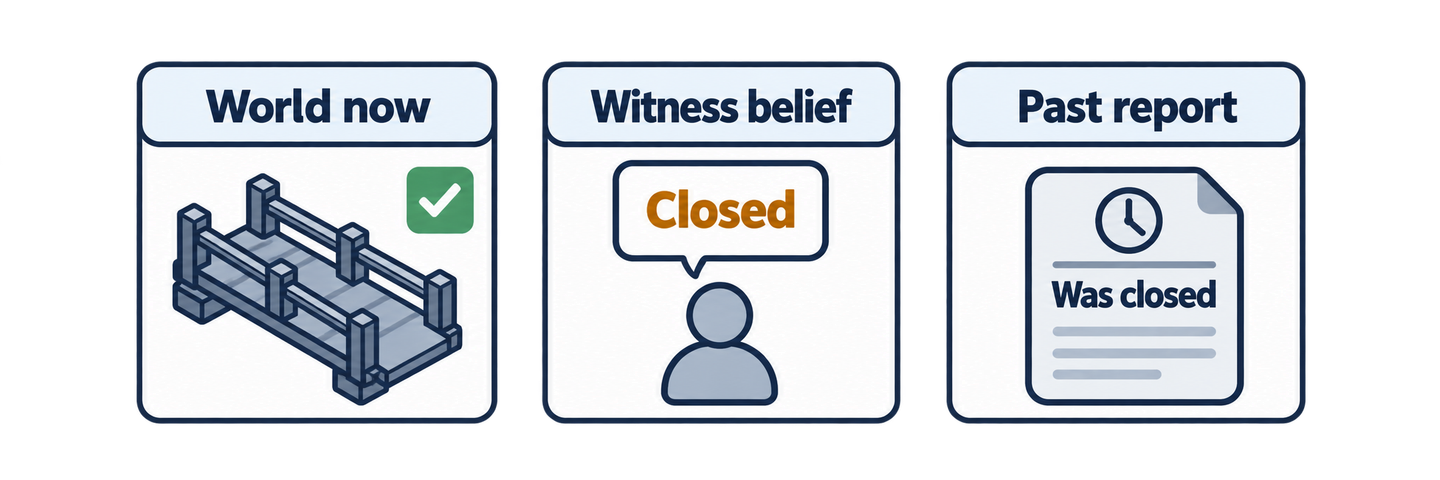
In this proposed scene, the repaired bridge should permit crossing even while the ferryman holds an outdated belief. A journal can preserve his earlier warning as something he said before the repair. Neither record should quietly become the bridge’s present condition. The useful memory is the distinction between what happened, what was reported and who has learned about the change.
The ink manual describes global variables that can hold story state, be changed during play and control conditional text or choices. The wider runtime can access those values. This supplies a small authored mechanism for expressing separate conditions. It does not decide whose knowledge a condition represents or verify the integration in a particular game. Those meanings remain the team’s responsibility.[1]
Give each record a reader
Let the route check read the bridge’s physical condition. Let the ferryman’s reply read whether he knows about the repair. Keep the earlier warning in a dated journal entry if recalling it matters. The repair event changes the route immediately; a witnessed repair or a later conversation can update the ferryman. Choose the information path explicitly instead of assuming every character receives every world change.
This separation also gives the writer a deliberate scene. The player might correct the ferryman, and he might acknowledge the news. If the story instead requires him to lie, write that response with knowledge of the open bridge. Ignorance and deception may use similar words, but they imply different later reactions. Store only the distinction a later scene will actually use.

Applying this to your game
Pick one change that players can reverse or complete, such as repairing a crossing. Have the writer name the later line that depends on it and the event that informs its speaker. Have the developer trace the physical condition, knowledge condition and journal display through that event. If an existing quest flag already supplies the physical condition, reuse it; a second copy gives the two readers another way to disagree.
For a first content pass, fund one uninformed reply, one informed reply and one way to deliver the news. Defer a general rumor network and free-form conversational recall. If keeping even these two replies coherent costs more than the callback earns, let the ferryman see the repair and update immediately. That smaller promise still permits a persistent world without asking the team to simulate information spreading.
Propose local checks in both orders: hear the warning then repair the bridge; repair it before meeting the ferryman. Return before and after delivering the news. Reload at those boundaries and inspect which conditions and lines survive. Include an older save without the new knowledge field, and define a conservative fallback that allows the valid route without fabricating a conversation. These checks can reveal inconsistent state; they cannot establish that the distinction interests players.
Keep a mistake only when the fiction earns it
Observe whether returning players understand why the warning is outdated and whether correcting it leads anywhere worthwhile. If they read the repeated line as a broken quest, a brief acknowledgment or visible source of the news may do more than a longer history. If the distinction is understood but the exchange feels like administrative work, remove the correction step and let the character learn through the world event.
Retaining the old warning does not require leaving it active everywhere. Preserve it as past speech when the story needs that history, and stop using it for current route advice once the speaker is informed. A richer memory system becomes worth considering when the game needs additional, meaningful differences in who knows what, and the team can maintain their consequences. A fluent recollection alone does not supply that reason.
Sources
- Writing with ink
documentation · inkle/ink master documentation, Part3 Global Variables, Logic and Conditional blocks; live October26,2026, exact raw snapshot retained; commit not pinned · Source accessed: