A witness becomes angry after an accusation. The next question concerns a missing parcel: did it leave by the north gate? The writer can make the witness answer coldly, refuse to answer, lie, or end the exchange. Each response may fit the character. Each also makes a different promise about what the player must understand to finish the investigation.[1]
Emily Short’s account of Alabaster offers a useful distinction. She describes mood as strongly affecting wording while having little effect on conversation flow; major paths do not disappear because the character is unreceptive. She connects that choice to her intention that players pursue facts and reproducible narrative goals. Her discussion of Galatea allows more opaque behavior for a different intended experience. These are accounts of her design intentions, without evidence here that players interpreted either game as intended.[1]
Choose what the anger is allowed to change
For a proposed investigation scene, let the witness’s anger change how they answer while keeping the parcel clue available. A warm reply might offer to repeat the route; an angry reply might state it curtly. Both must communicate that the parcel left by the north gate. The player can still regret the accusation, receive an unwelcome acknowledgment, or decline to apologize. Access to this fact does not have to carry every consequence of the encounter.[1]

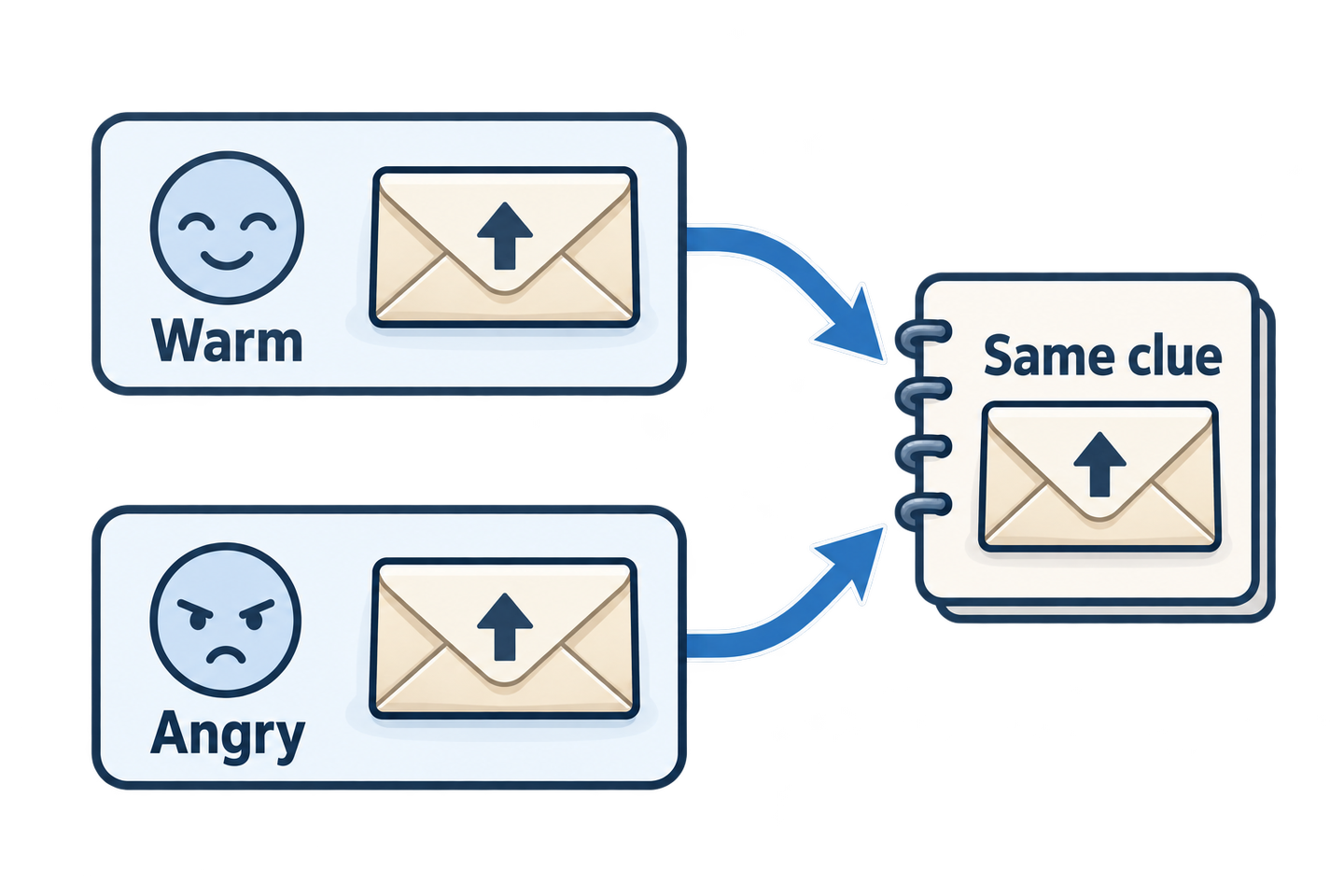
Start with the fact the scene must communicate, then author each response around it. Keep a separate record for whether the player learned the route and for the witness’s current mood. A mood label should select wording only where that is the chosen rule. This separation is an editorial implementation proposal, not a claim about Alabaster’s exact code. A dialogue author still has to inspect what each version actually implies: a sarcastic answer can leave a nominally present clue practically unusable.[1]
The distinction also protects the player’s intention. An apology should repair an accusation only if the player chooses to make it. If the next button looks like a neutral request for evidence but performs an apology, the scene rewrites their position. Offer wording that makes the social act clear, and let the player return to the question when that route is supported. Repeated acknowledgment may matter even when it grants no new tactical option; ask whether players knowingly value it before cutting it.[1]
Author the reaction the team can support
For one small scene, fund a factual response and two deliberate tonal versions before adding more mood states. The writer owns the clue’s meaning and the character’s response. A developer connects those lines to the fact and mood records, while a tester checks the reachable combinations. Reuse an existing dialogue tool if it exposes those conditions. Building a general emotion simulator first adds work without showing that this exchange needs one.[1]
Compare the same known-fact state with a warm and an angry witness. Ask the route question, change the subject, return, and repeat it after the fact is recorded. Check that necessary information stays available, that repeated lines do not promise a new clue, and that the player’s chosen stance persists. Include localization review when tone changes could alter factual meaning. This takes authored coverage and maintenance even when both branches eventually supply the same fact.[1]
When the relationship is the challenge
A different game may deliberately ask the player to earn a witness’s confidence. There, refusal can be a meaningful obstacle. Name the social goal, give players a way to investigate the refusal, and decide what recovery costs. A fixed clue route would remove part of that design. If the team cannot author and evaluate those consequences, a direct evidence interaction may fit this scene better, while giving up the relationship challenge explicitly.[1]
For the investigation proposal, ask an unfamiliar player what they learned and what they believe their accusation changed. Watch whether they can use the route clue without accepting an apology they did not intend. If they mistake anger for a missing evidence condition, revise the reply or the access rule. If they value repairing trust more than reaching the gate, reconsider which experience the scene should support. These are proposed observations; no player results have been collected here.[1]
Sources
- Moods in conversation
article · Emily Short; dated December 10, 2009 with an additional July 1, 2011 date of unspecified meaning; main essay served October 21, 2026 · Source accessed: