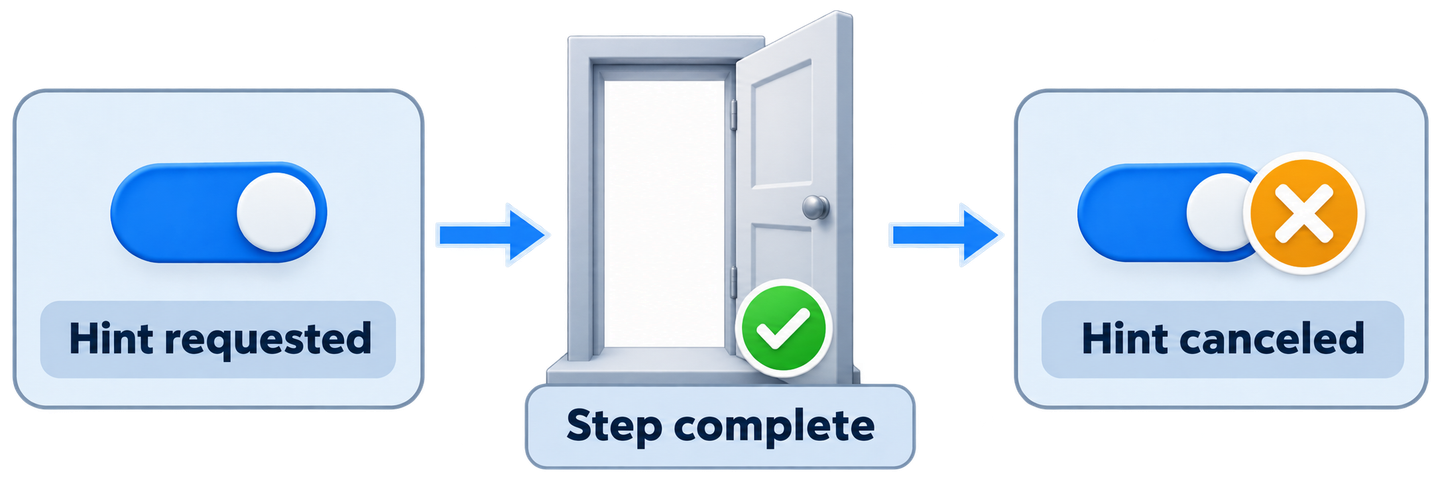
A player asks for help finding the blue switch. While the answer waits to appear, they find it and open the door. The hint then arrives: look behind the blue panel. It describes a step the player has already finished, leaving them to decide whether the game means another panel or failed to notice the open door.
In this proposed puzzle, the help is meant to restore progress toward the next room. Once that door is open, cancel the queued switch hint. Do not automatically replace it with advice about the next puzzle: the player has not asked for that help, and the new obstacle may deserve time to explore.

Relevant when requested is only the first check
Lisa Spira’s 2016 account of escape-room hinting recommends clear, actionable assistance. She identifies irrelevant hints and hints that interrupt a player who is about to solve the puzzle as problems, and ties useful delivery to following the team’s progress. Her account motivates checking relevance at delivery time. It does not evaluate software cancellation, measure learning or establish a universal delay threshold.[1]
A digital game can create a gap between requesting help and receiving it through an authored pause, a remote response or a delivery animation. The request records an obstacle at that earlier moment. It is insufficient evidence that the same obstacle remains when the message becomes visible. This proposal applies to any such delay; it does not depend on using generated text.
Let the completed step invalidate its help
For one prototype, bind the switch hint to the unsolved switch step and its current attempt. Immediately before display, check that the same attempt is active and the step remains unsolved. Restarting the puzzle retires requests from the previous attempt, even if the new attempt needs the same switch. If the door is open, retire this pending message and show a short request-status acknowledgment, such as Step completed, in the help interface. Keep that acknowledgment separate from a new hint.
The change needs a reliable completion event, a way to retire the pending message, and a final relevance check at display. Test the boundary where completion and delivery happen close together. If a hint was already visible when the player solved the step, dismiss or mark it complete without claiming it was never shown. Cancellation cannot take back information the player already read.
This distinction matters for later evaluation. Record a canceled pending hint separately from a displayed hint and from a request the player withdrew. A request followed by independent progress should not be reported as success caused by a hint that never appeared. Nor does it prove the request was unnecessary; searching while help is pending may itself change what the player tries.
Keep the first change small
Implement the check for this one completed step before adding a model of the player’s ability. The cost is coordination between puzzle state and help delivery, plus checks for restart and interruption. Spend that work before writing several increasingly detailed switch hints. The smaller alternative is an immediate authored hint, which reduces the waiting gap while giving up the intended pause. It still needs a rule for a step that has already finished.
Keep a retrospective explanation available if the design goal includes understanding why the switch worked. Put it behind an optional review action so the player can choose it after opening the door. That would serve a different purpose from the original rescue hint. This article does not claim that canceling help improves learning.
In planned checks, request help just before solving, leave the puzzle while a request is pending, and restart the step before delivery. Verify that each message still refers to the right attempt and obstacle. Then observe whether people understand the cancellation acknowledgment and whether they can continue. Compare it with the existing delayed delivery while preserving both versions.
If players deliberately want the explanation even after completing the step, offer that review route rather than silently discarding it. If they report that cancellation hides an answer they still need, inspect whether the completion event actually represents their goal. The rule should follow the capability help is meant to support. No game build, network race test or player study has been run for this example.
Sources
- Hints and Hinting Systems [Room Design]
article · First-party 2016 authored essay; scoped body read 2026-11-08 · Source accessed: