You’ve got time to rewrite one suspect interview. The player tells the station keeper that she shut off the transmitter, then finds a log that puts her outside when it went down. Without a way to retract the claim, the player can change their mind and leave the keeper with the original accusation. Give that retraction its own acknowledgment. For this small prototype, the same greeting can cover visits where the player has said nothing new.

Cut the histories you have to answer
In “WIP Rescue,” Emily Short suggests replacing an ask-anything conversation with a menu or a general Talk To command when the broader system demands too much content. She also suggests limiting the number of turns. When a team has many mostly similar dialogue objects to build, Short offers another option: use a scripting language or a form to generate the repetitive implementation code. In the discussion beneath the post, a commenter says they’d undo turns to try the topics they missed. The reply clarifies what the cap was meant to save: the work of handling repeated questions and their combinations, not the work of writing an initial answer for each topic. That exchange explains the rationale for the cap. It doesn’t compare tested versions.[1]
A turn cap can block the retraction if the player finds the clearing entry after their last turn and can’t reopen the exchange. Let them return to the keeper after reading the log. In A they can tell her they were wrong. In B they can correct the report. For the two paper versions, show the same current accusation on the case panel. The keeper has a line for hearing the accusation and a line for hearing it withdrawn. Other games may need different replies depending on the order of the evidence, who heard the claim, what the keeper remembers, or which systems read the case state. Check those dependencies before sharing lines there. For this one case, check whether the dialogue tools you already have can handle the two actions. Writing it by hand may take less work than setting up and maintaining a new tool. That setup may pay off across many similar cases.
Build one claim the player can take back
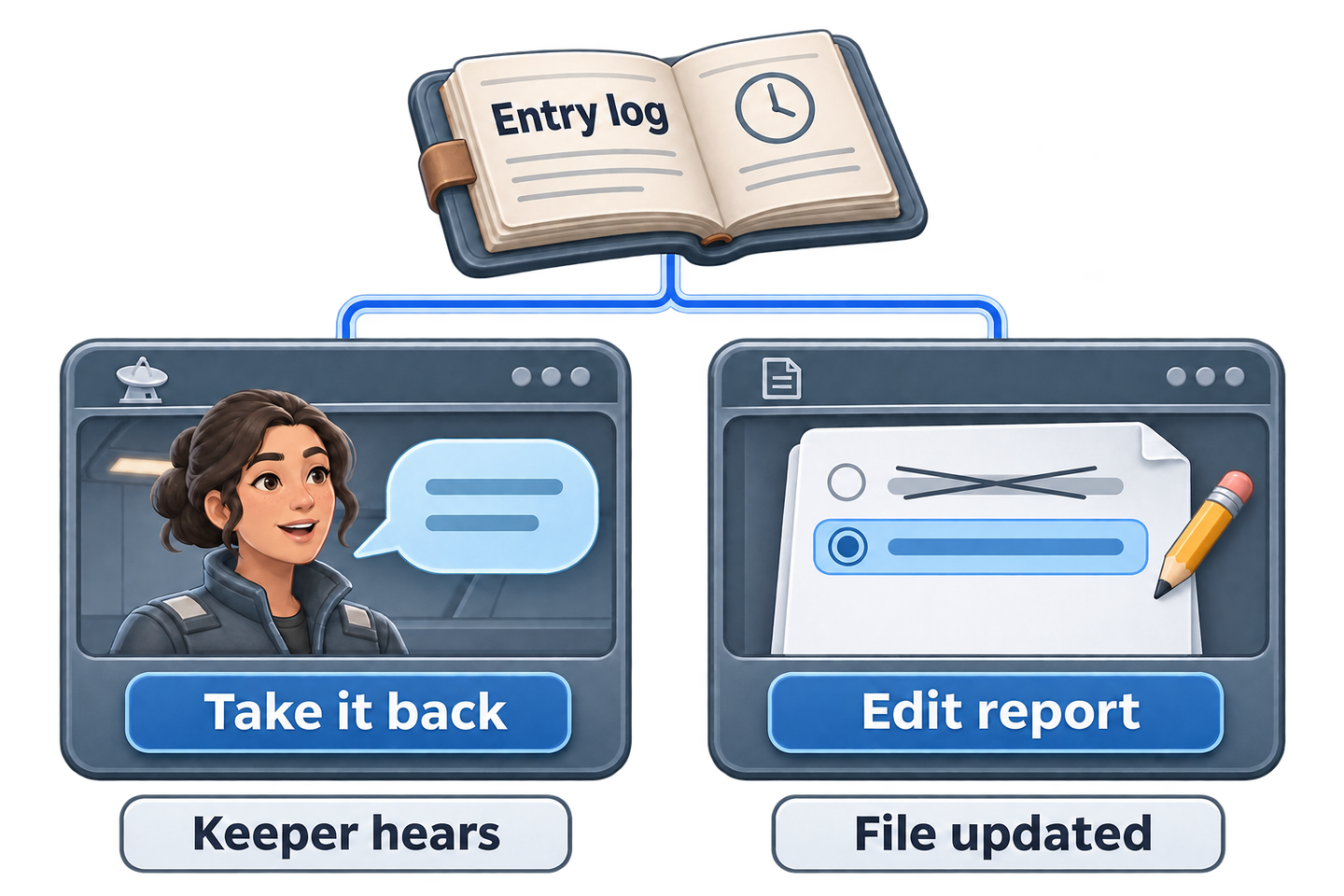
Both paper versions show the same case summary so each player can check what they have accused the keeper of. A card can track the current claim as active or clear. Read the case summary and any report display from that one field. This keeps the written reminder the same while the player uses either conversation or report editing to change the accusation. In A the player chooses to tell the keeper, “I think you shut off the transmitter.” Saying it sets the field the report reads. She says, “I was outside.” While the accusation is active and the case is open, “Take it back” appears on every visit. Choosing it clears the field, removes the option at once, and gets her immediate reply: “All right. You’re not saying it was me anymore.” The option is also hidden once the case closes. Author those two replies for A. The same report can be read-only in A. In B the report has one fixed choice for this case: “The keeper shut off the transmitter” or “No current accusation.” The player chooses a value and saves it. The accusation sets the case field. Saving “No current accusation” clears it. The report shows that saved value alongside the common case summary. The control is available while the case is open and the current choice stays visible after closure. B plays no acknowledgment. In both versions the report shows the field and keeps no separate copy of the accusation. In this paper scope, the entry log, other characters, and the case outcome never read the field. Neither version stores accusation history or lasting relationship state.
In free play, both versions open at the station with the same optional clue: “You can check the entry log.” The log is available from the start. The player can open it without the keeper’s permission, before or after accusing her. That access rule is a proposal for these prototypes. Emily Short’s post makes no claim about it. While the case is open, the player can make the accusation again after withdrawing it. The same accusation action returns in A and the same choice is available in B. Every repeat uses the same lines and controls. We accept that repetition in the paper prototype to keep the state to one field. The acknowledgment is what the keeper says at the moment of withdrawal. The prototype makes no claim about what she would remember or how much she would trust the player later. The matched paper pass below sets when the new evidence appears.
Compare it with a report the player can edit
Shuffle equal numbers of A and B cards. Give each participant one version and the same incomplete evidence. Hold back the contradicting log entry. Let each participant choose whether to accuse and confirm the accusation themselves if they choose it. No accusation is assigned or prefilled. In A they say it to the keeper. In B they select and save the same claim in the report’s fixed choice. Give both groups the same new timestamp at the next case beat. Use the same case panel, cue, instructions, and time. Match the steps from the panel to the correction and the transition back to the panel. Keep the pictured “Take it back” and “Edit report” labels in the same place and at the same size. Show each correction option at the same point, while the case is open and the accusation is active. Count starts, first confirmed accusations, and the use of the first chance to correct separately for A and B. For the matched pass, end observation of that choice after the first correction or the allotted time. Mark players who never accused as having no retraction opportunity. Keep them out of the count of eligible players who left the option alone. Ask eligible players “What changed, if anything?” and “Why did you use the option or leave it alone?” before giving any social cues. Save their unprompted reasons. Then ask separately who they think knows about the correction and whether they expect any change in later trust or in the case outcome. Set aside reasons that rely on effects the prototype does not have. Keep prompted social preferences separate. This pass would describe how players use two bundles of label, context, and action, and why eligible players say they acted. It cannot isolate the effect of telling the keeper or support claims about embarrassment or trust.
For one small case, compare the time to build and test the simpler version with the time to recruit players, prepare and run both paper passes, review the notes, and fit that work into the schedule. If the story requirements allow the simpler version and it takes less time, build it first. Start the log where it would normally appear and watch who accuses, who gets a chance to correct the claim, and who uses that chance. If you can reuse the pattern across several cases or add it to an already planned report-editor test, use the matched pass above and a separate free-play pass. Offer the log from the start in free play. Take separate counts of players who see the log first, make a claim, reach a chance to correct it, and use the first chance. Record later accuse-and-withdraw cycles separately. That tells you how often the moment comes up in each version. Fix differences in how easily players find or understand the controls before comparing their reasons. Use unprompted reasons from players who understood what the action changes. If they explain why the keeper needs to hear the correction in that scene, keep testing A. If they want to fix the record, keep testing B. Keep both in the next test if both needs recur. If few players reach the correction, move it down the list. For a team that already has report editing, an optional acknowledgment after the edit is another possibility. Budget the work of getting that response to play at the right time. For an interview that no report or later system reads, start by pricing a local flag in A. It only needs to survive return visits and control when the retraction appears. Test that accusing reveals the option, retracting clears it, and closing the case hides it. That version needs no connection between the interview and a report. If the game also shows the current accusation in a report or uses it elsewhere, store it in one shared case field. Budget how the interview and report read or change it, and test that both show the same current claim. Price those connections separately from the dialogue and menu work for A and the fixed choice and save behavior for B. If the game already has a free-text report, budget the work of adding a structured choice, connecting it to the case, and validating what gets saved. Test both transitions into and out of a saved accusation. If the design needs to prevent a repeat or respond differently after a withdrawal, budget a separate history field and test what reads it. Any lasting reaction or change to the case outcome needs its own implementation and test.
Sources
- WIP Rescue
article · Primary source extracted on 2026-11-18 · Source accessed: