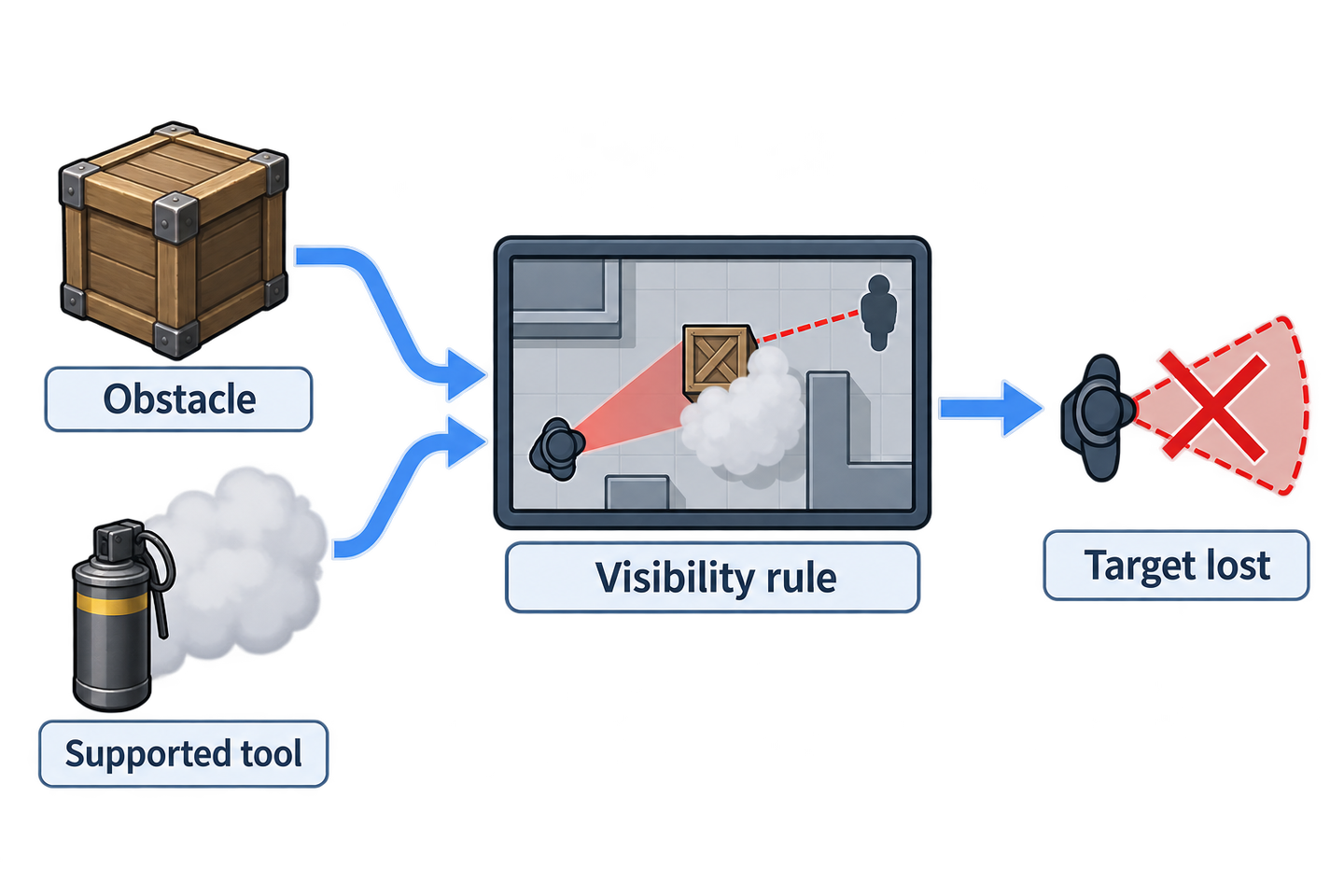
Imagine a generator offers a player a smoke canister. Its description says it conceals movement, but the guard keeps tracking the player through the cloud. You can repair that encounter with a special exception. You can also ask whether the canister participates in the same visibility rule as the rest of the room. That second question matters if you want players to carry what they learn into the next encounter.

Follow an effect through the world
Tom Francis explains emergence through a crate placed between a player and a turret. Movement, blocked sight and target visibility combine to produce a solution without a rule written for that particular placement. He also argues for interactions between non-player elements and tools that do more than damage. These are his design arguments and reported examples, rather than controlled comparisons of player experience.[1]
For a generated tool, the useful design question is which existing relationship its effect changes. In the hypothetical smoke example, a canister creates an obstruction, the visibility system checks that obstruction, and the guard loses its target. A dramatic description alone supplies none of those steps. The game needs an implemented effect and feedback the player can connect to it.
This suggests a bounded first prototype: keep the generator’s names and descriptions flexible while choosing one supported effect. The game can accept concealment only when the generated item maps to that implemented effect. For this prototype, a designer should review each description against the authored effect’s opacity, duration and recovery behavior, reject unsupported promises and keep the authored item available. Include that checking and rejection work in the estimate; unrestricted generation and an automated verifier are outside this first pass.
Applying this to your game
Build one room with a guard, a movable obstacle and the proposed generated tool. The team should use an authored version to check the implementation before inviting anyone to inspect the wording. For a first player-facing check, show one version and collect a prediction before demonstrating or explaining the effect. Keep the geometry and visibility rule fixed. If the same person later sees the other version, treat the comparison as exploration affected by prior exposure; it cannot establish that wording caused the difference.
Before the person uses it, ask them to describe a plan. After use, ask what made the guard react. Record the plan, the visible response and the game’s actual target state separately. If they struggle to explain the response, compare that account with a prediction or attempt in a new position. Successful reuse can challenge a diagnosis of unclear feedback. A wrong state transition calls for an implementation repair. These observations can guide local revision without establishing a causal effect of wording.
Inspect whether varied wording supports a useful plan or a presentation the player values. If both versions communicate the effect and generation supplies neither benefit while requiring more checking, the authored item is sufficient for this iteration. A successful parse or understood effect does not by itself justify keeping generation.
Also try the obstacle and the tool away from the initially convenient position. Inspect whether each result follows the rule you intended. Decide whether opacity is binary or partial, what ends the effect, and when the guard can reacquire a target. A failed attempt should leave enough information to try again; otherwise the cost of discovering the rule may discourage the experimentation you want.
Spend the next iteration on the weak relationship
This first pass gives up a wider collection of generated effects. It leaves authoring and checking work for one relationship, including a recovery path. Estimate that work with the people implementing the tool, the guard behavior and the feedback. If even this small case cannot fit the available iteration, retain an authored item and postpone generation. No fixed production budget follows from the essay.
Shared rules may create interactions your design does not want. If combinations trivialize the room, inspect the challenge and the rule’s scope before adding more exceptions. If players understand a deliberately authored interaction better and value its surprise, that can justify the authored version. Clarity and reuse are design commitments to examine, rather than sufficient evidence that a game is enjoyable.
Francis’s essay motivates the focus on consistent, understandable relationships. It does not evaluate generated tools, the smoke example or this proposed comparison. We have not implemented the room or observed players. The transfer depends on a game that benefits from recombining tools; an experience built around a fixed dramatic sequence may call for a different design.[1]
Sources
- What Works And Why: Emergence
article · Authored essay as returned on 2026-10-13; URL date is a hint, not a verified publication timestamp · Source accessed: