The Friction of Obfuscated Guidance

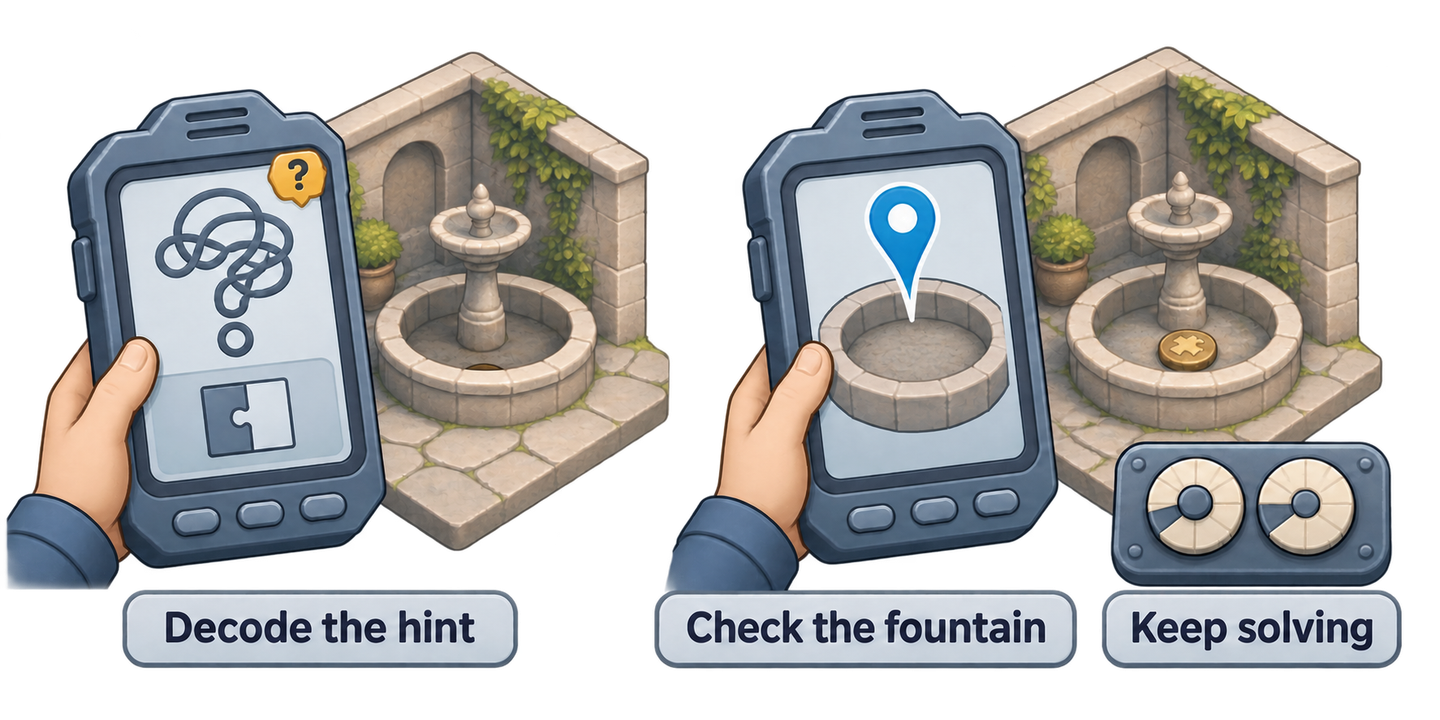
Requesting a hint in an interactive game or physical escape room represents a moment of surrender. Players acknowledge that their active exploration or logical deductions have stalled, the fun has stopped, and they need assistance to restart. However, designers often fear breaking immersion or handing over the solution too easily. In response, they frequently cloak hint text in ornate diegetic riddles, muffled in-character audio, or multi-step pedagogical sequences. Instead of helping players resume play, this turns the hint itself into another puzzle.[1]
Lisa Spira argues that burdensome hinting occurs whenever the medium or delivery method obscures the message. If a hint is hard to hear, difficult to read, or delivered in another room away from the relevant challenge, players expend extra effort just to decipher what the system is telling them. Spira notes that while thematic integration—such as messages sent via in-universe radios or companion characters—can enhance engagement, functional clarity must come first. A hint system must efficiently return players to the path of success rather than presenting an additional deciphering task.[1]
Separating Search Bottlenecks from Logical Deductions
Stalls typically arise from two distinct failure modes: failing to find a required component in the environment, or failing to infer the rule that connects the components. When a player cannot locate an object, delivering a clever, poetic clue about its symbolic meaning forces them to engage in speculative reasoning about a physical item they simply have not seen. The player does not lack understanding; they lack the component.[1]
In these scenarios, providing a direct, unambiguous confirmation of the missing piece restores momentum immediately. Rather than hinting at why an item matters, an effective prompt tells the player where to look or highlights the neglected container. Once the component is in hand, the player retains the opportunity to solve the deduction independently. Clear assistance removes the search bottleneck without depriving the player of the intellectual reward of solving the logic.[1]
Applying This to Your Game
To apply this principle, puzzle and systems designers should audit their on-demand hint ladders to classify the underlying cause of player hesitation. When an automated or moderator-guided hint triggers, determine whether the player possesses all necessary inputs. If the player is missing an interactive token, key, or dial, suppress high-level deductive hints and deliver a direct locational or factual prompt. For example, instead of displaying an in-character musing like 'The scholar left wisdom where water gathers,' state explicitly: 'Inspect the dry fountain basin in the courtyard.'[1]
Teams can evaluate this change during playtests by tracking the post-hint resumption time: the duration between hint delivery and the player's next productive interaction with the puzzle apparatus. If players spend two minutes discussing what the hint meant before taking an action, the hint is acting as an obstacle. A successful hint produces immediate, purposeful movement toward the objective. A plausible trade-off is a slight loss of poetic diegesis for players who prefer obtuse lore, but this is outweighed by preventing frustrating session abandons.[1]
This direct approach has clear transfer limits. In pure mystery or detective games where deducing the meaning of cryptic fragments is the entire game loop, delivering plain factual directives can collapse the core challenge. Designers must verify whether deciphering ambiguous instructions is an intended test of skill or merely an accidental barrier between the player and an otherwise enjoyable deduction.[1]
Sources
- Hints and Hinting Systems [Room Design]
article · Lisa Spira, October 2, 2016; substantive article read live October 18, 2026 · Source accessed: