When a player repeatedly fails an objective, modern games often trigger automated assistance, such as an ambient voice line, a sparkling trail, or an onscreen text prompt. Most hint systems trigger purely on negative outcomes, such as three consecutive deaths or two minutes spent in an uncompleted puzzle room. This coarse threshold treats every failure as an intellectual impasse. However, Daniel Cook's analysis of game chemistry demonstrates that a player's interaction with a mechanic is not a monolithic event. It is a multi-stage loop where breakdown can happen long before or long after comprehension occurs.[1]

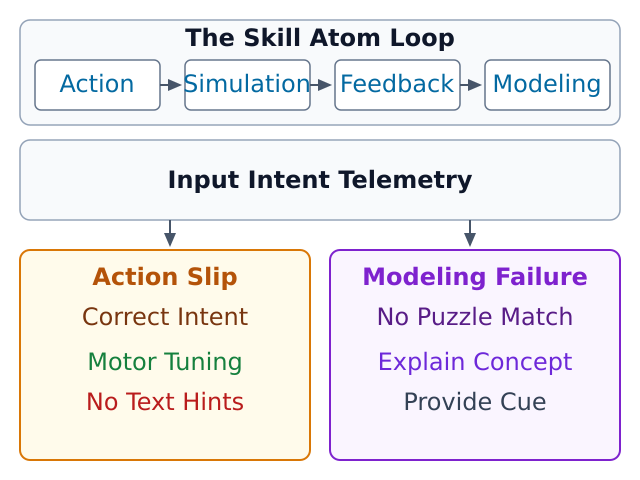
In Cook's framework, player learning is structured around what he calls a skill atom, an atomic feedback loop made up of four basic elements: Action, Simulation, Feedback, and Modeling. First, the player performs an action, such as tapping a button or navigating an avatar. The underlying simulation updates its state according to that input, and the game provides sensory feedback, whether visual, auditory, or visceral. In the final step, the player absorbs that feedback and updates their internal mental model regarding whether the action succeeded and why. Learning occurs as players chain these atoms together into directed networks, using mastered skills as reliable tools to engage higher-order mechanics.[1]
Because the skill atom separates physical execution from mental modeling, it exposes why standard hint triggers often fail. When a player fails to clear a chasm, the breakdown may sit entirely inside the Action step: the player understood the spatial geometry and intended to jump, but pressed the button two frames too late. If the game responds by serving a conceptual hint explaining that the chasm can be crossed by jumping, the assistance frustrates rather than aids. The player already possessed an accurate mental model; what failed was input execution. Conversely, if the game's sensory feedback fails to communicate that a surface is slippery, the player cannot update their mental model accurately. Cook notes that when players fail to find meaningful utility or clear feedback from an atom, they experience burnout, abandoning the mechanic altogether.[1]
Applying this to your game
Designers building contextual hint systems or adaptive tutorials can use the four stages of the skill atom to diagnose player failure before selecting an intervention. Instead of counting failed attempts or raw time elapsed, the telemetry pipeline should track whether the player's inputs correlated with the intended solution. For instance, in a platforming puzzle requiring a double jump across a moving hazard, the game can log the vector and timing of button presses relative to the ledge. If the player consistently jumped toward the correct platform within a narrow timing window, the diagnostic system should classify the failure as an Action slip.[1]
For Action slips, the game should never display conceptual text hints that explain the puzzle's goal. Instead, the design can introduce subtle execution assistance, such as widening the input buffer, slightly extending coyote time, or providing clearer physical feedback like a distinct landing reticle. Conceptual hints should be reserved strictly for cases where the Modeling step has failed. This occurs when the player's recorded actions show no alignment with the puzzle rules, such as idling, running in circles, or repeatedly testing mechanics that have no interaction with the active challenge.[1]
To evaluate this approach, developers can run playtests comparing outcome-based hint timers against skill-atom diagnostic filters. Teams should inspect whether execution-filtered hints reduce rapid hint dismissals and post-hint frustration without artificially deflating puzzle difficulty. However, transfer limits apply. Cook's essay is a conceptual design framework rather than an empirical psychological study with measured performance constants. In open-ended systemic games, inferring a player's internal mental model from controller telemetry is inherently noisy. A designer must weigh the development cost of building custom intent heuristics against the simpler alternative of making player hints purely on-demand.[1]
Sources
- The Chemistry Of Game Design
article · live migrated Gamasutra article; revision unpinned · Source accessed: