A mission board recommends an escort job. The player dismisses it because they have five minutes before leaving. Tomorrow the board offers fewer escort jobs, including a short one they would have enjoyed. The recommendation system has treated a decision about this moment as a preference about a category.
Define what the dismissal authorizes before using it to personalize the board. In this proposed design, Dismiss removes the current offer from the current view. It does not change the player’s category settings. A separate Hide escort suggestions action changes the recommendation category until the player restores it. Keep the complete mission list reachable so that a recommendation filter does not become an unnoticed content lock.

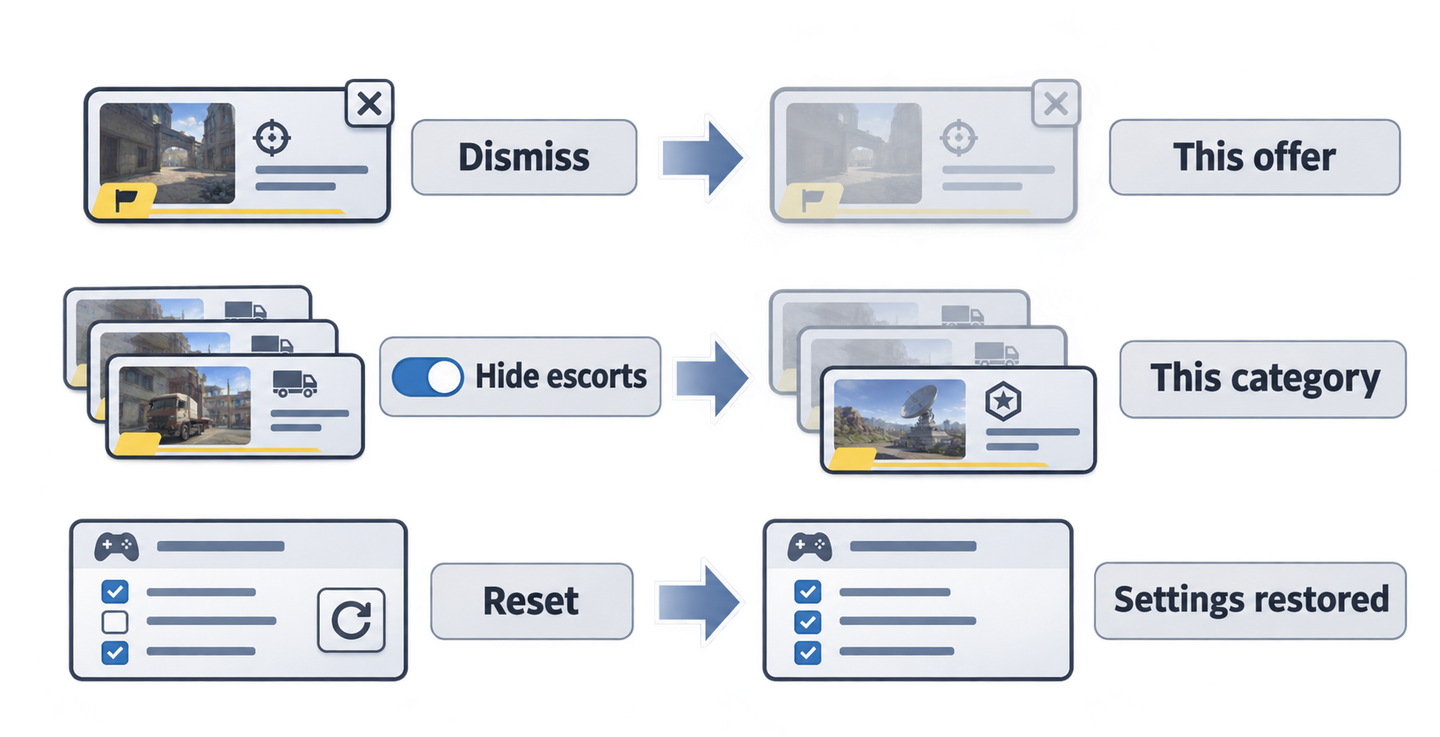
Microsoft’s HAX guidance describes feedback on individual AI outputs and system-wide controls as separate design considerations. Guideline 15 discusses explicit feedback during ordinary interaction; Guideline 17 discusses broader settings for system behavior and collected information. These pages provide design guidance. They do not establish that a particular dismissal button reveals a stable game preference or that the proposed mission board improves play.[1][2]
The useful distinction is the consequence the player can reasonably attach to the action. A close icon beside one offer gives little reason to expect that an entire mission category will disappear tomorrow. If a button will suppress a category, say so where the player chooses it and provide a way back. An explicit category setting still describes that setting, rather than proving why the player chose it.
Record the affected scope together with the action: this offer, this recommendation category, or all recommendation settings. Keep a short-lived dismissal separate from persistent settings. If the system also learns from dismissals, decide how that evidence expires and what it can change. Do not let a temporary interface action silently overwrite an explicit preference. This representation and precedence rule are editorial proposals, not a description of Microsoft’s implementation.
More controls can make a small mission board exhausting. Begin with Dismiss and one discoverable recommendation settings view. Add category controls when there is an actual category-level decision worth exposing. A fixed rotation with a complete mission list may cost less to build and explain than personalization with several poorly understood settings. A game with only a handful of missions may gain little from maintaining a preference model.
Before shipping the proposed system, check one sequence: dismiss a long escort job, return later, browse all missions, hide escort suggestions, then restore them. Inspect which offers change at each step and whether the player can predict those changes. Check another profile or save only if the product promises settings transfer. No implementation or player test was run for this article.
A later study could change the recommendation. If players understand a plainly labeled category action and repeatedly want the same filter, a persistent preference may be useful. If they interpret every dismissal as temporary, narrow the model’s influence. If they want the board to learn automatically, test an explained and reversible learning rule against the simpler fixed board. Each comparison concerns the promised behavior; one rejected job cannot settle it.
Sources
- Guideline 15: Encourage granular feedback
documentation · Official HAX guideline body, read November12 2026 · Source accessed:
- Guideline 17: Provide global controls
documentation · Official HAX guideline body, read November12 2026 · Source accessed: