During a negotiation, a player smiles at a courier, asks about her route, and then refuses her request to carry a sealed package. Days later, the courier greets the player as a trusted partner. The campaign counted two friendly gestures against one refusal. It retained the conversation but lost the distinction that mattered: the player declined the job.
Emily Short’s Narrative States describes a useful separation between scene-level and longer-term variables. A small action can affect a local relationship value, while resolving a scene in someone’s favor can affect a larger value. Her article presents ways to reason about narrative state; it does not report an experiment showing that this structure produces better relationships.[1]
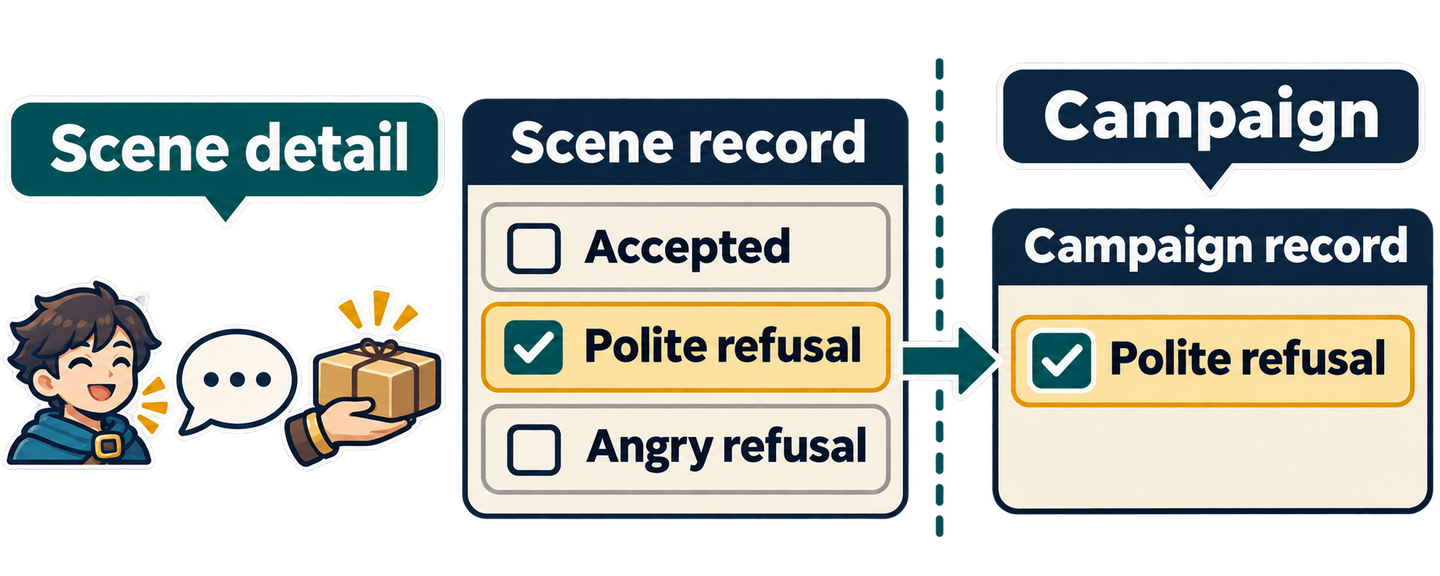
For the proposed courier scene, keep warmth and agreement separate. Warmth can shape the courier’s replies during the negotiation. Accepting or refusing the package decides whether this encounter establishes a work commitment. A friendly refusal may deserve a warmer farewell without creating an accepted job.

Define the consequence that crosses the scene boundary
Write the next encounter before choosing which values to retain. If it needs to ask whether the player took the package, store that outcome explicitly. If it needs to acknowledge a courteous refusal, retain that distinction too. Avoid exporting every gesture just because the dialogue system already records it. Each exported distinction gives later content another condition to honor.
A scene outcome can still be revised when the fiction allows it. The player might return before departure and accept the package. Decide whether that replaces the earlier refusal or creates a second encounter. The campaign should receive the new commitment through the same defined route, so a local conversation cannot quietly leave the long-term record behind.
Spend the writing time on a consequence
Start with three authored outcomes: accepted, declined politely, and declined angrily. This costs writing and checking three later greetings, while postponing a richer history of every exchange. It also loses subtle combinations. That sacrifice is reasonable only if the next encounter has no use for those combinations.
A smaller game might need only accepted and declined. A game about social ambiguity may deliberately keep courtesy and obligation in tension. Choose the records from the promised experience. This proposal does not require turning every conversation into a contract or exposing the variables to players.
Check what survives, then ask what it means
Before a player session, replay a polite refusal and an abrupt acceptance. Save at the scene exit, load the next encounter, and compare its greeting and available quest actions with the intended outcomes. Also check leaving midway and returning to revise the answer. These are proposed engineering checks, not completed tests or evidence of player understanding.
In a later playtest, ask what the player expects the courier to remember before showing that greeting. If the exported outcome is technically correct but erases a detail players reasonably expect to matter, add that specific distinction and fund its later response. If nobody can identify a useful consequence for it, keep the detail local. A compact record earns its place by supporting the next encounter.
Sources
- Narrative States
article · Primary author article; scoped reading2026-11-04 · Source accessed: