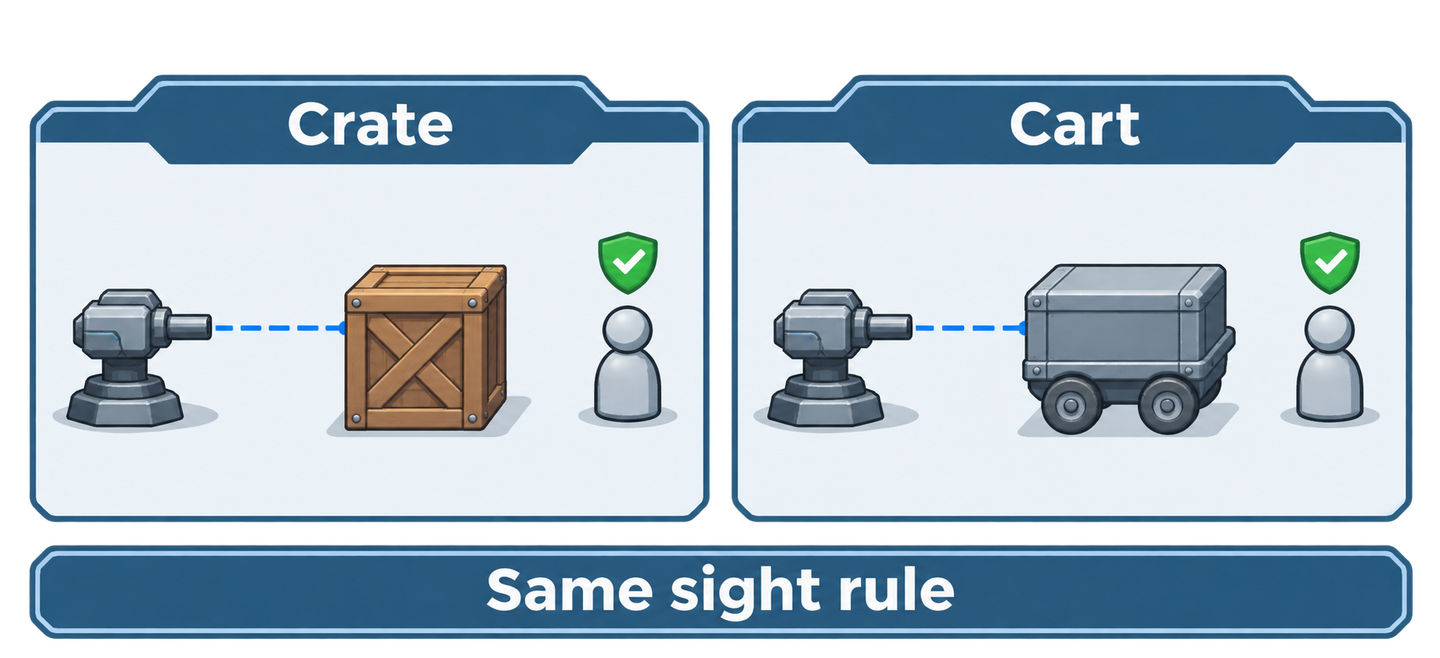
A player pushes a crate between a turret and a doorway. The turret loses sight of them. Later, a loaded supply cart sits beside another exposed doorway. Its cargo looks just as solid, but the turret sees straight through it. The player has to discover whether each prop is secretly on the designer’s list before using the room as a tool.
For a stealth encounter built around manipulating the environment, start by defining which visible property interrupts detection. In this proposed room, opaque solid geometry blocks the turret’s view. The crate and loaded cart should participate through that property. An empty cart frame may leave gaps, and a transparent panel may transmit vision. Their differences should follow the rule the player can inspect.

Tom Francis uses a movable crate obstructing a turret as an example of a solution produced by interacting general rules. His essay connects this kind of play to consistency and rules players can understand. It is a practitioner argument illustrated with games, rather than a controlled test of how reliably players infer those rules.[1]
Turn that argument into one small implementation decision. Make detection consult the relevant occluding geometry instead of checking for a specific crate interaction. Then define the scope: does the turret need a view of the player’s center, any exposed body point, or a sustained view over several samples? A cart can block one ray while leaving a shoulder visible. Decide what counts before calling an inconsistent outcome a bug.
The visibility decision also needs a readable response. A turret that has lost sight might stop tracking while keeping its last known aim for a moment. That delay is compatible with the proposed rule if detection and firing are separate states. Show enough of the change for the player to distinguish lost sight from a weapon that simply happens to be cooling down. This response is a design proposal, not behavior verified in a source game.
Build a comparison scene with the crate, loaded cart, empty frame and transparent panel at the same distance. Inspect the actual detection samples with the player fully covered, partly exposed and moving behind each prop. Move the blocker while the turret tracks. The useful question is whether the outcome follows the declared visibility geometry in each case. No such scene or game test was run for this article.
General interaction has a production cost. Art collision, detection layers, movable-object physics and encounter scripting must agree. A prop that blocks sight can also make an encounter easier or create a safe position the level designer did not expect. Check whether the objective remains reachable and whether moving the prop can trap the player. Keeping the rule consistent does not settle encounter balance.
For a small release, use fewer movable opaque props and make the rest visibly fixed. That reduces combinations while keeping a clear promise. If player observation later shows that partial cover is unreadable, simplify the detection policy or the geometry before adding a tutorial for each exception. If the intended game instead relies on explicitly marked cover slots, a limited placement system may be the more affordable choice. The decision should follow the interaction the team can explain and maintain.
Sources
- What Works And Why: Emergence
article · Authored essay as read November10; exact publication date not independently verified · Source accessed: