A player spends another conversation in the harbor, then returns to find the last ferry gone. The game remembers the time spent and applies its departure rule correctly. The player may still feel that the route vanished without a meaningful choice. Before adding a richer history system, inspect whether the scene gave them a usable chance to understand what was about to happen.[1]
Emily Short’s essay Narrative States describes abrupt boundaries between story outcomes and proposes warning zones that trigger events near a transition. She also distinguishes showing the designer’s outcome machinery from conveying the stakes through the scene. Her examples offer a way to reason about narrative state; they do not establish how players will interpret a particular warning. The practical question is which approaching consequence the player needs to recognize.[1]
Keep the consequence, make its approach readable
Consider a proposed harbor scene with an optional ferry route. A harbor worker says that the last crossing leaves soon while the ferry is still available. A visible departure event later closes the route. The player can board or spend the remaining opportunity elsewhere. The warning gives context to that decision without requiring the game to show a numerical time counter or list every future ending.[1]

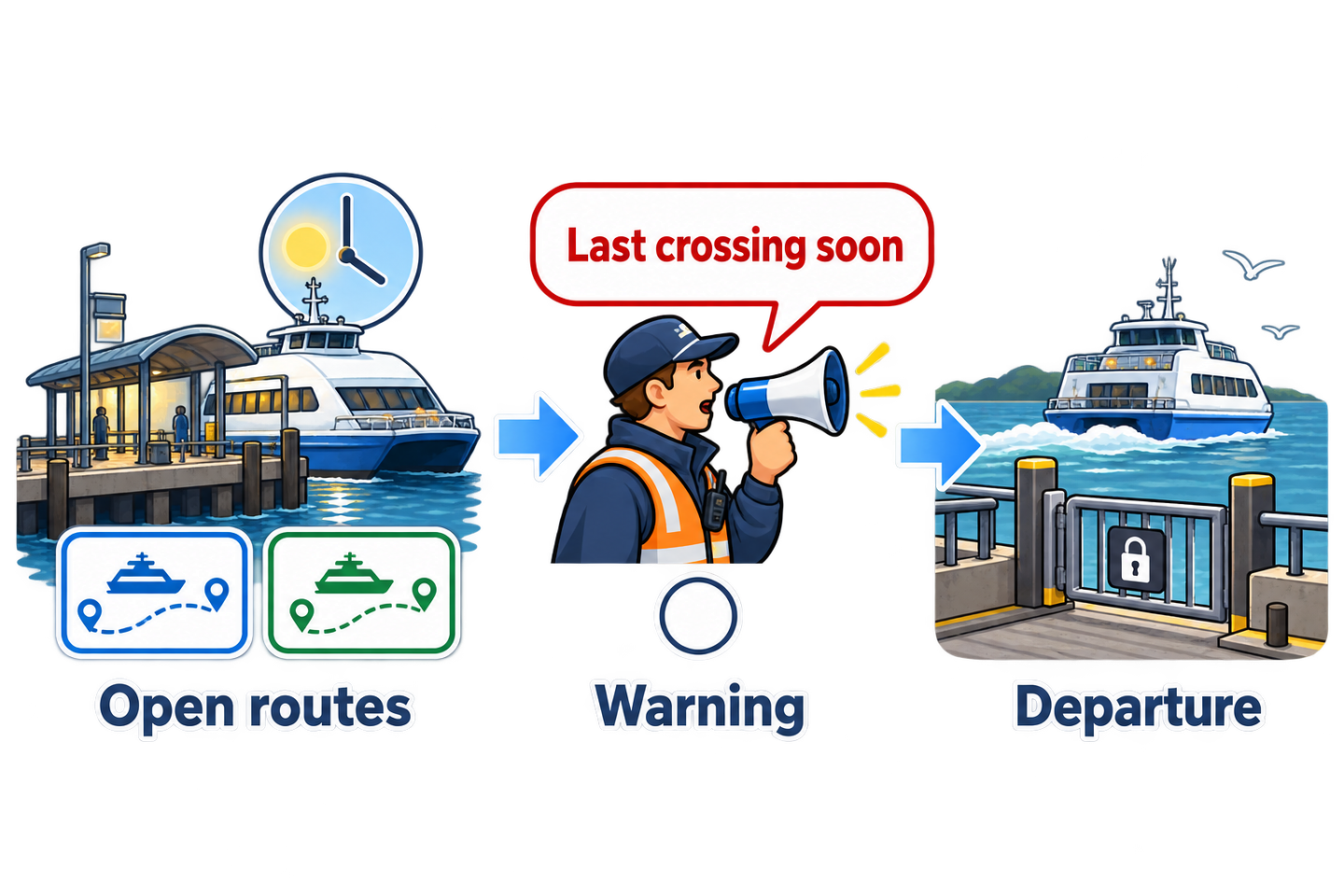
Write the rule before writing extra dialogue. Name the event that closes the route, the condition that makes the warning available, and the action a player can still take after hearing it. If time advances when a conversation ends, the warning must arrive before a conversation that would cross the boundary, with a reachable chance to board. A warning delivered inside the final conversation can come too late even when its words sound clear.[1]
The departure event owns whether the ferry is available. Hearing the warning records only that the line was presented; it does not prove that the player noticed or understood it. Boarding records the player’s action. Keep these meanings separate so a later scene does not turn an offered warning into evidence of informed consent. A save should restore the departure state and the relevant warning state together, according to the game’s existing save rules.[1]
Spend on the boundary the scene actually needs
For one route, fund one readable warning and an inspection of the actions around departure before building a general prediction display. The writer needs to explain the local stake without spoiling later events. The developer needs to connect the warning and departure to the same rule. Testing needs to cover arrival before the warning, immediately after it and after departure, including a return from another conversation and a saved game.[1]
That work displaces other content. A team might choose a simple final-boarding interaction instead, where the harbor worker explicitly offers the last departure. This reduces the timing coverage but changes the experience: the world waits for a direct decision at that point. Keeping the ferry available forever would change it again. Choose the smaller promise deliberately if the team cannot maintain a timed route across all its entry points.[1]
Short also cautions that explicit information about stats and likely outcomes can encourage players to optimize toward an ending. Her distinction between scene-level and broader narrative state gives another reason to limit the display. A local warning about this ferry need not expose every relationship score or future consequence. If discovering the world’s uncertainty is central to the game, preserve that goal while checking whether the immediate peril is legible.[1]
Check what the player thinks will happen
In a proposed playtest, ask an unfamiliar player what they believe the harbor worker means and what they can still do. Observe whether they reach the ferry after hearing the warning and whether departure matches the rule they inferred. A line that was displayed is insufficient evidence of understanding. No such sessions were run for this article; local state checks would establish consistency only.[1]
Revise the wording or timing if players hear the warning but reasonably expect another crossing. Reconsider a warning display if it turns the scene into unwanted arithmetic, or if the intended surprise is more valuable than advance notice. If the player understands the last crossing and knowingly stays, preserve the consequence. The design decision is which opportunity the game promises, and the stored state should carry that promise into the next scene.[1]
Sources
- Narrative States
article · Emily Short; November 23, 2019; main essay read October 22, 2026 · Source accessed: