An agent that once collected enough wood should not have to invent the entire procedure again when the next task needs planks. Yet saving its conversation does not necessarily preserve a procedure it can execute. Voyager makes a useful distinction for developers building persistent agents: a record of what happened and a reusable action have different jobs.

A memory the agent can run
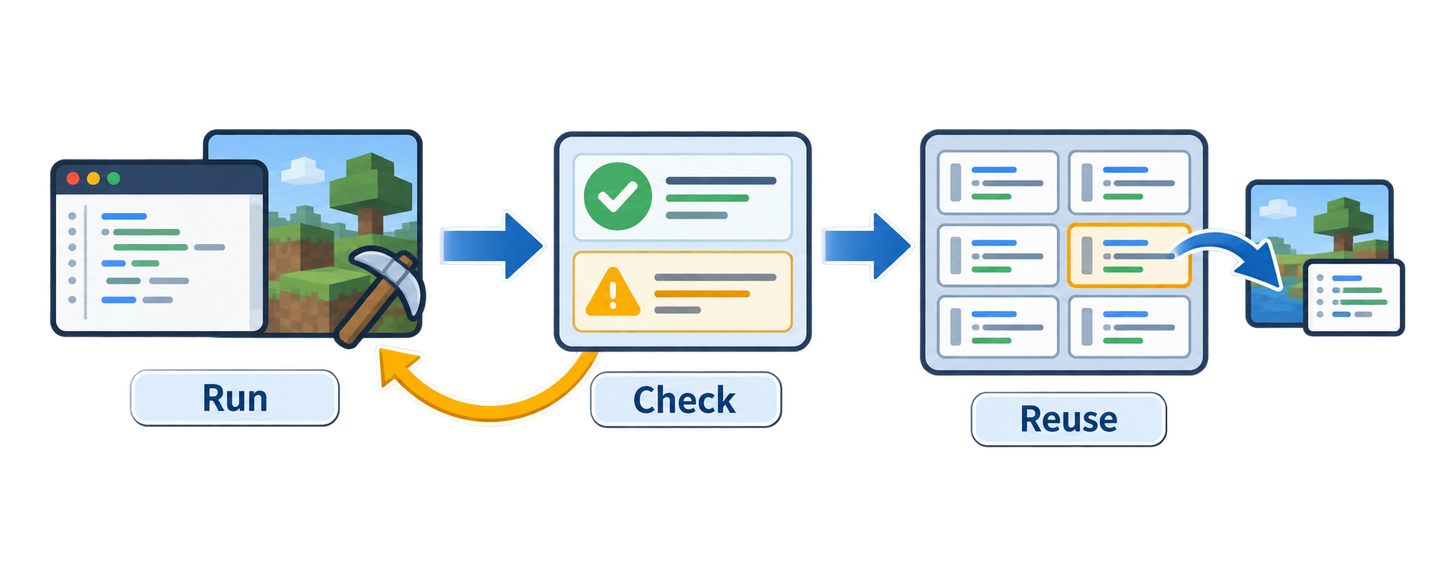
Voyager's authors represent skills as executable code. A language model receives a task, the agent's current state, control APIs and relevant previously stored skills, then generates a program. Execution supplies environmental feedback and errors. A separate model-based critic checks whether the task has succeeded and, when it has not, offers feedback for another attempt. A skill enters the library after this checking process.[1]
The library indexes a skill by an embedding of its description. The agent retrieves skills using its task plan and environmental feedback, then can use those routines in a more complex program. The description helps find a procedure; the code supplies the procedure itself. That distinction matters when a fluent recollection such as “I know how to collect wood” would otherwise be mistaken for a usable capability.[1]
The paper reports that the version without the skill library tends to plateau later in exploration. This supports the library's role in the authors' Minecraft setup, alongside the curriculum, code generation and feedback loop. It does not establish that every agent needs an expanding code archive, or that the archive preserves a character's personal history.[1]
Success still needs a meaning
Checking before storage gives the library a gate, but the gate can make mistakes. The authors report a critic failing to recognize spider string as evidence that the agent had defeated a spider. They also describe impossible proposed items and calls to APIs that do not exist. A retained routine therefore carries the limits of the environment description and success check used to accept it.[1]
Voyager uses the high-level Mineflayer API rather than learning all control from screen pixels. Its authors explicitly distinguish that setting from approaches that solve perception and low-level control. A development team must inspect the APIs and state available in its own game before treating an executable skill as portable.[1]
Applying this to your game
Suppose you are prototyping a companion that gathers a resource for a crafting task. Start by defining the small promise that reuse must keep: given the required tools and an available resource, the routine should collect the resource and return a result the next task can inspect. Keep the task's starting conditions, relevant state changes, procedure version and acceptance check together. This is a proposed adaptation of the paper's mechanism, not a tested companion design.
Try the same routine after a tool changes or the resource becomes unavailable. Inspect whether it reports failure before a dependent task proceeds, and whether a repaired routine replaces the earlier version deliberately. Keep an execution log for diagnosis, but do not let the log itself certify success. This work favors a small, inspectable library over accumulating every apparent achievement; it postpones broader task coverage while you establish what one retained capability means.
An authored routine is a useful comparison if the companion only needs a few stable actions. Compare recovery work, incorrect success reports and the effort required to revise each approach, rather than counting stored skills alone. If the generated routine adds little useful flexibility or repeatedly needs manual repair, keep the authored action. If it handles meaningful combinations reliably under the same checks, expand that particular capability. We have not run Voyager or this proposed comparison; the paper supplies a mechanism and bounded experimental evidence, while your game's promise determines what deserves to survive.
Sources
- Voyager: An Open-Ended Embodied Agent with Large Language Models
paper · 2305.16291v1 (2023-05-25; arxiv_v1_submission_date) · Source accessed: