A player offers to help the villain and the character responds. Has the game opened an alliance, or has it only produced dialogue about one? That difference matters as soon as the player tries to act on the exchange. Player-Driven Emergence examines unexpected paths people proposed through an LLM-driven mystery, including paths the prototype could not yet support.

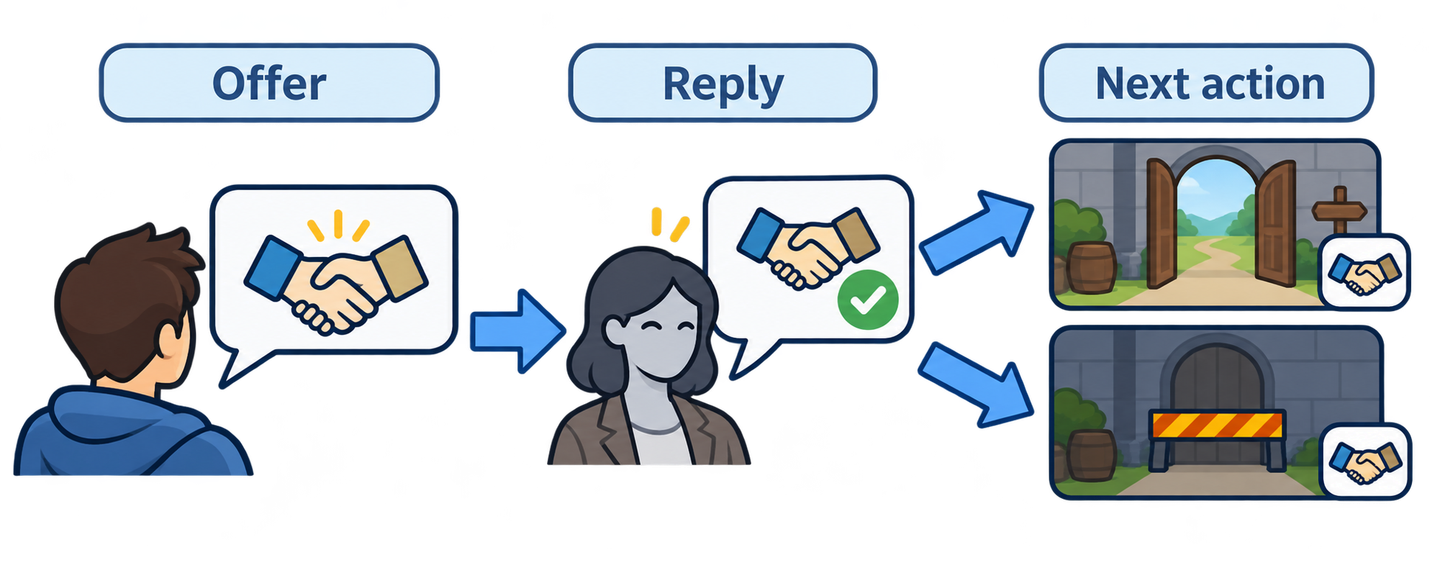
A suggestion can reveal an intended action
The study involved 28 human players and used gameplay logs to identify emergent narrative nodes. The authors describe attempts to extract information creatively, find new useful objects and propose alternative solutions. In one example, a player offers to aid an antagonist's plans to elicit information. The researchers suggest that a designer could develop such an exchange into a diverging narrative path.[1]
The paper's conclusion explicitly says that the novel nodes were not always actionable and could lead to dead ends. An emergent node is therefore evidence of an attempted interaction in this prototype, not proof that the game supplied its promised continuation. The authors also bound their investigation to the models, players and setting studied.[1]
That leaves a useful authoring question. What did the player try to make happen, and what did the system accept in its reply? A character's apparently encouraging response can raise an expectation that later rules do not honor. The exchange may still reveal an interesting intention even when the prototype fails to carry it forward.
Decide which part of the exchange to keep
Suppose a player proposes an alliance in your mystery. Reconstruct the request, the character's answer and the next action the player attempted. Distinguish using an offer as a bluff from actually committing to help. Those intentions need not open the same branch. If the system treats both as agreement, richer wording can make the mismatch harder to notice.
A designer might retain the bluff as a bounded conversation, add a real alliance or let the character refuse. Each choice needs a consequence the game can provide. Adding an alliance can change clues, objectives and later reactions; accepting it in dialogue before paying for that work leaves the player with a commitment the game cannot keep.
Applying this to your game
Use logs from one bounded encounter as proposed authoring input. Mark unexpected intentions, then inspect which ones the character response acknowledged and which subsequent actions the game supported. Keep unsuccessful attempts in the record; selecting only novel successful exchanges would hide the dead ends this paper makes visible.
Choose one intention worth supporting and author its first response and continuation together. Let the player qualify or withdraw the offer before a commitment is made. State which consequences remain after a bluff or an accusation has already affected the character. This is a proposed prototype, not a feature established by the source study.
The smaller alternative is to keep the existing branch and give a clear, relevant refusal. It sacrifices the proposed alliance's expressive range while avoiding new objectives and reaction coverage. Compare whether participants understand that boundary and whether addressing the character supplies something they value, rather than counting dialogue turns or generated branches alone. An ambiguous rejection might suit the story, provided it does not imply an action the rules silently prohibit.
If people value the attempted social act and repeatedly encounter a missing continuation, fund that branch's consequences. If they want a useful clue and the alliance adds little, a direct authored exchange may serve them better. The paper's observed attempts help locate possibilities; they do not settle which possibility your team should implement. We have not played the prototype or tested these alternatives.
Sources
- Player-Driven Emergence in LLM-Driven Game Narrative
paper · 2404.17027v1 (2024-04-25; arxiv_v1_submission_date) · Source accessed: