A character can give a coherent answer and still forget a promise made earlier in the scene. It can also respond politely to an instruction that changes the game's rules. A narrative system needs to decide which prior events the response should honor and which attempted changes it should refuse. PANGeA puts memory and validation into the same generation pipeline.

Give each character the right past
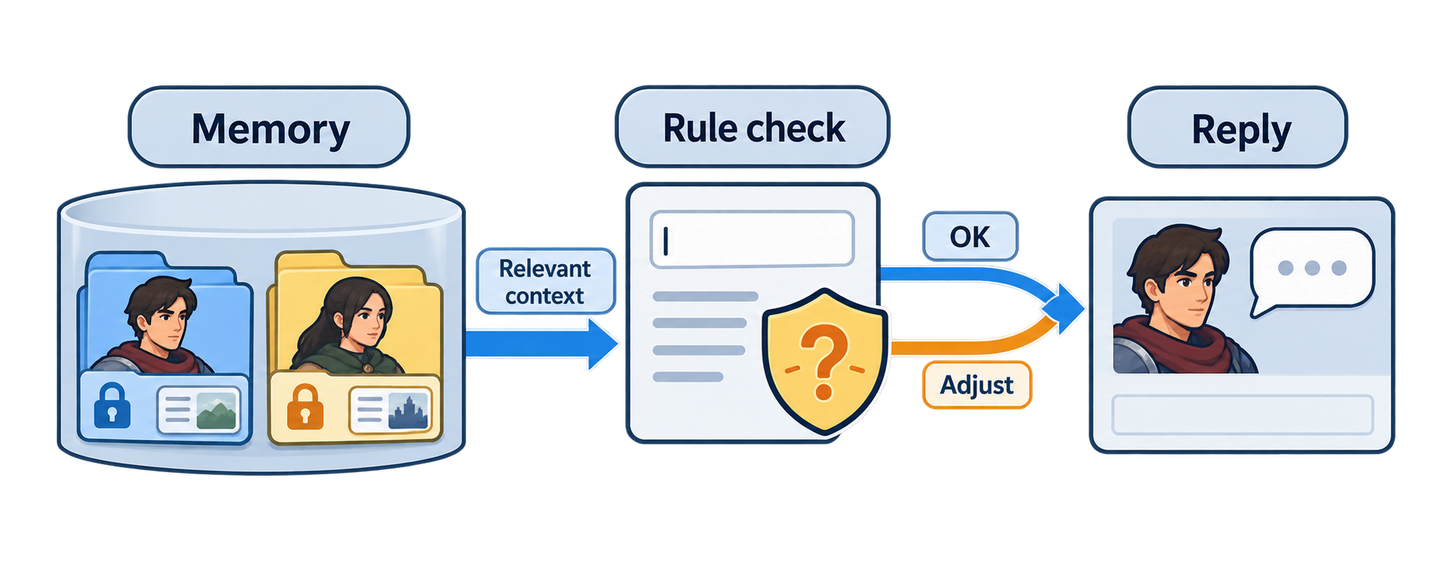
PANGeA generates rules, setting, player and NPC information, and narrative beats during initialization. Its memory system carries context between those generation steps. During play, recent conversations and actions occupy short-term memory; older conversations and actions are stored for retrieval from a vector database. Retrieved material is summarized to fit the language model's context.[1]
Each NPC uses a separate memory instance. This arrangement supports a distinction that matters in an investigation: an event that happened in the game is not necessarily something every character knows. The source describes storing and retrieving narrative context, rather than supplying a guarantee that every summary preserves every relevant event.[1]
The validation system prompts the LLM to assess whether text input breaks a gameplay rule. If it does, another prompted step produces corrective guidance for the response; otherwise the system generates a response directly. It can also answer in character when the input falls outside the game's scope.[1]
Remembering and accepting are separate decisions
Retrieval gives a response access to earlier material. Validation asks whether a new input should steer generation. Both mechanisms still depend on the records and instructions the system receives. A player asking a character to ignore a rule is different from a legitimate action that changes a narrative state. A developer must define that distinction before asking a model to enforce it.
The paper presents demonstrations and a bounded comparison of generation with and without its validation system. It does not establish a general anti-cheat defense or prove that personality percentages correspond to fully human personalities. Those claims would require different evidence. For a production decision, the useful starting point is the explicit flow of records and checks.[1]
Applying this to your game
Choose one exchange in which a character makes a commitment and later has to respond to it. Write down the commitment as an authoritative game record, who may change it and which character has learned about it. Compare that record with the context retrieved for the later reply. This is a proposed implementation boundary, not a mechanism tested by Playable Frontier.
Then introduce a correction: perhaps the player withdraws a request before the character agrees. Inspect whether the later reply uses the revised record or repeats an older summary. Keep the event and its interpretation distinct so that a repeated model statement cannot promote a provisional account into fact. A rule check should also leave a valid in-game correction available, rather than rejecting every attempt to change the situation.
An authored state variable and a few responses may be enough for this first commitment. That option gives up conversational breadth while reducing retrieval and correction work. If the scene genuinely needs varied conversation, add generated wording around the retained state and inspect both the reply and its later consequence. Budget the revision path alongside storage; a larger archive makes stale records harder to manage.
Change the approach if users understand the retained commitment but still find the exchange unrewarding, or if a simpler authored response keeps the same promise more reliably. Conversely, a specific missing callback can justify adding a record without expanding memory indiscriminately. We have not run PANGeA or these comparisons. Its pipeline supplies a useful division of work; your narrative determines which memories may control a later response.
Sources
- PANGeA: Procedural Artificial Narrative using Generative AI for Turn-Based Video Games
paper · 2404.19721v1 (2024-04-30; arxiv_v1_submission_date) · Source accessed: