A character can accuse another player fluently without choosing a useful moment to accuse them. In a social deduction game, that sentence is an action: it can invite a defense, disclose evidence or direct suspicion. A developer needs to know what the speech is trying to change before judging whether the wording sounds natural.

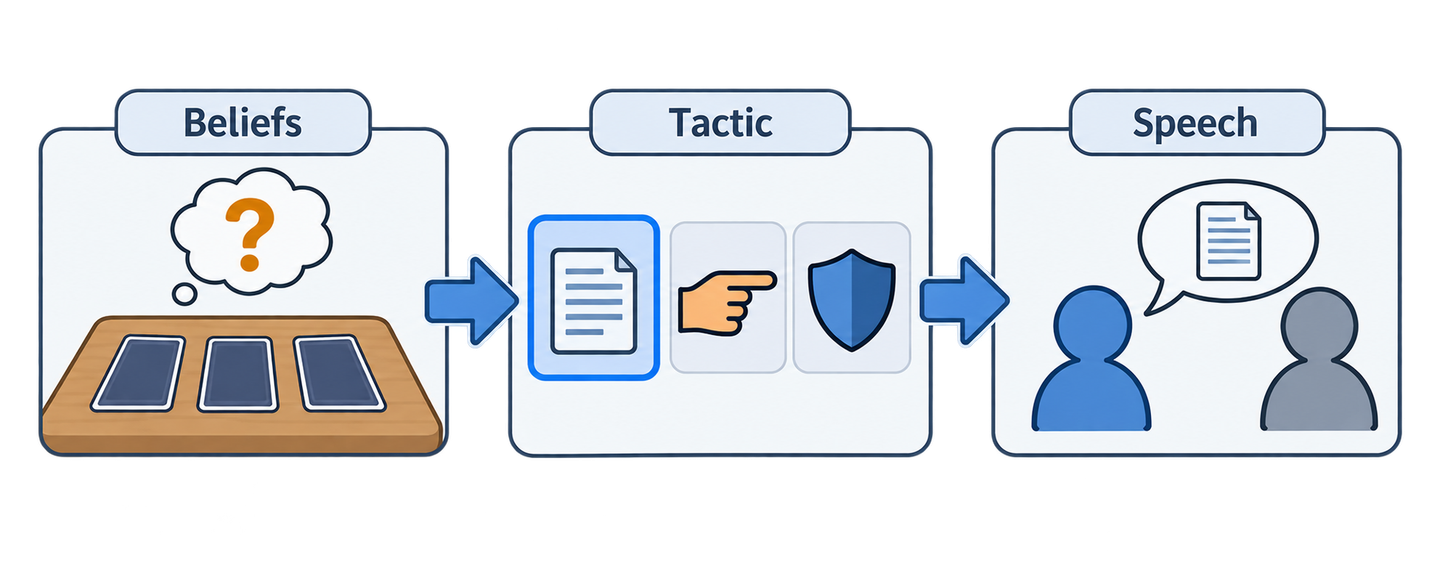
Choose what the next statement should do
Learning to Discuss Strategically separates a language agent's beliefs, its discussion tactic and its generated action. In One Night Ultimate Werewolf, roles can change during the night, so a player must reason about information that may no longer describe the current role assignment. The framework uses an LLM to form beliefs from the player's observations, a learned policy to choose a tactic, and the LLM to generate a statement conditioned on that choice.[1]
The authors organize tactics around providing evidence, making accusations and defending, with honest or deceptive variants. The policy chooses among those categories; it does not independently author every sentence. During voting, the agent uses observations and beliefs without the discussion-selection component. That separation gives the tactic a specific job in the conversation phase.[1]
The discussion policy is trained with offline reinforcement learning on LLM-generated game logs. The authors evaluate agents in restricted three-player and five-player settings, including comparisons with agents that form beliefs but lack the trained tactic policy. They report better strategic performance in their tested settings, while also showing that the advantage weakens in a harder setting. These experiments concern agent behavior, not whether human players enjoy the conversations.[1]
Fluency cannot settle the social design
The useful design question is whether a statement gives another participant an intelligible opportunity to act. Winning the deduction game is one objective, but a character in a narrative scene might instead need to invite clarification, acknowledge a concern or preserve an unresolved disagreement. A policy trained to maximize game payoff would not automatically serve those purposes.
Nor should a character's belief silently become established world truth. The source framework conditions behavior on inferred roles; a game designer still needs to decide how accusations, uncertainty and corrections appear to a player. The consequences of an accusation belong in the game rules, including what a later defense can and cannot repair.
Applying this to your game
For a small social deduction prototype, author a few tactics first. Give the character an observation, a provisional interpretation and a chosen act, then ask generated wording to preserve that act. Compare an authored line and a generated line with the same information and intention. Inspect whether the listener can tell what is being asserted and which responses remain available. This is a proposed comparison, not a replication of the paper's experiments.
Include an incorrect accusation in the comparison. Let the character withdraw or qualify it and inspect whether the listener receives the promised chance to answer. Keep that repair work in the first scene's scope; defer a larger conversation tree if you cannot author its consequences. A refusal or a useful acknowledgment can be a worthwhile response even when it supplies no new clue.
Separate strategic outcomes from the player's account of the exchange. If the agent wins while participants cannot understand or contest its claims, improve the social action before training a stronger policy. If a simple authored tactic already supports the intended encounter, keep it. A learned tactic selector becomes worth considering when variation creates a specific decision that the smaller approach cannot handle. We have not run the source agents or this prototype; the paper offers a way to control discussion, while the intended relationship determines which discussion deserves to happen.
Sources
- Learning to Discuss Strategically: A Case Study on One Night Ultimate Werewolf
paper · 2405.19946v1 (2024-05-30; arxiv_v1_submission_date) · Source accessed: