A player may know which wall material would reduce energy use and still struggle to pick it up in VR. Another may handle the objects comfortably without understanding the building problem. If both fail to finish an educational escape room, the same completion result can point to very different work for the designer.

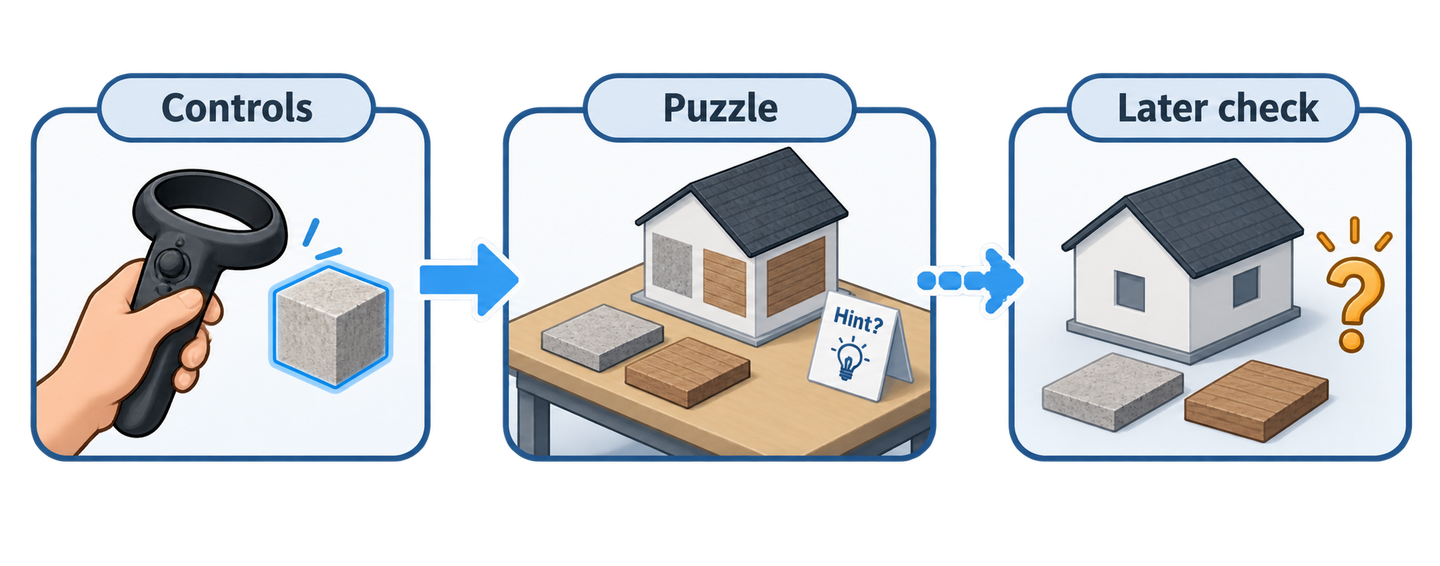
Project Beyond separates an onboarding level from its building-energy escape room. That makes it a useful case for deciding what an introductory cue should supply and what the puzzle should still ask the player to work out.
Two tasks to evaluate separately
The game combines a VR room, physical interaction, building-simulation controls and visualized results. Hints appear when relevant quests activate, and a projector lets players review collected paper hints at a larger scale. Audio and visual feedback mark progress. These are assistance and feedback mechanisms the authors describe in their design.[1]
The authors evaluated general usability and experience with eleven VR and gaming experts. Participants completed questionnaires after onboarding and after the escape room, allowing the two parts to be considered separately. The evaluation included task load, onboarding usability and player-experience measures. It was not a test of learning gains.[1]
The paper explicitly leaves learning effects for later work. Expert usability results can identify interaction problems and motivate revisions, but they cannot establish whether a novice learns building-energy concepts, applies them to another case or remembers them later.[1]
Decide what the hint is meant to restore
If the player's intended work is comparing wall assemblies, assistance might explain how to select an assembly without explaining which assembly to choose. That distinction should follow the game's learning goal. For an unfamiliar VR interaction, preserving ignorance about the controller may add work that has little to do with the subject matter.
Conversely, a hint that reveals the right material can remove the comparison the game was meant to support. A player can complete the task with that help, and the assistance can still be appropriate when the goal is relief or continued play. The designer should describe what the cue supplied instead of treating every completed puzzle as evidence of learning.
Applying this to your game
For a small educational puzzle, write down one capability the player should exercise, then trace a stalled attempt. Was the necessary clue available? Could the player operate the relevant object? Did the player make a comparison that the game failed to acknowledge? Inspect actions alongside the player's account; asking for an explanation alone can miss understanding expressed through play.
Prototype a short optional control cue and a separate subject-matter hint. Check whether the control cue lets the person attempt the comparison while leaving the answer open. If continued struggle no longer serves the intended experience, provide a direct explanation or let the player move on. These are proposed help decisions, not findings from the source study.
Begin with those authored cues before funding a learner model. You will need to author the material, decide when it is relevant and check what happens when help is declined. This sacrifices adaptive breadth while keeping the support's content inspectable. If a fixed cue repeatedly arrives at the wrong moment, that evidence can justify a narrower trigger rather than a broad claim about ability.
Observe the task with help and, if learning is your goal, plan an appropriate later opportunity without the same cue. A smoother supported attempt answers an immediate usability question; a new comparison asks a different question about transfer. Project Beyond supports making that separation explicit. We have not played the game or evaluated either outcome ourselves.
Sources
- Project Beyond: An Escape Room Game in Virtual Reality to Teach Building Energy Simulations
paper · 2407.02981v1 (2024-07-03; arxiv_v1_submission_date) · Source accessed: