A player moves differently after an adaptive opponent changes its response. If a model later reads that movement as a stable preference, it can mistake the effect of its own intervention for a property of the person. A controlled human-AI interaction game shows why adaptation speed belongs in the record alongside the behavior it produces.

Change the response, change the interaction
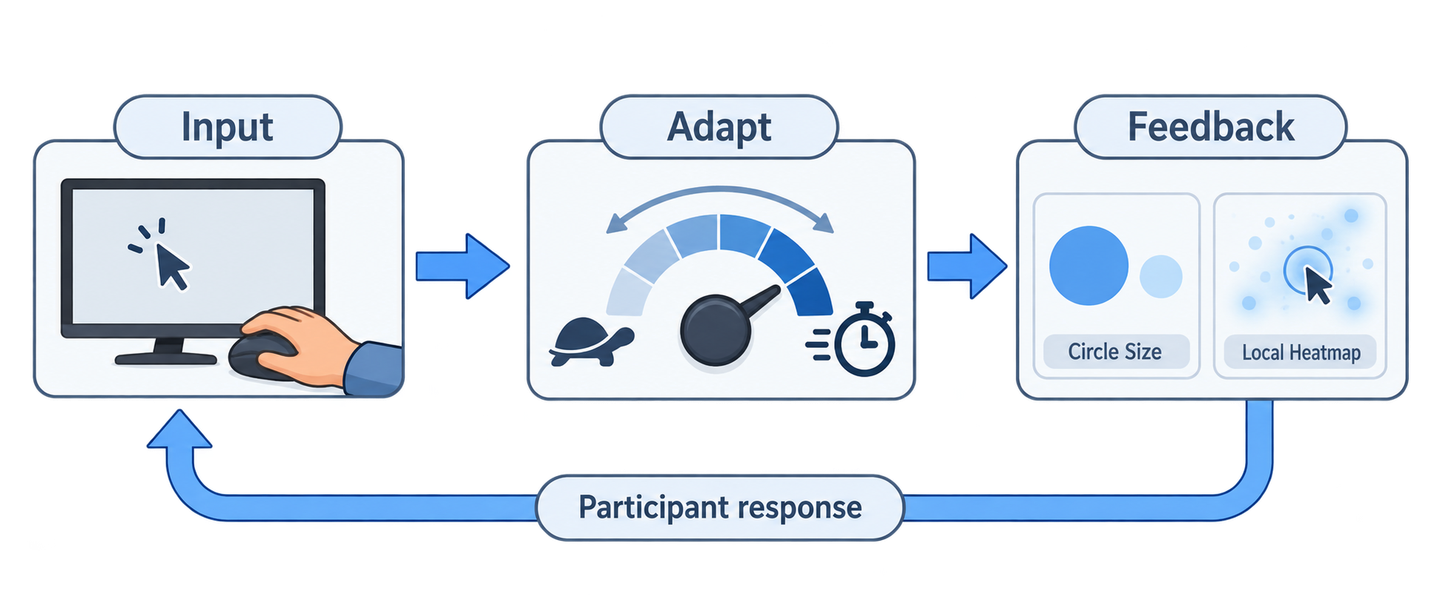
The study uses a continuous two-player game in which participants move a cursor and an AI adjusts its action. Participants try to reduce a displayed cost: either the size of a circle or a local visual indication of the cost landscape. Here “cost” is the game's objective value, rather than money spent on computation.[1]
The researchers vary how quickly the AI adapts. They report that slow and fast adaptation move the resulting behavior toward different game-theoretic equilibria. At faster rates, outcomes approach a setting in which the human effectively leads and the AI responds. The additional local cost information also changes the resulting behavior compared with displaying only the current cost.[1]
These findings concern a deliberately constrained cursor task with defined objectives and feedback. They do not establish which adaptation speed players prefer in a commercial game, whether faster adaptation improves enjoyment or whether it increases retention. The useful inference is narrower: the system's response and the information displayed can change the behavior being observed.[1]
Keep the intervention inside the explanation
Suppose a game makes enemies less aggressive after repeated failed attempts. A subsequent slower approach could reflect relief, a new strategy, caution or a response to the changed enemy behavior. Calling that person a cautious player would add an interpretation that the movement alone does not settle.
Record which adjustment was active, when it changed and what information the player could see. A behavior model trained across those conditions needs to account for the game's intervention before its output is used to alter another consequence. A precise prediction still leaves the question of whether the proposed adjustment is wanted.
Applying this to your game
For a bounded prototype, compare a fixed response with one clearly specified adaptive response. Define the signal, adjustment rate and action it can change. Inspect what happens before and after the change, including whether people notice it and whether it obstructs a strategy they chose. This proposed comparison draws a design question from the study; it does not transfer its equilibrium results into your game.
Allow a straightforward way to return to the fixed setting when that fits the experience. The correction path requires testing as well as the adjustment itself. A reversible current-state response may need less machinery than a persistent motivation profile, but hiding content or permanently narrowing options would require stronger evidence and a more substantial repair route.
This first comparison postpones personalization across many signals. It favors a narrow intervention whose consequences the team can trace, or an explicit player choice if guessing would create more correction work. Keep mistaken adjustments visible in the evaluation rather than averaging them into a favorable completion rate.
If people understand the adjustment and find repeated control requests tedious, simplify the controls. If the adjustment predicts task outcomes but pushes play away from the person's intended approach, change or remove it. The observed movement remains useful; the explanation attached to it must stay open to revision. We have not run the source task or evaluated the proposed game adaptation.
Sources
- Effect of Adaptation Rate and Cost Display in a Human-AI Interaction Game
paper · 2408.14640v1 (2024-08-26; arxiv_v1_submission_date) · Source accessed: