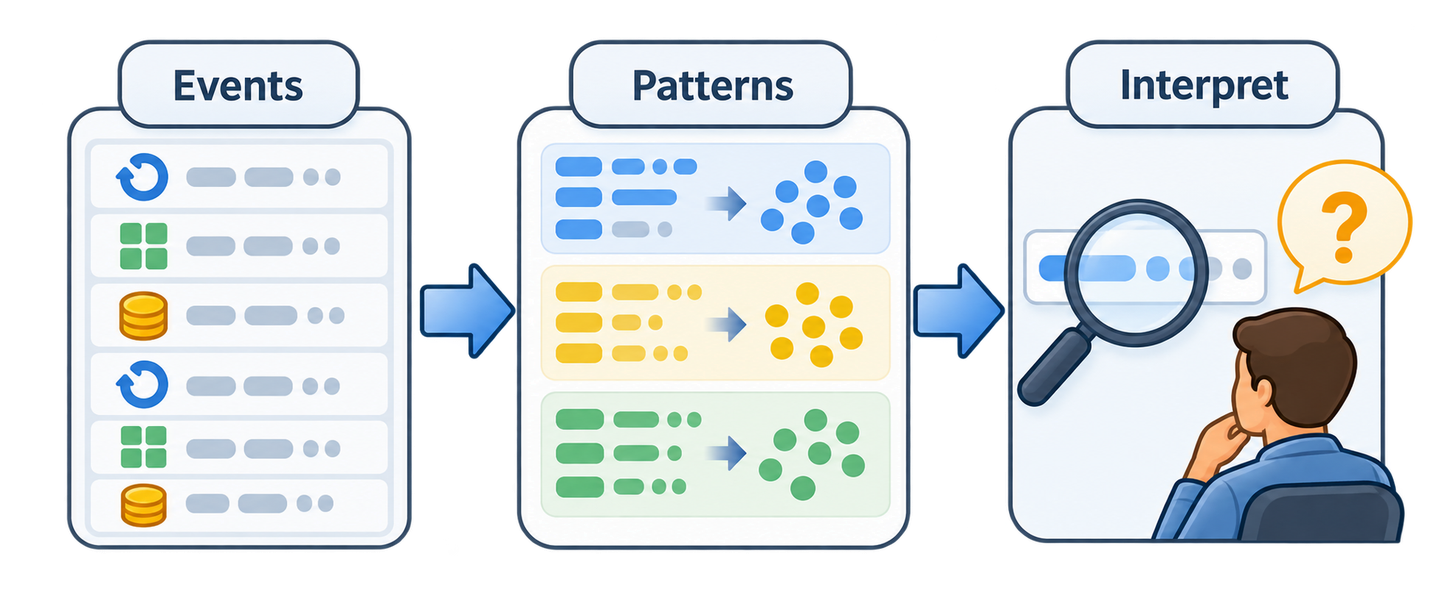
An event log records a purchase, a failed level and another attempt. It does not tell you whether the player wanted a harder challenge, felt blocked or simply returned after an interruption. A pilot study treats such event sequences as a language so that a model can learn patterns across sessions. The patterns can guide investigation, but interpreting them still requires a decision about what the events mean.

Represent the sequence before naming the person
The authors transform events from a mobile game into textual sequences and pretrain a Longformer model. Longformer can process longer sequences than the conventional short text window discussed in the paper, making it useful for patterns spread across many events. The study uses self-supervised training rather than requiring a ground-truth preference label for every sequence.[1]
The researchers extract session embeddings, reduce their dimensions and group them into clusters. They then examine event distributions with game analysts and identify segments that qualitatively resonate with user researchers' self-reported behavioral surveys. This combines a learned representation with interpretation by people who know the product.[1]
The clusters do not by themselves explain why a person acted. The paper presents an exploratory pilot and leaves labeled benchmarking for future work. Qualitative correspondence with survey-derived personas is useful context, but it does not establish a causal explanation of preference or demonstrate that adapting the game to a cluster improves experience.[1]
A useful segment needs a job
Suppose one cluster contains many repeated attempts and purchases. Before calling it a motivation type, inspect what each event means in that game and which opportunities preceded it. A purchase may indicate interest, an obstacle or the options the interface supplied. A segment can reflect a current session condition without describing a durable characteristic of the player.
The next question is what a model output would change. Choosing examples for an analyst to inspect has different consequences from hiding content or selecting assistance for a player. The latter needs evidence about the intervention and a way to recover from an inaccurate inference. Good separation in an embedding plot does not answer those questions.
Applying this to your game
Start with one product question and audit the events needed to investigate it. Check session boundaries, omitted actions and what numeric values or repeated events contribute to the representation. Compare a simple event-count summary with the learned grouping and inspect representative and awkward cases from each. This proposed comparison tests whether a more expensive representation earns its place in your workflow.
Ask analysts to describe observed behavior before assigning a player label. Where possible, compare those interpretations with appropriate player accounts, keeping disagreement visible. A self-report about one session should not license a profile across unrelated games, and absence of a label should not become permission to invent one.
This first use keeps the model in an investigation workflow and postpones automatic personalization. It needs event maintenance, computation and interpretation work; those costs compete with a fixed design change or an explicit player choice. If a simple summary identifies the same actionable problem, use it. If a learned sequence reveals a useful pattern the simpler view missed, inspect that pattern's meaning before expanding its influence.
The source study supplies a way to represent traces, not an authorization to act on every inferred persona. We have not trained its model or evaluated a personalization system. A segment becomes valuable when it helps answer a concrete design question while retaining the uncertainty attached to the player's behavior.
Sources
- Understanding Players as if They Are Talking to the Game in a Customized Language: A Pilot Study
paper · 2410.18605v1 (2024-10-24; arxiv_v1_submission_date) · Source accessed: